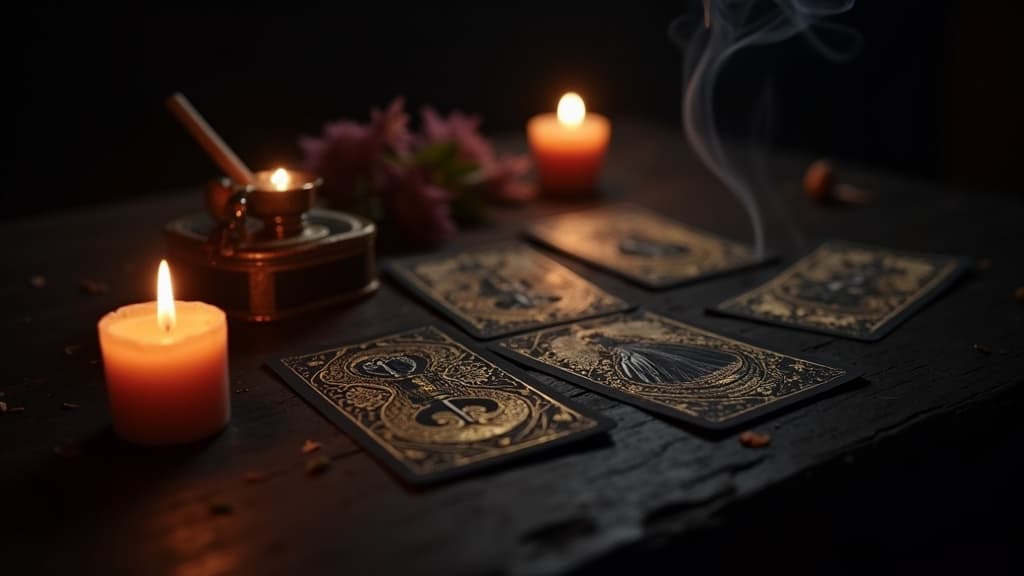
If you have never had a tarot reading, the most useful thing to know before your first one is what it is not: it is not a psychic telling you what will happen. A reading is an interpretive practice. The cards are a set of images — drawn from the Rider-Waite-Smith tradition — that give you a structured way to look at a question you already carry. What you bring to it shapes the experience far more than what you happen to draw.
What is a tarot reading actually doing?
A reading takes a question and holds it up against a set of archetypal images, then interprets how those images speak to your situation. There is no claim of supernatural knowledge involved — not from a human reader, and not from an AI one. The reader (or the model, in Vidastral's case) is doing interpretation: reading the symbolism the Rider-Waite-Smith deck established more than a century ago and relating it to what you asked. The cards reflect; they do not foretell.
This is the single expectation worth adjusting before you begin. Popular culture tends to frame tarot as fortune-telling — a reader accessing a fixed future. The interpretive tradition Vidastral works in treats the future as open and the reading as a mirror: a way to name what you already sense, surface an assumption you have not examined, or see a familiar situation from an angle you had not tried. If you go in expecting a verdict, a good reading will disappoint you. If you go in expecting a better question, it usually delivers.
A reading does not hand you the future. It holds a question long enough, and from enough angles, that you can begin to see your own thinking inside it.
How do you choose a question to bring?
The question you bring shapes the answer more than the cards do, so this is the part worth preparing. The most useful questions are open and present-tense, and they point back at you rather than out at fixed events. "Will he call me?" leaves the cards almost nothing to work with. "What am I holding onto in this situation, and what would it take to loosen it?" gives them room to reflect something back. A reading answers the second kind of question well and the first kind poorly.
A simple way to prepare is to take whatever first comes to mind and turn it from a yes-or-no into a "what" or "how." "Should I take the job?" becomes "what is this decision really asking of me?" "Does she still love me?" becomes "what is the honest state of this relationship right now?" If you want to go deeper on that reframing, our guide to writing a tarot question walks through the pattern in detail. And if no precise question arrives at all, that is fine — bring a theme instead. Work, a relationship, a choice you have been circling. The cards can meet a theme; they do not need a perfectly worded sentence.
What do the three cards mean — situation, action, outcome?
A first reading at Vidastral is a three-card spread, and each position has a job. The first card is the situation — the ground you are actually standing on, which is not always the ground you assumed. The second is the action — a posture or response the reading suggests you consider, given that ground. The third is the outcome — the trajectory that tends to follow when the first two are taken seriously. It reads as one sentence with three clauses, not as three separate predictions.
The word "outcome" is the one most likely to mislead a beginner, so it is worth setting the expectation now. In the interpretive tradition, the outcome card is not a fixed result waiting to arrive. It describes where things are heading if the pattern in the first two cards continues unchanged — a likely trajectory, not a sealed fate. That is precisely what makes it useful: it shows you a direction while the direction is still yours to adjust. (If you want the fuller logic of why three cards read differently than one, we cover it separately in our piece on the three-card spread.)
What if you draw a "scary" card like Death or The Tower?
Most first-timers arrive quietly braced for two cards in particular, so it helps to meet them before they appear. Death, in the Rider-Waite-Smith image, is an armored skeleton on horseback with a sun rising between two towers behind it — and in a reading it almost never refers to literal death. It marks an ending that makes room for something else: a transformation, a release of what has already run its course. The Tower shows a lightning-struck tower with two figures falling from it — sudden upheaval, a structure or a belief that can no longer hold, a truth that arrives without asking permission. Unsettling, yes. A catastrophe waiting to befall you, no.
The larger point is that no single card is a sentence handed down about your life. Even the hardest images in the deck describe movement rather than doom, and every card is read in the company of the others and of the position it lands in. A first reading is a much gentler thing than its reputation, and knowing that in advance is part of preparing well.
No card is a verdict. In the Rider-Waite-Smith tradition even the falling tower and the armored rider describe change in motion, not a fate that has already closed.
How should you hold what comes up?
You do not have to accept everything a reading offers, and you are not meant to. The most reliable thing you can do during a first reading is notice your own reactions: which lines land with a quiet click of recognition, and which slide off as not-quite-right. Both are information. Resistance to a card is often worth more than easy agreement with one, because the reading you want to argue with is usually the one pointing at something you would rather not look at directly.
Nothing about a reading obligates you. It is a mirror, not an instruction, and its value shows up in the days after as much as in the moment — which is why many readers keep a few notes on what they drew and what it stirred. You can revisit those later and see what actually held true, and what was only fear or hope talking.
There is a reason the deck opens with The Fool: a figure stepping toward a cliff edge with a white rose in one hand and a small dog at their heel, beginning a journey without a map of the whole of it. That is roughly where you stand before a first reading, and it is a fine place to stand. You do not need to know tarot to sit down with it — you only need a question you are willing to look at honestly. A single three-card reading is the shortest way to see what the practice actually feels like, which is quieter, and kinder, than most people expect.