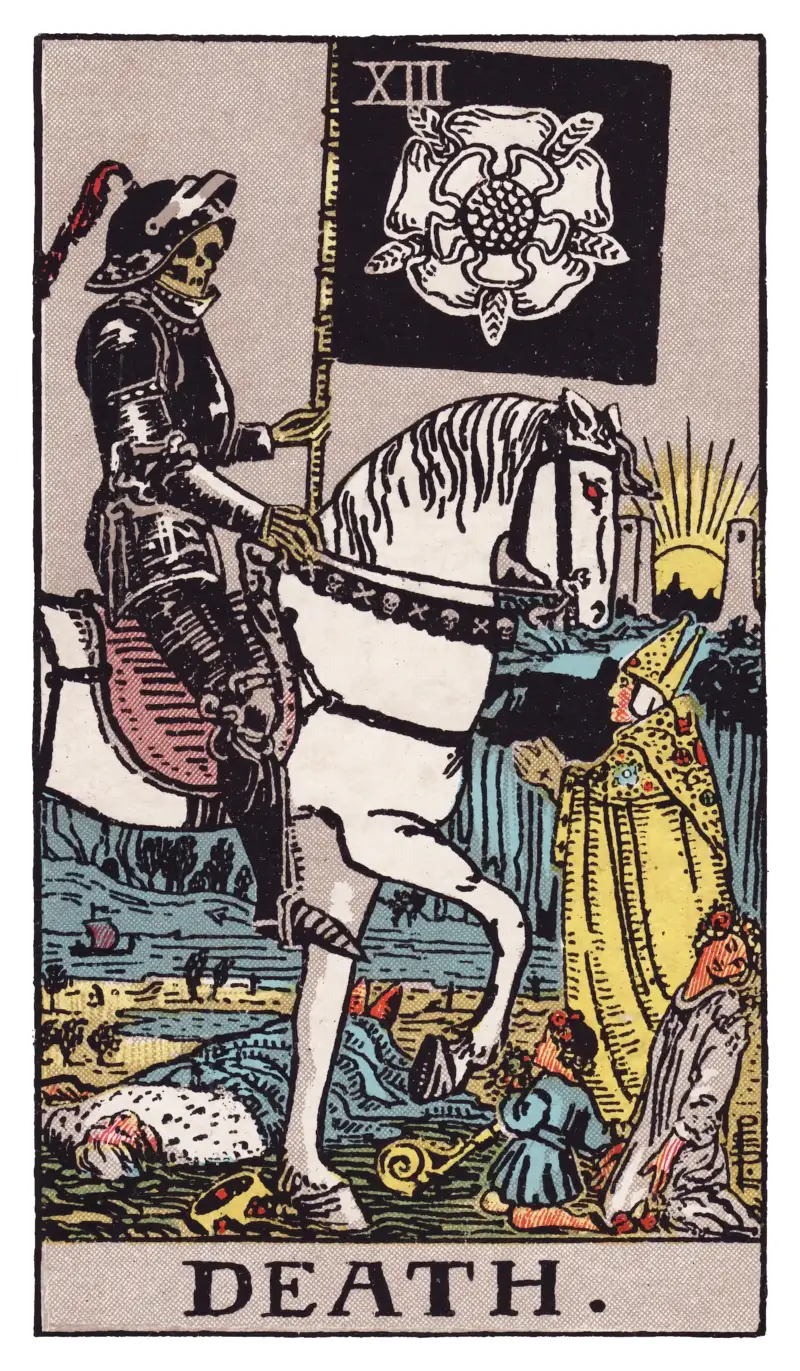
What the card shows
Death in the Rider-Waite-Smith deck shows a skeletal figure in black armor on a white horse, carrying a black banner with a white rose, moving past a fallen king and figures in postures of supplication, with twin towers and a rising sun on the horizon.
Upright vs reversed
| Upright | Reversed | |
|---|---|---|
| Keyword | TRANSFORMATION | RESISTANCE |
Upright meaning
In the Rider-Waite-Smith tradition, Death is read as the card of structural ending — the close of a chapter that allows what comes after to begin. Waite was emphatic that the card refers to transformation, not literal death, and that the white rose on the banner signals the renewal carried within the ending. Practitioners often read this card as a sign that something in the reader's life has reached the end of its useful form, and that the question is best framed not as how to keep it but as how to recognize that it is already over.
The rising sun on the horizon between the towers is associated in modern RWS commentary with the new arrangement that follows the close — light returning on its own schedule, not the reader's. The Golden Dawn correspondence to Scorpio grounds the card in themes of profound change, secrecy, and the alchemical movement from one state into another. As an upright card, Death is most often interpreted as the counsel to release what has finished, and to refrain from confusing letting go with losing.
Reversed meaning
Reversed, Death is traditionally read as transformation refused or stalled: the chapter that should have closed but is being held open, the change that has been resisted into a slow grind, or — at the other extreme — a fear of letting go that has hardened into denial. Waite associated the reversal with stagnation and loss; many modern practitioners read it as a prompt to examine where the reader is keeping a structure intact past the point where it serves them.
In a reading
In a situation position, Death is often read as naming a context defined by something already ending. In an action position, it is interpreted as a call to release deliberately, on the reader's own terms. In an outcome position, the card is commonly read as the close of a phase that makes a new arrangement possible.
In combination
Death and The Tower together are read as two of the most transformative cards in the deck, but the tradition distinguishes their mode: Death names the natural conclusion of a cycle, The Tower names the sudden collapse. Together, they are often read as a period of multiple simultaneous releases. Death with The Judgment card names the classic renewal sequence: the ending that makes renewal possible. When Death appears with The Fool, the tradition reads the combination as the cycle's full movement — completion meeting the threshold of the new.
Frequently asked questions
- What does the Death card mean in a love reading?
- In a love reading, Death is most often read as the transformation of a relationship rather than its literal ending — the shift from one form of connection to another. For some readings, this means a relationship is completing and the ending is real; for others, it means a chapter within the relationship is closing and a new dynamic is beginning. The tradition is clear that the card names what has run its course, and that resistance to this recognition is typically what the reading is actually about.
- What does the Death card mean in a career reading?
- In a career reading, Death is commonly read as the ending of a professional chapter — a role, a field, or a way of working that has served its purpose and is now completing. The tradition does not read this as catastrophe; it reads it as natural transition. Modern practitioners often note that this card appears when the reader already knows at some level that the current professional form cannot continue as it is.
- What does the Death card reversed mean?
- Reversed, Death is traditionally read as the resistance to a transition that has already taken place — the holding on to what has ended, the inability to release the form that is no longer viable. Some modern practitioners read the reversal as the moment just before acceptance: the transformation is imminent, and the reversed position names the last phase of resistance before the change becomes undeniable.
These notes follow the Rider-Waite-Smith tradition. They describe what the card is associated with — not predictions about your life.