What the card shows
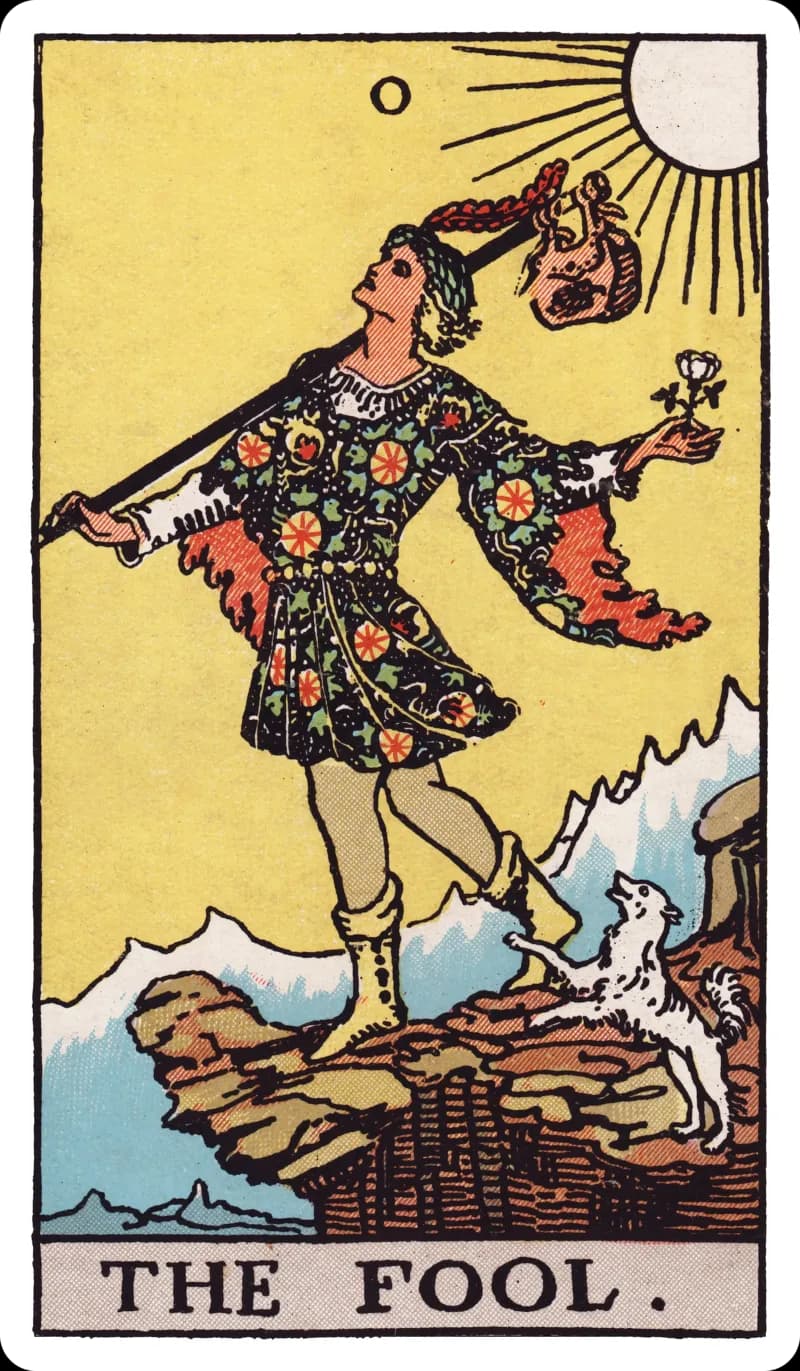
The Fool of the Rider-Waite-Smith deck shows a young figure stepping forward from the edge of a cliff, a small bundle slung over one shoulder and a white rose in the other hand, a small dog at the heel.
Upright vs reversed
| Upright | Reversed | |
|---|---|---|
| Keyword | NEW BEGINNINGS | RECKLESSNESS |
Upright meaning
In the Rider-Waite-Smith tradition, The Fool is read as the threshold of a journey not yet undertaken — the moment before the first step, when the path ahead is still open and unmapped. The card carries the number zero, and Waite himself described it as the principle of beginnings, of motion before form. Practitioners often read The Fool as a call to trust what is not yet proven: a project that has not been written down, a question that has not been spoken, a direction that does not yet have evidence to support it.
The figure walks toward the edge without looking, which the tradition treats not as recklessness but as openness — the willingness to step into something before knowing how it will end. The white rose is associated with purity of intention; the bundle, with how little one truly needs to begin. Modern RWS commentary often frames the card as the archetype of the beginner, the one who is permitted not to know yet.
Reversed meaning
Reversed, The Fool is traditionally read as the same impulse turned in on itself — the open step held back, the threshold unwalked. Waite's commentary on the card's reverse points toward heedlessness or imprudence; modern practitioners often soften this to a question of timing or readiness rather than failure. In a reversed position, the card invites the reader to consider what is being avoided, or where caution has hardened into stalling.
In a reading
In a situation position, The Fool is often read as naming where the reader currently stands at the threshold of something new. In an action position, it is commonly interpreted as a call to step forward without complete information. In an outcome position, the card is sometimes read as the opening of a chapter rather than its close — a beginning rather than a verdict.
In combination
The Fool and The World together are read in the RWS tradition as the end of one cycle meeting the beginning of the next — a completion that does not close the door but opens a new one entirely. The Fool paired with The Tower names a different dynamic: unexpected disruption as the condition for an open step, the forced beginning rather than the chosen one. When The Fool appears beside The Hierophant, the tradition often reads tension between the instinct toward freedom and the weight of structure or institution — a question of whether the leap is available within the existing frame.
Frequently asked questions
- What does The Fool mean in a love reading?
- In a love reading, The Fool is traditionally read as the card of new relationship energy — the willingness to enter something before the outcome is certain. For someone already in a relationship, it often names a chapter where the connection is renewed or redirected. The tradition does not frame this as a warning against attachment; it frames it as a recognition that love, like all journeys, begins before it is fully mapped.
- What does The Fool mean in a career reading?
- In a career reading, The Fool most often names the beginning of a professional direction that has not yet been tested. RWS practitioners commonly read it as the card that appears when someone is considering a change they cannot fully justify with evidence — a new role, a project outside their established field, or a pivot away from security. The tradition does not recommend recklessness; it names the moment when the move is available.
- What does The Fool reversed mean in a reading?
- The Fool reversed is traditionally read as the open step held back — not necessarily by wisdom, but often by fear that has hardened into stalling. The distinction between caution and avoidance is the central question the reversed card raises. Some modern practitioners read it as a timing issue rather than a character flaw: the step may be right, but the readiness is not yet there.
These notes follow the Rider-Waite-Smith tradition. They describe what the card is associated with — not predictions about your life.