What the card shows
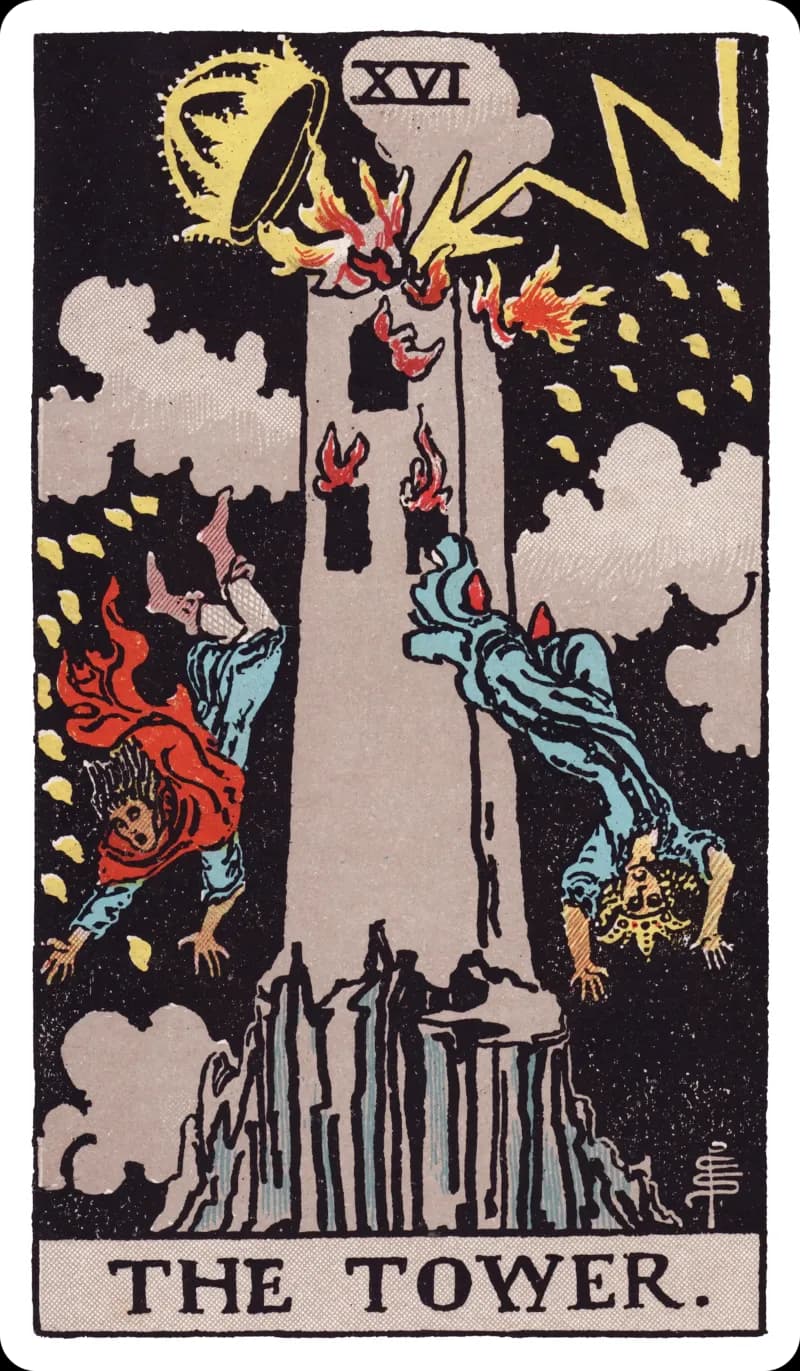
The Tower of the Rider-Waite-Smith deck shows a stone tower struck by lightning, its crown dislodged, two figures falling from its windows against a black sky.
Upright vs reversed
| Upright | Reversed | |
|---|---|---|
| Keyword | UPHEAVAL | RESISTED CHANGE |
Upright meaning
In the Rider-Waite-Smith tradition, The Tower is read as the card of structural rupture — the sudden clarity that a framework one has been working inside cannot hold its shape. Waite described the lightning not as punishment but as revelation: a stroke that exposes what was already true beneath the building's appearance. Practitioners often read this card not as destruction for its own sake but as the moment when something that was built on ground that would not last is finally seen for what it is.
The dislodged crown is associated in modern RWS commentary with the collapse of a self-image or governing assumption that no longer fits the facts. The card's Golden Dawn correspondence to Mars points toward sudden, forceful change — energy that arrives without warning and changes the room. As an upright card, The Tower is most often interpreted not as a verdict but as a frame: it names where the reader stands and what has just been revealed, and leaves the response to be chosen in the cards or actions that follow.
Reversed meaning
Reversed, The Tower is traditionally read as rupture postponed, partially absorbed, or quietly internalized: the breakdown that has already begun but is being held off, the upheaval that arrived in a softer form, or the lingering shock of an event whose external phase is over. Waite associated the reversal with imprisonment by old structures; many modern practitioners read it as a prompt to ask what the reader is still propping up that the lightning has already, in truth, brought down.
In a reading
In a situation position, The Tower is often read as naming a frame that has just collapsed or is collapsing now. In an action position, it is interpreted as a call to stop defending what is already gone, and to attend to what the rupture has revealed. In an outcome position, the card is commonly read as a clearing — a hard one, but a real one.
In combination
The Tower and Death together are read as two of the most transformative cards in the deck, but the tradition distinguishes their mode: Death names the natural completion of a cycle, The Tower names the sudden collapse. Together, they are often read as a period of multiple simultaneous releases — more than one structure giving way at once. The Tower with The Star names the most recognized of the Major Arcana sequences: disruption followed by the renewal of hope, the clearing that makes the light visible. When The Tower appears with The Fool, the tradition reads the combination as a forced beginning — the threshold that was not sought but has now arrived.
Frequently asked questions
- What does The Tower mean in a love reading?
- In a love reading, The Tower names the unexpected disruption of a relational structure — the revelation that changes everything, the crisis that arrives without warning. The tradition does not consistently read this as the end of a relationship; it reads it as the end of the form the relationship had taken. For some, this is the rupture that cannot be repaired; for others, it is the clearing of something that needed to come down for the relationship to become what it actually needs to be.
- What does The Tower mean in a career reading?
- In a career reading, The Tower is read as sudden, significant disruption to the professional structure — a dismissal, a company collapse, a project that falls apart. The tradition does not treat the card as punishment; it treats it as the arrival of something that makes the existing form untenable. Many modern practitioners note that while the immediate experience is often destabilizing, what is destroyed by The Tower was typically not as solid as it appeared.
- What does The Tower reversed mean?
- Reversed, The Tower is traditionally read as a disruption being avoided or delayed — the collapse that is coming but has not yet arrived, or the shock that has been narrowly averted. Some practitioners read it as a smaller version of The Tower's disruption: the warning that allows partial preparation. Others read the reversal as the continued resistance to the release that the upright card names, with the consequence that the eventual disruption is not lessened but merely postponed.
These notes follow the Rider-Waite-Smith tradition. They describe what the card is associated with — not predictions about your life.