What the card shows
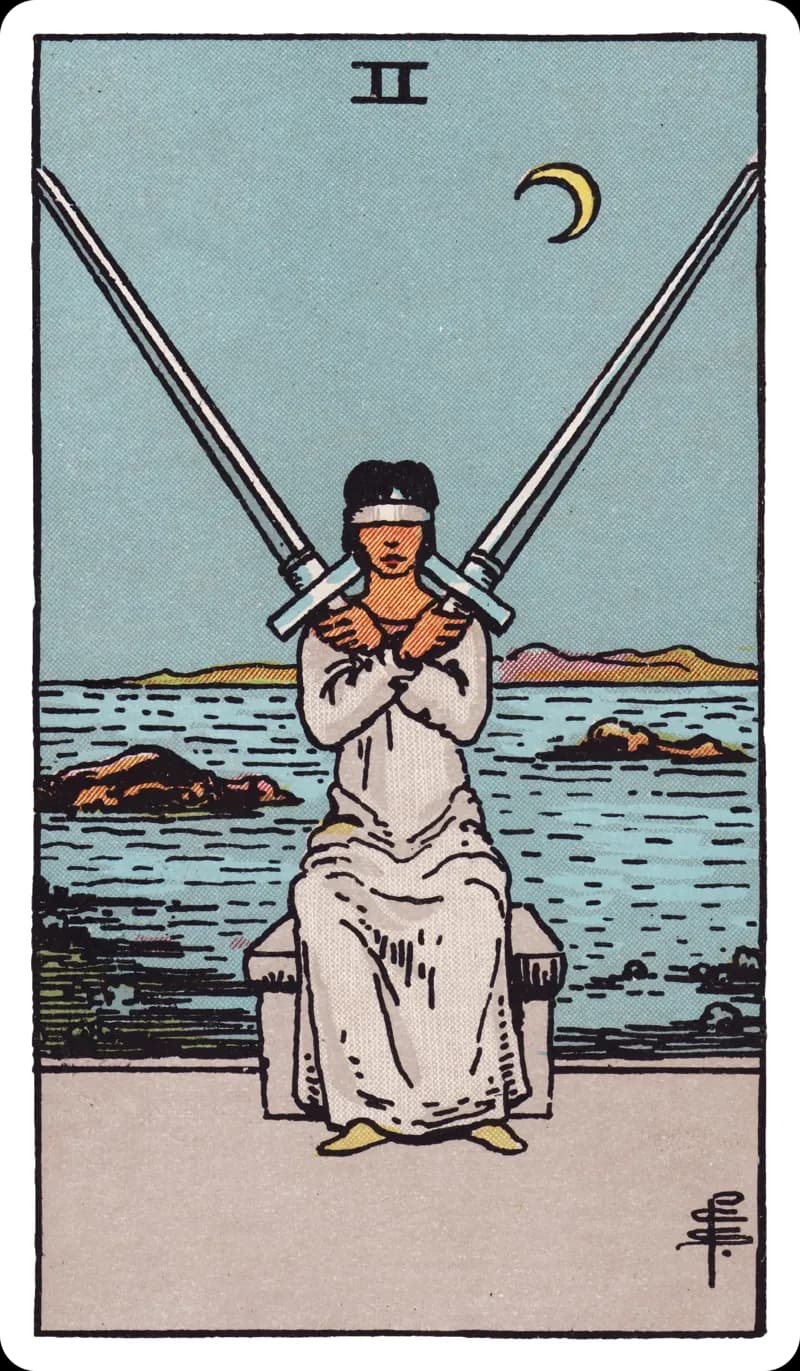
A blindfolded figure dressed in white sits before a calm sea, arms crossed over the chest, balancing a sword in each hand with practiced stillness; a crescent moon hangs in the dark sky above.
Upright vs reversed
| Upright | Reversed | |
|---|---|---|
| Keyword | STALEMATE | INDECISION |
Upright meaning
In the Rider-Waite-Smith tradition, the Two of Swords is read as a state of deliberate suspension — a choice held in perfect, if uneasy, equilibrium. The figure's blindfold is not accidental; it signals that the information needed to decide may be available but the querent is, for now, refusing to look at it. The crossed swords held in balance evoke the classic impasse: two competing truths, two equally weighted options, or two forces that cannot coexist and yet have not yet collided. The calm sea behind the figure suggests the emotional reality of the situation is more turbulent than the pose implies — the stillness is willed, not natural. Waite placed this card in a lineage of mental conflict held in check, and practitioners consistently read it as the moment before a decision, when the mind has erected a barrier against choosing.
In contemporary RWS readings, the Two of Swords is often encountered in situations where the querent knows, on some level, what they need to see but has chosen not to. The blindfold can represent self-imposed ignorance, a refusal to gather more information, or simply the overwhelm of holding two painful options simultaneously. Practitioners note that the card is not inherently negative — sometimes the pause is wise, and the balance serves a purpose — but it rarely indicates a stable long-term state. The crescent moon in the image is often read as a reminder that clarity tends to emerge in its own time, but only if the blindfold is eventually removed.
Reversed meaning
Reversed, the Two of Swords in the RWS tradition is read as the moment the impasse breaks — though not always cleanly. Information that was being withheld, from others or from oneself, begins to surface. The balance shatters, and the querent is now forced to confront what the blindfold had kept at a distance. Some practitioners read the reversal as relief: the decision finally made, the truth finally seen. Others read it as exposure of a deception or the painful arrival of news that had been delayed. Either way, the stasis of the upright card cannot hold, and the reversal marks the moment it releases.
In a reading
In the situation position, the Two of Swords describes a genuine impasse — something in the querent's circumstances is suspended, unresolved, and actively resisted. In the action position, the card may counsel strategic patience, or it may be pointing directly at the blindfold: what is the querent refusing to look at? In the outcome position, the Two of Swords suggests the matter may not resolve quickly — a decision point is approaching, but it has not yet arrived.
In combination
The Two of Swords beside Justice is read in the RWS tradition as a decision that cannot be postponed indefinitely — the scales waiting behind the blindfold. Paired with The Moon, the impasse deepens: what is being avoided grows less clear the longer it goes unexamined, and imagination fills the space where information should be. When the Two of Swords appears with the Eight of Swords, practitioners often read a warning within the suit itself — a pause that is hardening into a felt imprisonment, the chosen blindfold becoming one that no longer feels removable.
Frequently asked questions
- What does the Two of Swords mean in a love reading?
- In a love reading, the Two of Swords is traditionally read as an impasse of the heart — a choice between two people, two futures, or two truths about a relationship that the querent is not yet willing to look at. For someone single, it can name a guardedness that keeps new connection at arm's length. For someone in a relationship, it often marks a conversation being postponed because both possible outcomes feel costly. The card names the pause; it does not choose.
- What does the Two of Swords mean in a career reading?
- In a career reading, the Two of Swords usually describes a professional decision held in suspension — two offers, two directions, or a conflict between security and change that the querent is managing by not deciding. Practitioners often read the blindfold as deferred information-gathering: something knowable is being left unexamined because knowing would force the choice. The tradition treats the stalemate as workable but temporary — balance this deliberate takes energy to maintain.
- What does the Two of Swords reversed mean in a reading?
- The Two of Swords reversed is traditionally read as the impasse breaking — withheld information surfacing, a delayed decision forced, or the blindfold finally coming off. Some practitioners read it as relief: the truth seen at last, the choice finally made. Others read it as exposure that was not chosen. Either way, the reversal marks the end of the stalemate — what was being held in balance now has to move.
These notes follow the Rider-Waite-Smith tradition. They describe what the card is associated with — not predictions about your life.