What the card shows
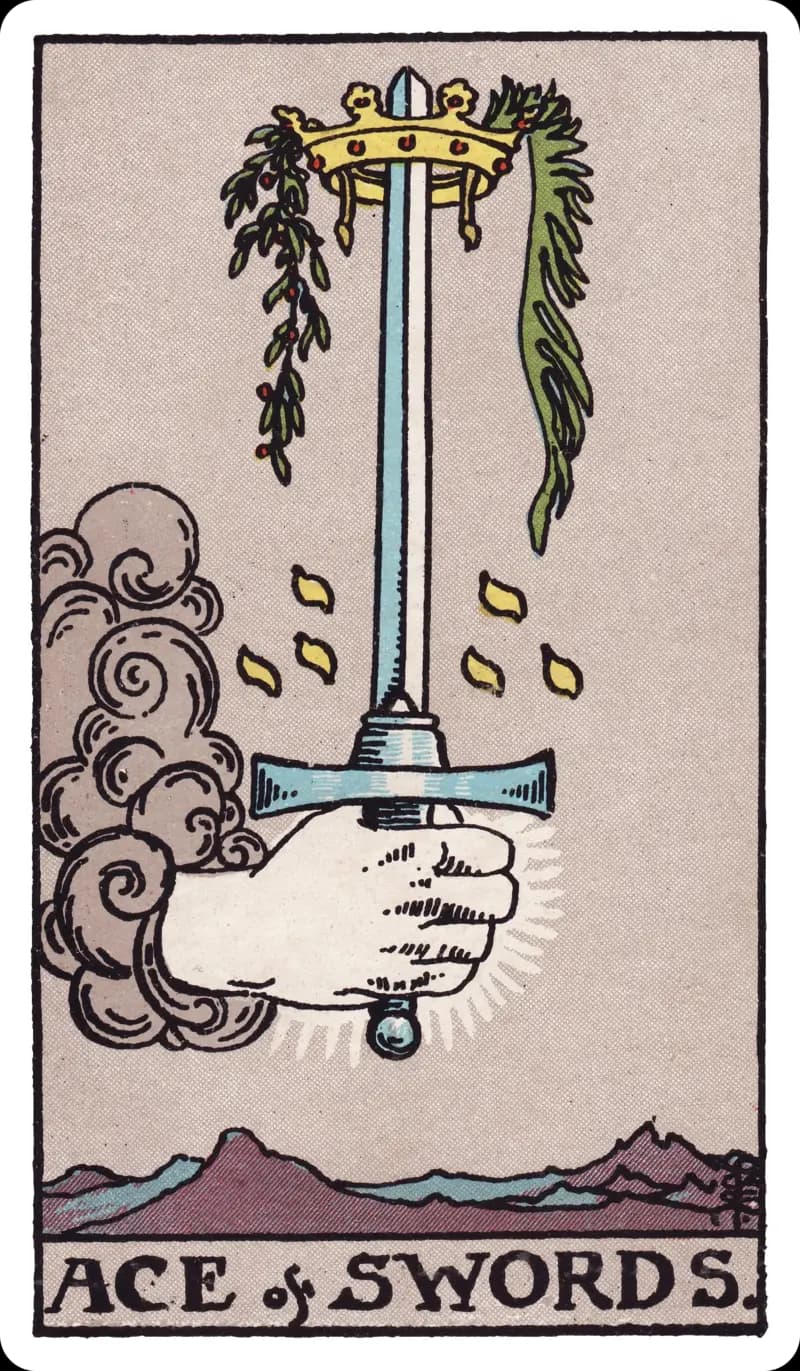
A hand emerges from a cloud grasping an upright sword, its tip encircled by a golden crown wreathed in laurel and palm; beneath the blade, a range of grey mountains recedes into the distance.
Upright vs reversed
| Upright | Reversed | |
|---|---|---|
| Keyword | CLARITY | CONFUSION |
Upright meaning
In the Rider-Waite-Smith tradition, the Ace of Swords is read as the inception of mental force — the moment a truth becomes undeniable, a decision crystallizes, or a new understanding breaks through what was previously obscured. The crown at the blade's tip echoes the sword's capacity to cut through pretense and arrive at clarity; the laurel and palm suggest both victory and the peace that follows honest reckoning. Waite associated this card with the triumph of the mind, the inaugural stroke of intellect applied to a situation that requires directness above all else. Practitioners read the Ace of Swords as a call to name what has not yet been named: the difficult conversation that must happen, the analysis that has been avoided, the judgment that must finally be rendered. Like all aces, it is pure potential — but the potential here belongs entirely to the realm of thought, language, and discernment.
In contemporary RWS practice, the Ace of Swords is often read as a breakthrough moment — not necessarily comfortable, but necessary. Where other aces carry warmth or abundance, this one carries edge: the edge of a decision, a diagnosis, a confession, or a revelation. Practitioners frequently see it as permission to think clearly after a period of confusion, or to speak plainly after a period of diplomatic evasion. The sword is double-edged, and the tradition acknowledges that clarity can cut both the one who wields it and the one it is aimed at. The card does not ask whether the truth is convenient — it asks whether the querent is ready to hold it.
Reversed meaning
Reversed, the Ace of Swords in the RWS tradition is read as mental force turned inward against itself — the capacity for clear thinking undermined by confusion, misuse of language, or a truth wielded carelessly. Where the upright card cuts through, the reversed suggests a blade turned sideways: analysis that cannot reach a conclusion, communication that clouds rather than clarifies, or a decision made with faulty information. Some practitioners also read it as a warning against using sharp words as weapons rather than instruments of discernment. The reversal does not erase the card's power; it points to where that power is currently misdirected or suppressed.
In a reading
In the situation position, the Ace of Swords names a moment that demands clear thinking — something in the querent's circumstances requires honest appraisal rather than wishful interpretation. In the action position, the card calls for directness: speak the truth, make the decision, or cut through what has been avoided. In the outcome position, the Ace of Swords points toward a breakthrough — a resolution achieved through clarity, even if it arrives with difficulty.
In combination
The Ace of Swords beside The Tower is read in the RWS tradition as revelation at full force — a truth arriving with enough power to change the structure it lands on. Paired with the Two of Swords, the sequence often describes clarity offered and not yet accepted: the blade extended toward a figure still wearing the blindfold. When the Ace of Swords appears with The Lovers, practitioners tend to read a decision of values coming into focus — the choice was already present, and the Ace supplies the clarity to name it.
Frequently asked questions
- What does the Ace of Swords mean in a love reading?
- In a love reading, the Ace of Swords is traditionally read as the arrival of clarity in matters of the heart — a truth about the relationship, or about what the querent actually wants, becoming impossible to ignore. For someone single, it often names honest self-assessment before a new connection. For someone in a relationship, it tends to mark a conversation that has been waiting to happen. The tradition reads it as clarity offered, not verdict imposed — the card names the truth's arrival, not its content.
- What does the Ace of Swords mean in a career reading?
- In a career reading, the Ace of Swords usually names a breakthrough in thinking — the moment a decision about direction, a negotiation, or a long-avoided professional conversation becomes clear enough to act on. Practitioners often read it as the card of the well-framed problem: the situation has not changed, but the querent can finally see it precisely. Its invitation is directness — naming terms, asking the exact question, making the cut that has been postponed.
- What does the Ace of Swords reversed mean in a reading?
- The Ace of Swords reversed is traditionally read as clarity obstructed rather than absent — analysis that circles without concluding, words that cloud instead of cut, or a truth being wielded carelessly. It often appears when a decision is being made on faulty information, or when sharpness is serving as a weapon rather than an instrument. The reversal points to where the mind's force is misdirected; it does not say the clarity is out of reach.
These notes follow the Rider-Waite-Smith tradition. They describe what the card is associated with — not predictions about your life.