What the card shows
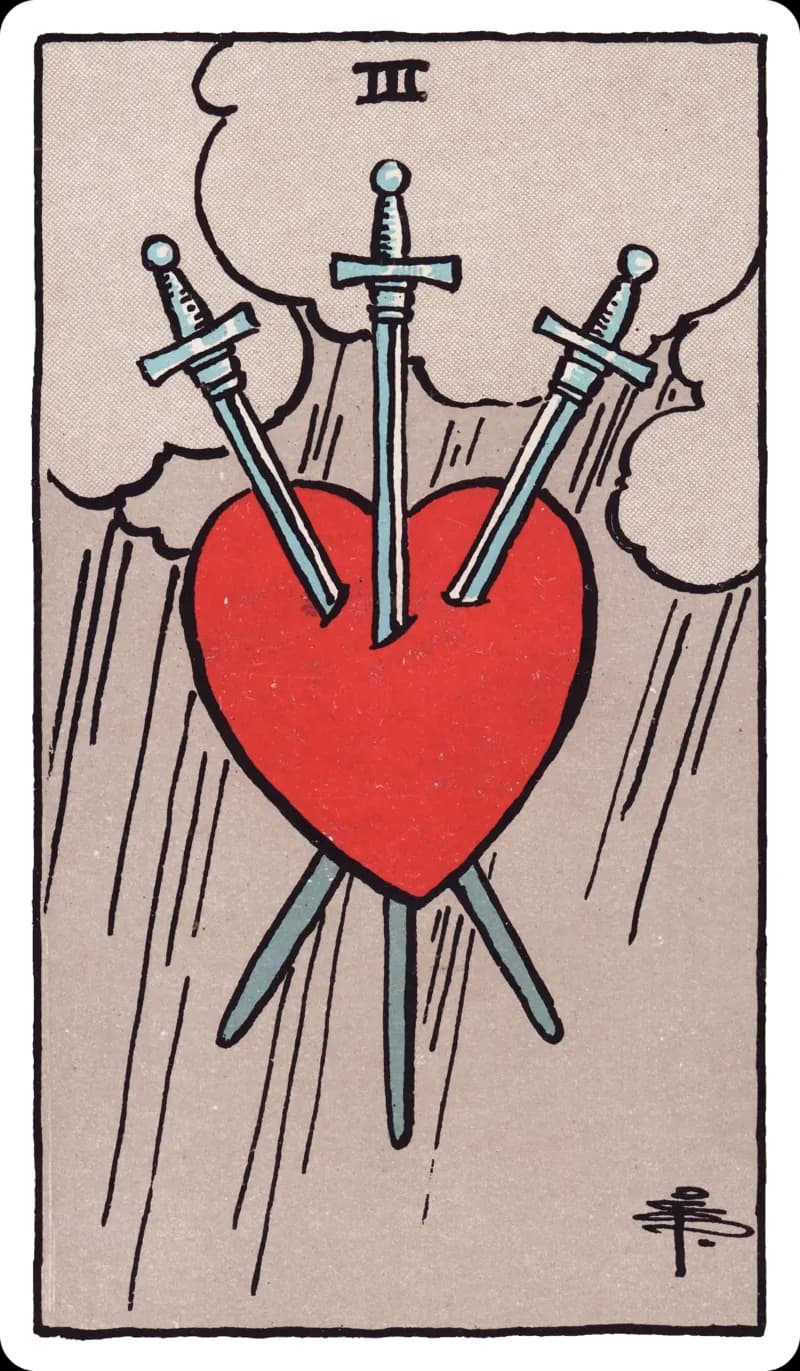
Three swords pierce a large red heart suspended against a sky filled with grey clouds and driving rain, with no figure present — only the image of the wound itself.
Upright vs reversed
| Upright | Reversed | |
|---|---|---|
| Keyword | HEARTBREAK | HEALING |
Upright meaning
In the Rider-Waite-Smith tradition, the Three of Swords is read as one of the most direct images in the deck: grief, heartbreak, or sorrow made visible without ambiguity. Waite stripped the card of narrative — there is no figure to contextualize or soften the image — leaving only the pierced heart as the central statement. The three swords suggest that the pain has a specific, identifiable source: a betrayal, a separation, a loss, or a truth spoken or discovered that cannot be unknown. The rain and cloud do not merely set atmosphere; in RWS symbolism they indicate that the emotional weather is total and, for now, unavoidable. Practitioners read this card not as a warning of future pain but as an acknowledgment of pain that is already present — the tradition asks the querent to name what hurts rather than continue past it.
In contemporary RWS practice, the Three of Swords is often read with more nuance than its stark image might suggest. Practitioners note that grief named is grief that can eventually be processed; the swords in the heart, however painful, are visible and countable. The card appears in readings during periods of loss — romantic, relational, or otherwise — but also during moments of difficult clarity: the realization that a relationship has ended, that a hope was misplaced, or that someone's words inflicted real damage. Some readers emphasize that rain eventually passes, and the cloud-filled sky of the Three of Swords does not foreclose the possibility of a clearing.
Reversed meaning
Reversed, the Three of Swords in the RWS tradition is read as the slow emergence from grief rather than its sudden release. The swords are being withdrawn from the heart, but the process is tender and incomplete — wounds of this kind do not close all at once. Some practitioners read the reversal as the beginning of forgiveness, whether of another or of oneself; others read it as grief that is being suppressed rather than processed, pushed out of sight without being worked through. The reversal can also point to the lingering aftermath of a painful truth: the words have been spoken, the wound has been made, and now the querent must decide what to do with the scar.
In a reading
In the situation position, the Three of Swords names grief or painful truth as the dominant reality of the querent's circumstances — something has been lost, broken, or spoken that cannot be taken back. In the action position, the card calls for honest acknowledgment of the wound rather than avoidance. In the outcome position, the Three of Swords suggests that sorrow or difficult clarity is part of the path ahead — not punishment, but a passage that must be moved through.
In combination
The Three of Swords beside The Lovers is read in the RWS tradition as the wound inside a significant bond — heartbreak that matters precisely because the connection did. Paired with the Ace of Cups, practitioners often read grief and new feeling side by side: mourning that has not finished while something in the emotional life begins to reopen. When the Three of Swords appears with The Star, the sequence is commonly read as sorrow followed by repair — the storm in the card giving way to the deck's clearest image of recovery.
Frequently asked questions
- What does the Three of Swords mean in a love reading?
- In a love reading, the Three of Swords is traditionally read as heartbreak named directly — a separation, a betrayal, or words that caused real damage. For someone in a relationship, it often marks a wound inside the bond that needs acknowledgment before anything else can happen. For someone single, it can name grief from a previous connection that is still being carried. The tradition is careful here: the card describes pain already present, not pain to come — it asks that the hurt be named rather than stepped past.
- What does the Three of Swords mean in a career reading?
- In a career reading, the Three of Swords usually names a professional loss or a painful clarity — a role that ended, a project that failed, recognition withheld, or honest feedback that landed hard. Practitioners read it less as commentary on ability than as acknowledgment of the wound itself: something in the working life hurt, and pretending otherwise delays the recovery. The rain in the image is weather, not verdict — it passes, but it is real while it falls.
- What does the Three of Swords reversed mean in a reading?
- The Three of Swords reversed is traditionally read as the slow withdrawal of the swords — grief beginning to move rather than sitting fixed in the heart. Some practitioners read it as the start of forgiveness, of another or of oneself; others as sorrow being suppressed rather than processed, pushed from view without being worked through. The reversal asks which of the two is happening — the wound closing, or the wound hidden.
These notes follow the Rider-Waite-Smith tradition. They describe what the card is associated with — not predictions about your life.