What the card shows
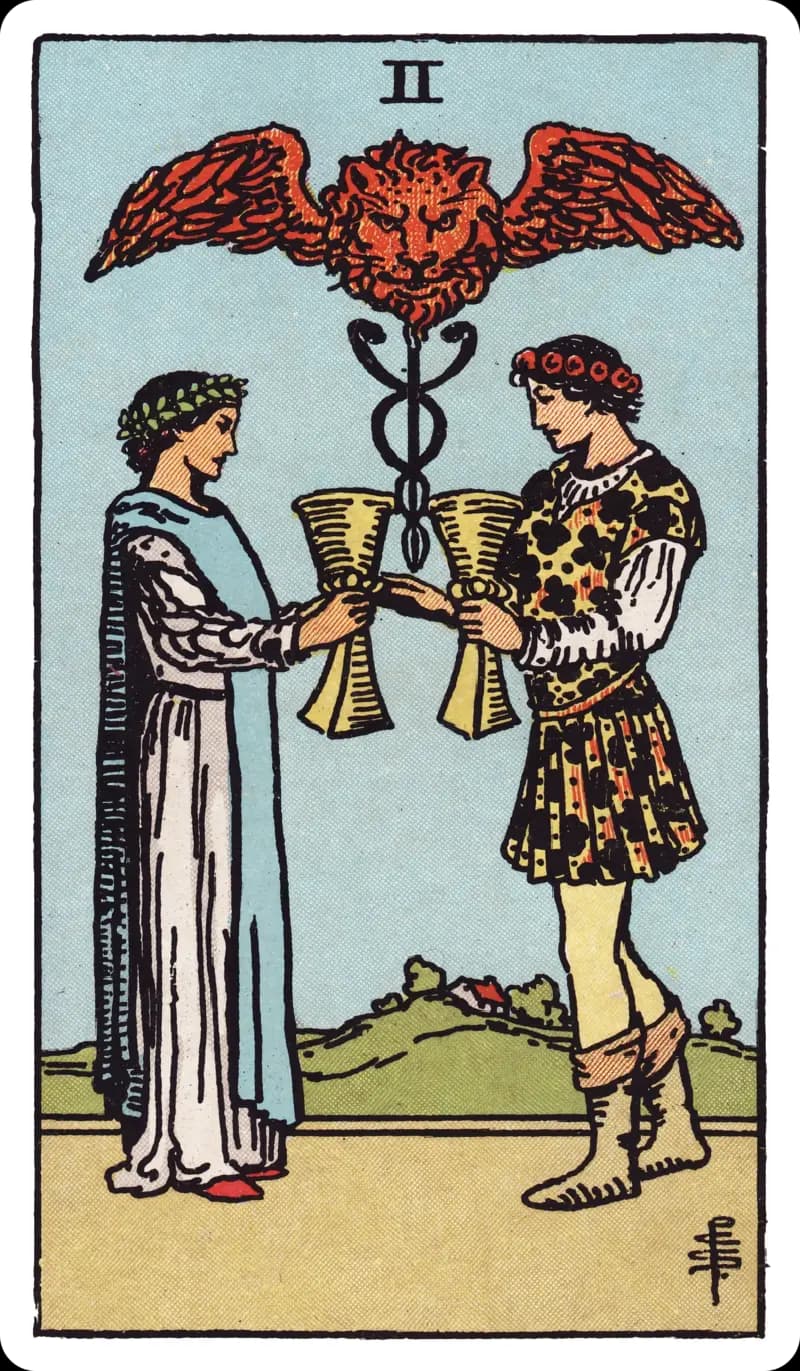
Two figures stand facing each other and exchange cups before a winged caduceus crowned with a lion's head; the posture of both figures conveys a moment of mutual pledge, and the caduceus above them carries the symbolic weight of reciprocal agreement and transformation.
Upright vs reversed
| Upright | Reversed | |
|---|---|---|
| Keyword | CONNECTION | IMBALANCE |
Upright meaning
In the Rider-Waite-Smith tradition, the Two of Cups is read as the card of recognized mutuality — the moment in which two distinct emotional currents find their point of meeting. The caduceus that rises between the two figures is borrowed from the iconography of Hermes and the medical arts, both domains concerned with exchange and with the mediation between opposites. Waite described this card as representing the harmony of masculine and feminine principles, though modern practitioners have expanded the reading considerably beyond that binary framing. What persists in the tradition is the centrality of encounter: this is not love as a feeling within one person, but love as a field that exists between two people, created by what each brings toward the other. The lion's head above the caduceus introduces an element of courage — true mutuality requires the willingness to be seen.
Contemporary RWS readers consistently place the Two of Cups in contexts of partnership, whether romantic, creative, or professional. The card marks the moment of conscious connection — the handshake, the declaration, the agreement to move forward together. It appears not only at the beginning of relationships but also at their renewal: a moment of re-recognition within a longer bond. The tradition emphasizes the quality of balance in this card; neither figure dominates the exchange. What is being described is a meeting of equals, a union in which both parties are changed by the encounter.
Reversed meaning
Reversed, the Two of Cups in the RWS tradition points to disruption within a bond or a failure of mutuality. This position is not simply the opposite of harmony; it describes a relationship in which the exchange has become unequal, the connection has been broken by misunderstanding, or the pledge between two parties is under strain. Some practitioners read the reversal as a caution against pursuing a connection that presents as reciprocal but conceals an imbalance. The caduceus between the figures, when inverted, suggests that the mediating principle — the element that holds the exchange together — has been destabilized.
In a reading
In the situation position, the Two of Cups identifies a significant relationship or partnership as the central context — a bond between two people is the ground on which everything else rests. In the action position, the card counsels mutual acknowledgment: the work is to move toward the other person with openness rather than strategy. In the outcome position, it points toward the formation or deepening of a meaningful connection as the likely resolution of the present situation.
In combination
The Two of Cups beside The Lovers intensifies the theme of union: where the Two names the meeting of equals, The Lovers adds the weight of conscious choice and its consequences — practitioners often read the pair as a bond arriving at the moment of commitment. With the Ten of Cups, the tradition reads the arc from encounter to belonging: the pledge between two people maturing into family and home. Paired with the Five of Cups, the combination often surfaces a bond shadowed by grief — a connection asked to hold what has been lost as well as what is being offered.
Frequently asked questions
- What does the Two of Cups mean in a love reading?
- In a love reading, the Two of Cups is one of the most direct cards in the deck: it names mutual recognition — a bond in which both people bring something toward the other and both are changed by the exchange. For someone single, it often marks the approach of a connection built on equality rather than pursuit. For someone in a relationship, it tends to name renewal: a moment of re-recognition within the longer bond. Reversed, it asks where the exchange has become unequal.
- What does the Two of Cups mean in a career reading?
- In a career reading, the Two of Cups usually names partnership as the operative force — a collaboration, an alliance, or a working relationship in which mutual respect carries more weight than hierarchy. Practitioners often read it as a sign that the question will be resolved between two people rather than by one alone. The card counsels honest exchange: agreements made openly, contributions acknowledged on both sides.
- What does the Two of Cups reversed mean in a reading?
- The Two of Cups reversed is traditionally read as a disruption of mutuality — an exchange that has become unequal, a misunderstanding that has broken the connection, or a pledge under strain. Some practitioners read it as a caution about a bond that presents as reciprocal but conceals an imbalance. The reversal does not declare the relationship finished; it asks what would need to be rebalanced for the meeting of equals to be restored.
These notes follow the Rider-Waite-Smith tradition. They describe what the card is associated with — not predictions about your life.