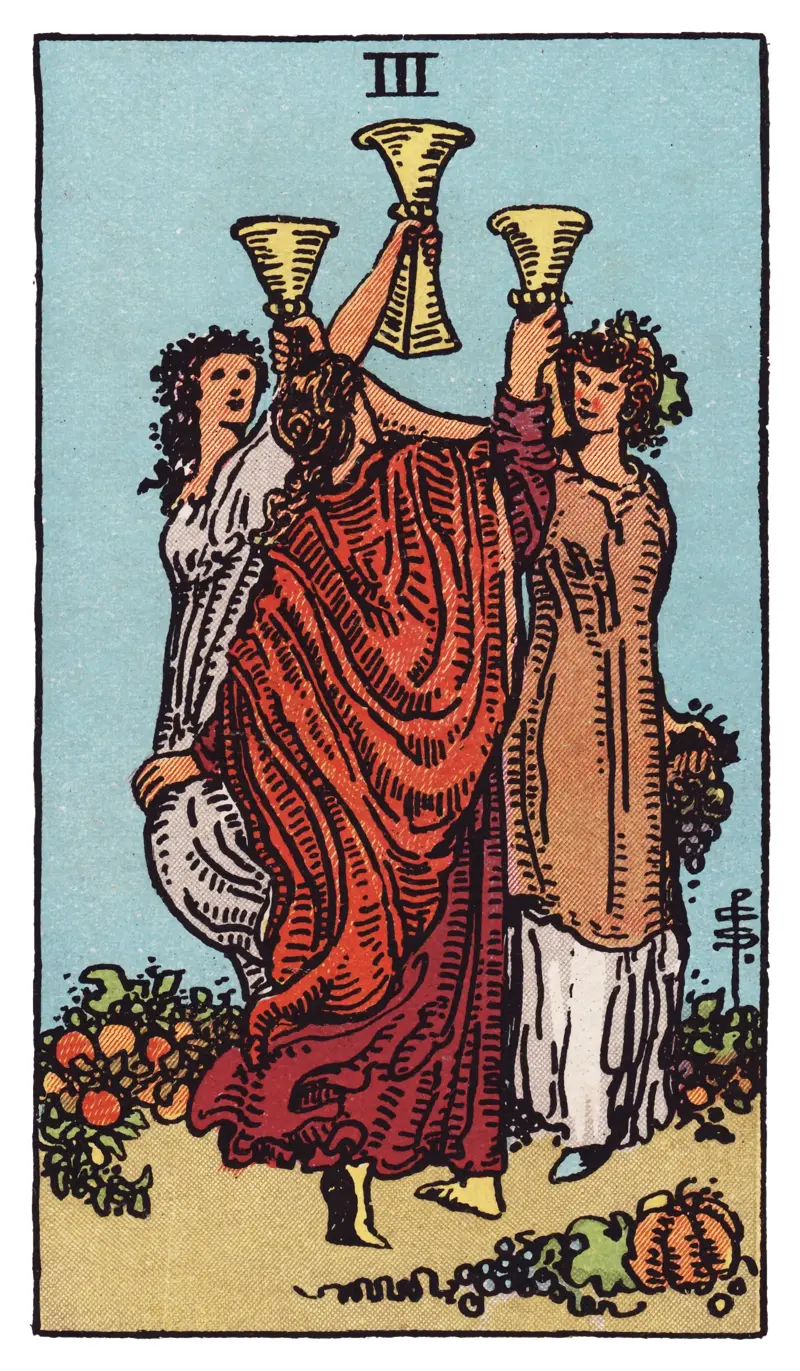
What the card shows
Three women raise their cups aloft in a gesture of shared celebration, surrounded by abundant fruit and flowers on the ground around them; the scene is overtly festive and communal, with all three figures turning toward each other in a moment of joyful acknowledgment.
Upright vs reversed
| Upright | Reversed | |
|---|---|---|
| Keyword | FRIENDSHIP | EXCESS |
Upright meaning
In the Rider-Waite-Smith tradition, the Three of Cups is read as the card of communal joy — the emotional life moving outward from the private encounter of the Two into the wider warmth of a group. The abundance of fruit and flowers in the imagery connects this card to themes of harvest and fruition: something has come to completion, and that completion is being celebrated not in solitude but in the company of others. Waite's commentators have described this as a card of plenty, of the good things in life enjoyed openly and shared freely. The three figures are not merely in proximity; they are actively turned toward one another, their cups raised in unison, which the tradition reads as the conscious choice to bring joy into relationship rather than to hold it privately.
Contemporary RWS readers encounter this card frequently in contexts of friendship, creative collaboration, and the pleasures of community. The card appears when a group of people is bound together by shared feeling rather than by obligation — the gathering chosen rather than assigned. Many practitioners note that the Three of Cups also carries a quality of emotional generosity: the joy here is not diminished by being shared but amplified. The card marks moments of reunion, of celebration after effort, of finding that others understand what you have been carrying. It is read in the tradition as fundamentally affirmative — the feast is real, the connection is genuine.
Reversed meaning
Reversed, the Three of Cups in the RWS tradition draws attention to what disrupts communal joy: gossip, excess, superficial socializing, or exclusion from a group that should offer welcome. This position is not a negation of celebration but a questioning of its quality. Some practitioners read the reversal as a sign that a social circle has become cliquish or that gatherings are being used to avoid rather than deepen connection. Others emphasize the shadow of overindulgence — when celebration becomes a way of evading what needs to be faced. The reversal asks whether the company being kept is genuinely nourishing.
In a reading
In the situation position, the Three of Cups identifies community, friendship, or a shared celebration as the ground of the present moment — other people are central to what is happening. In the action position, the card counsels turning toward others, allowing joy to be witnessed and shared rather than held in reserve. In the outcome position, it suggests that the path ahead leads through connection — that what is coming will be better arrived at in company than alone.
In combination
The Three of Cups beside The Sun is read in the RWS tradition as joy at its most unguarded — shared celebration meeting the open daylight of genuine vitality. Paired with the Four of Cups, the combination often names the tension between the feast and the guest who cannot taste it: community present, engagement absent. When the Three of Cups appears with the Nine of Cups, practitioners often contrast the two forms of satisfaction — the pleasure shared among many against the contentment held alone — and read the pair as a question about which one the moment calls for.
Frequently asked questions
- What does the Three of Cups mean in a love reading?
- In a love reading, the Three of Cups usually widens the frame beyond the couple: it names the community around a relationship — friends who witness it, celebrations that mark it, the social world in which a bond either breathes or suffocates. For someone single, it often points toward connection arriving through friendship or shared gatherings rather than through pursuit. Reversed in a love context, it can surface third-party interference or a social circle that crowds the intimacy rather than supporting it.
- What does the Three of Cups mean in a career reading?
- In a career reading, the Three of Cups names collaborative joy — a team that genuinely works, a project completed and celebrated together, or the recognition that colleagues have become companions. Practitioners often read it as counsel to share credit and mark completions openly rather than moving straight to the next task. It can also point to creative collaboration as the path forward: the work is better done in chorus than alone.
- What does the Three of Cups reversed mean in a reading?
- The Three of Cups reversed is traditionally read as a questioning of the celebration's quality rather than its negation: gossip inside a circle that should offer welcome, gatherings used to avoid rather than deepen connection, or festivity sliding into excess. Some practitioners read it as exclusion — being left outside a group where belonging was expected. The reversal asks whether the company being kept is genuinely nourishing, and what the celebration might be covering.
These notes follow the Rider-Waite-Smith tradition. They describe what the card is associated with — not predictions about your life.