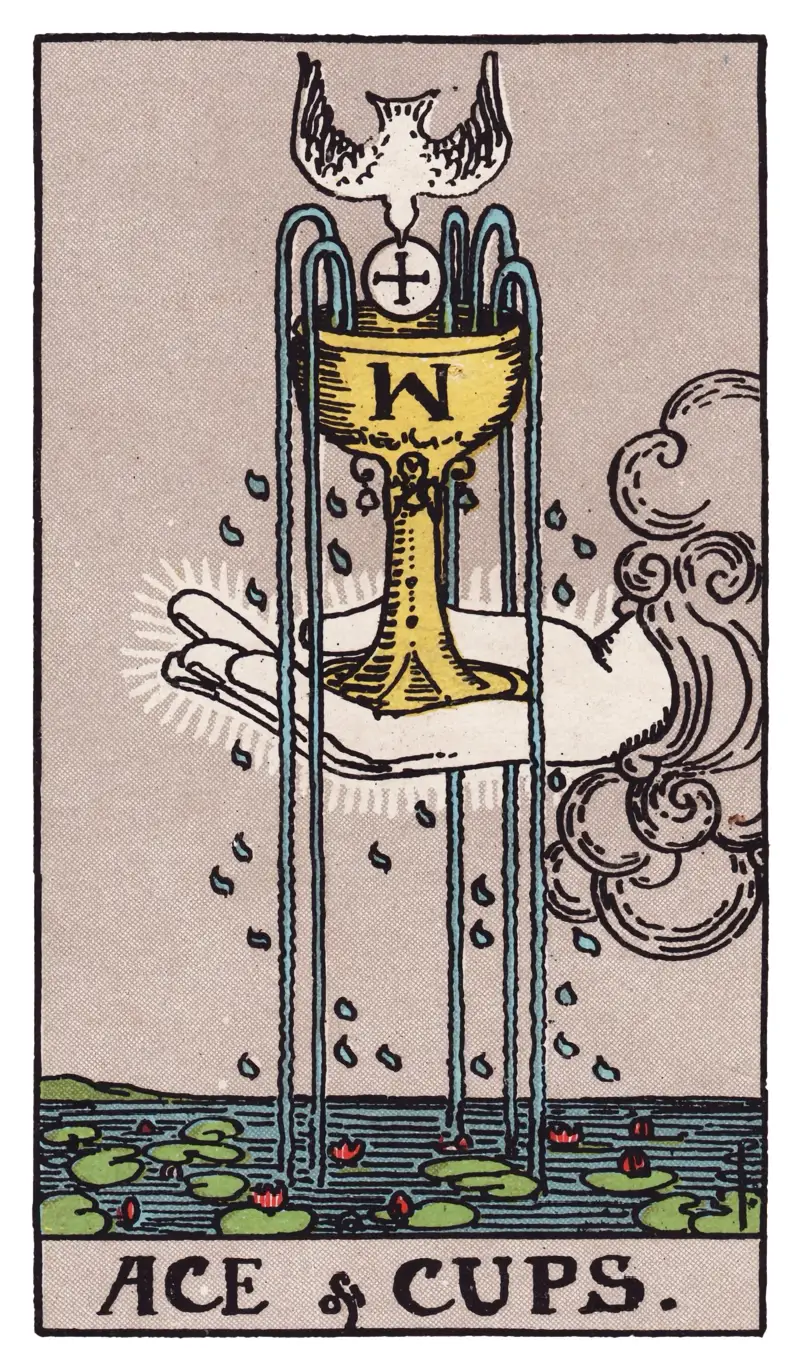
What the card shows
A hand emerges from a cloud and extends a great chalice from which five streams of water cascade downward into a lotus-covered pool below; a dove descends carrying a wafer toward the cup's mouth, and the overflowing water suggests an inexhaustible source of feeling.
Upright vs reversed
| Upright | Reversed | |
|---|---|---|
| Keyword | NEW FEELING | BLOCKED FEELING |
Upright meaning
In the Rider-Waite-Smith tradition, the Ace of Cups is read as the primal offer of emotional experience — not yet a feeling, but the condition that makes feeling possible. The five streams descending from the chalice have been linked by commentators to the five senses, suggesting that what is being offered is the capacity for full, embodied emotional life. The dove bearing the wafer introduces a quality of sanctity, of something arriving from outside the ordinary — and Waite himself described the suit of Cups as corresponding to the inner life, to imagination, and to what the heart receives before the mind categorizes it. Practitioners consistently read this card as a moment of opening: a new emotional chapter whose content has not yet been written, a relationship whose nature is still forming, a creative or spiritual current beginning to move.
Contemporary RWS readers often place the Ace of Cups at the beginning of an emotional cycle in much the way a new moon marks the beginning of a lunar cycle — the potential is whole, but the expression is still latent. The card appears frequently in contexts of new love, creative inspiration, spiritual awakening, or the beginning of a therapeutic or reflective process. What matters in the tradition is not the specific form the opening will take, but the quality of receptivity it calls for. The cup is full to overflowing; the invitation is to receive, not to acquire.
Reversed meaning
Reversed, the Ace of Cups in the RWS tradition is read not as the absence of feeling but as a blockage at the source — the cup is present, but something prevents the water from flowing freely. Waite's commentators describe this position as emotional suppression, an unwillingness or inability to receive what is being offered. It may appear when grief has been stored rather than moved through, when creative or spiritual channels are obstructed by exhaustion or fear, or when a relationship or situation calls for openness that the person cannot yet access. The reversal names a threshold, not a verdict.
In a reading
In the situation position, the Ace of Cups marks an emotional opening already underway — something new is arriving in the feeling life. In the action position, it counsels receptivity: the work here is to open rather than to pursue or control. In the outcome position, the card suggests that the path forward leads through an emotional threshold — what is coming cannot be reasoned into existence, only received.
In combination
The Ace of Cups beside The Lovers is read in the RWS tradition as new feeling meeting real choice — the opening of the heart arriving together with a decision about where to place it. Paired with the Two of Cups, the sequence is often read as an offer finding its answer: what begins as pure potential in the Ace takes the shape of mutual recognition in the Two. When the Ace of Cups appears with the Five of Cups, practitioners often read the tension between what is being offered and what is still being mourned — the new cup extended while the gaze remains on the spilled ones.
Frequently asked questions
- What does the Ace of Cups mean in a love reading?
- In a love reading, the Ace of Cups is traditionally read as the opening of the heart itself — new feeling arriving before it has taken the shape of a relationship. For someone single, it often names emotional readiness: the capacity to receive love being restored or offered. For someone in a relationship, it tends to mark a renewal of tenderness at the source. Reversed, it invites the question of what is blocking the flow — grief stored, or an offer not yet received.
- What does the Ace of Cups mean in a career reading?
- In a career reading, the Ace of Cups usually points away from strategy and toward feeling: the beginning of work that engages the heart — a creative project in its earliest stage, a vocation stirring, or a new emotional tone within an existing role. Practitioners often read it as a sign that satisfaction, not advancement, is the question at hand. The invitation is to notice where the work itself has begun to move something inward.
- What does the Ace of Cups reversed mean in a reading?
- The Ace of Cups reversed is traditionally read as a blockage at the source rather than an absence of feeling — the cup is present, but the water is not flowing. It often appears when grief has been stored rather than moved through, or when openness is being asked of someone who cannot yet access it. The reversal names a threshold, not a verdict: the work it points to is whatever would let the water move again.
These notes follow the Rider-Waite-Smith tradition. They describe what the card is associated with — not predictions about your life.