What the card shows
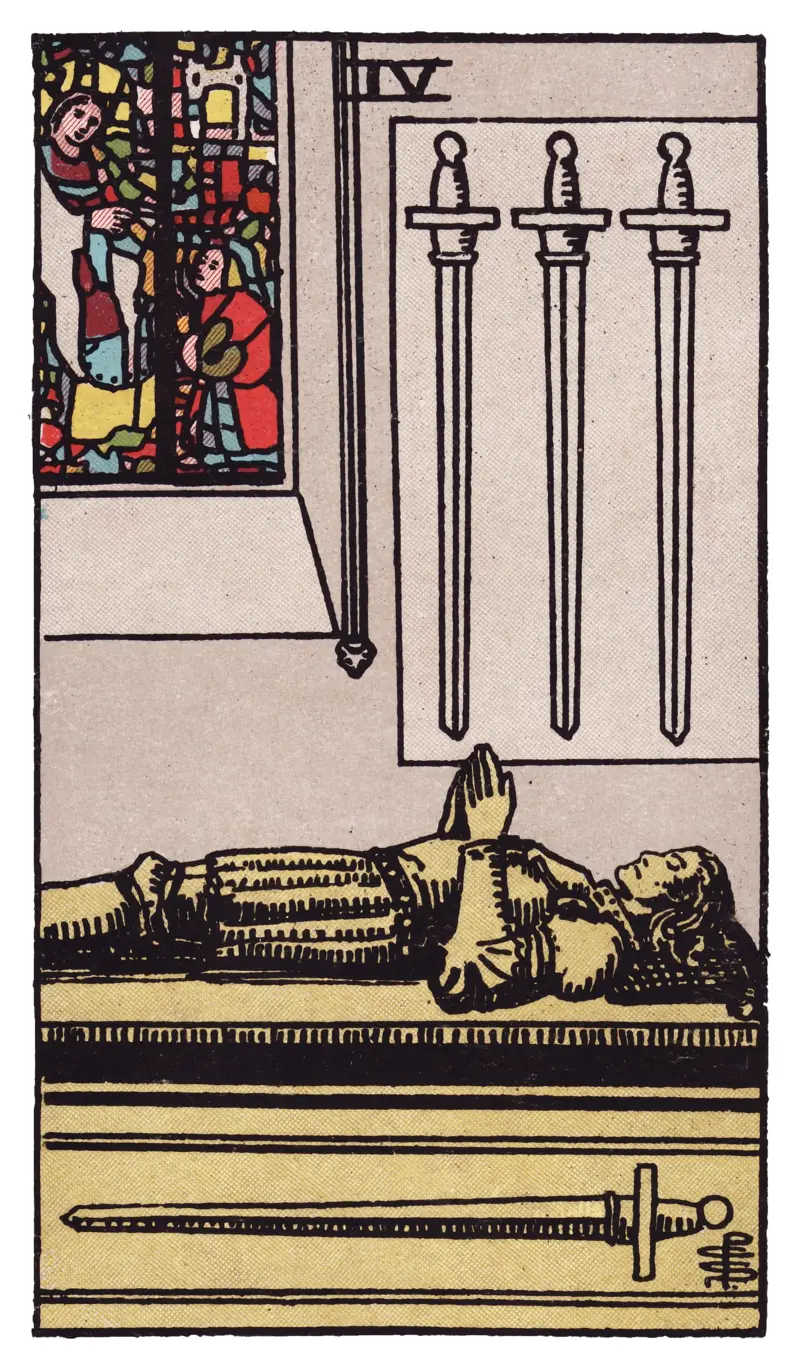
A stone effigy of a knight lies in repose on a tomb inside a church, hands pressed together in prayer; one sword lies horizontally beneath the figure while three more hang on the wall above, and colored light filters through a stained-glass window beside him.
Upright vs reversed
| Upright | Reversed | |
|---|---|---|
| Keyword | REST | RESTLESSNESS |
Upright meaning
In the Rider-Waite-Smith tradition, the Four of Swords is read as the necessary cessation of mental activity — not the resolution of conflict, but the deliberate withdrawal from it in order to recover. The image of the knight on the tomb is not death; it is the posture of stillness chosen by someone who has been in the field and must now step away from it. The single sword laid beneath the figure suggests that one problem remains immediate and real, while the three mounted above represent concerns held at a deliberate distance. The church setting and the stained-glass window introduce a dimension of contemplation: this is not passive collapse but a chosen, perhaps even sacred, pause. Waite associated the fours in general with consolidation and rest, and in the suit of Swords that rest is specifically mental — a respite from the relentless activity of the thinking mind.
In contemporary RWS practice, the Four of Swords appears frequently in readings where the querent is approaching exhaustion, whether from decision fatigue, prolonged anxiety, or the mental weight of a complex situation. Practitioners read it as explicit permission — even an instruction — to stop, withdraw, and allow the mind to quiet before engaging again. The card does not suggest the problem has gone away; the sword beneath the figure is still there. It suggests instead that continuing to press forward without rest will not produce clarity. Some readers also note the meditative quality of the posture: the Four of Swords can point toward practices of deliberate stillness — prayer, meditation, or simple retreat — as the appropriate response.
Reversed meaning
Reversed, the Four of Swords in the RWS tradition is read as the end of the period of rest — a return to activity, sometimes welcome, sometimes premature. The querent may be emerging from a time of recovery with renewed energy and readiness to engage. Alternatively, the reversal can indicate restlessness that refuses to allow the necessary pause: the inability to stop thinking, to sleep, to disengage from a problem long enough for perspective to form. Some practitioners read it as a warning that rest has been cut short before healing was complete, or that the querent is pushing back into activity before they are genuinely ready.
In a reading
In the situation position, the Four of Swords describes a period of enforced or chosen withdrawal — the querent's circumstances call for stillness rather than action. In the action position, the card is an instruction to rest, step back, and allow mental quiet before deciding or acting. In the outcome position, the Four of Swords suggests that the path forward moves through a period of recuperation — resolution will come, but not before a necessary pause.
In combination
The Four of Swords beside The Hermit is read in the RWS tradition as rest deepening into deliberate retreat — a pause that becomes a period of genuine interior work. Paired with the Nine of Swords, practitioners often read the suit's own prescription and its resistance in one image: the stillness the sleepless mind most needs and most refuses. When the Four of Swords appears with the Knight of Swords, the tension is between tempos — the charge and the pause in the same reading, asking which the situation actually calls for.
Frequently asked questions
- What does the Four of Swords mean in a love reading?
- In a love reading, the Four of Swords is traditionally read as a needed pause within the relationship question — not a separation, but a stepping back from the intensity of analysis so that feeling and perspective can settle. For someone in a relationship, it often names a season of quiet after conflict or strain. For someone single, it can mark a deliberate rest from searching. The tradition reads the pause as preparation, not verdict — what is rested returns clearer.
- What does the Four of Swords mean in a career reading?
- In a career reading, the Four of Swords usually appears near burnout — decision fatigue, a mind that cannot stop working the problem, a workload that has outrun recovery. Practitioners read it as an instruction rather than a suggestion: step back before the next move, because pressing forward without rest will not produce clarity. The sword beneath the figure stays — the problem is real and will still be there — but the tradition insists the pause is part of solving it.
- What does the Four of Swords reversed mean in a reading?
- The Four of Swords reversed is traditionally read as the rest ending — sometimes because recovery is genuinely complete, sometimes because restlessness cut it short. It can mark a welcome return to activity, or a mind that refuses to disengage long enough for perspective to form. The reversal asks a plain question: is the return to motion chosen from readiness, or driven by the inability to be still?
These notes follow the Rider-Waite-Smith tradition. They describe what the card is associated with — not predictions about your life.