What the card shows
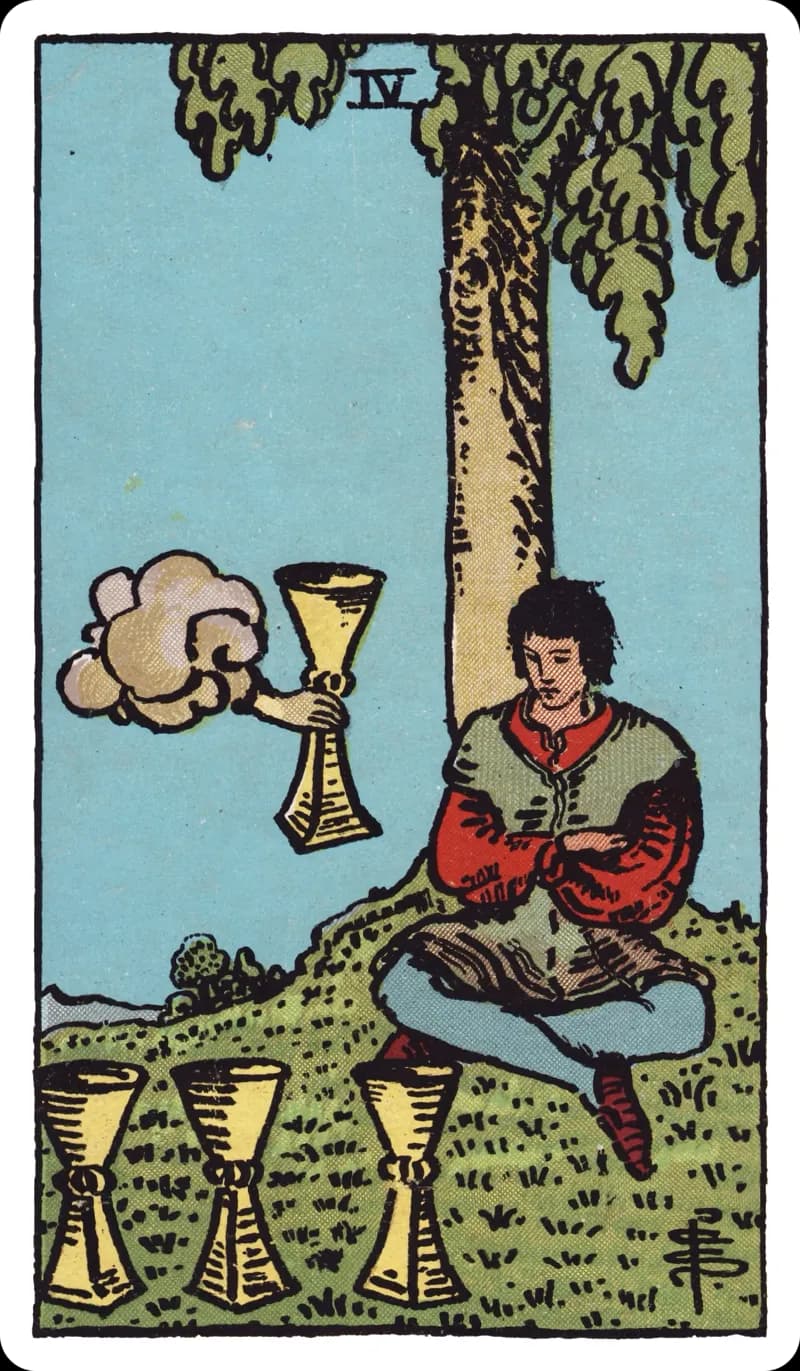
A young man sits beneath a tree with his arms folded and his gaze fixed on three cups arranged on the ground before him; a fourth cup is extended from a cloud to his right, an offering from an unseen source that the seated figure does not acknowledge or seem to notice.
Upright vs reversed
| Upright | Reversed | |
|---|---|---|
| Keyword | APATHY | NEW INTEREST |
Upright meaning
In the Rider-Waite-Smith tradition, the Four of Cups is read as the card of contemplative withdrawal — a state in which the inner life has turned so thoroughly inward that what is being offered from the outside goes unreceived. The three cups on the ground represent experiences already accumulated, already known; the figure's folded arms suggest a closing off rather than an active refusal. What is most distinctive about this image is the fourth cup emerging from the cloud: in the RWS system, this gesture carries the same quality as the Ace — something is being extended from a source beyond the ordinary — yet the figure remains unmoved. Waite's tradition reads this as a description of satiation that has curdled into apathy, of a contemplative state that has extended past its useful depth.
Contemporary RWS readers often encounter this card in contexts of boredom, emotional flatness, or a kind of dissatisfied restlessness that prevents engagement with what is actually available. The figure is not suffering in the dramatic sense; he is simply not present to what is being offered. Many practitioners note that the Four of Cups also carries a legitimate quality — some withdrawal is necessary for reflection — and distinguish between the productive solitude of the Hermit and the closed-off disengagement depicted here. The card asks whether the inward turning is serving the person or keeping them from something worth receiving.
Reversed meaning
Reversed, the Four of Cups in the RWS tradition marks a shift: the long period of withdrawal or disengagement is beginning to lift, and the figure is starting to notice what has been waiting. Some practitioners read the reversal as the moment a person finally sees the offered cup — awareness returning after a spell of apathy or self-absorption. Others describe it as a caution about excessive navel-gazing that has become an avoidance of action. In either reading, the reversal introduces motion where the upright position described stillness. Something that was being ignored is now demanding attention.
In a reading
In the situation position, the Four of Cups describes a state of withdrawal or emotional unavailability as the current context — attention is directed inward, and what is being offered from outside goes unnoticed. In the action position, the card counsels a careful examination of what is being overlooked: the work is to lift the gaze. In the outcome position, it suggests a period of reflection that, if not moved through, may cause the person to miss an opening.
In combination
The Four of Cups beside The Hermit sharpens the question the card carries: whether the withdrawal is productive solitude or closed-off apathy — The Hermit's search has a direction, while the seated figure's gaze has none. Paired with the Ace of Cups, the tradition often reads the offer renewed: the cup extended from the cloud appearing twice, harder to ignore. With the Seven of Cups, practitioners frequently read a warning about inner life turned entirely inward — withdrawal feeding fantasy rather than reflection, and the actual options going unexamined.
Frequently asked questions
- What does the Four of Cups mean in a love reading?
- In a love reading, the Four of Cups often names emotional unavailability — one person present in form but withdrawn in attention, or a connection being offered that goes unnoticed because the gaze is fixed on what has already disappointed. For someone single, it can mark a period of apathy after accumulated letdowns, when genuine offers blur into the background. For someone in a relationship, it invites the question of what is being taken for granted. Reversed, it often marks the moment the offered cup is finally seen.
- What does the Four of Cups mean in a career reading?
- In a career reading, the Four of Cups usually describes disengagement — a role that has become routine, opportunities dismissed before they are examined, or a restlessness that no offer seems to satisfy. Practitioners often read it as counsel to distinguish between genuine dissatisfaction, which points toward change, and apathy, which discounts everything equally. The card asks whether the fourth cup — the option not yet considered — has actually been looked at.
- What does the Four of Cups reversed mean in a reading?
- The Four of Cups reversed is traditionally read as the lifting of apathy — awareness returning after a period of withdrawal, the figure beginning to notice what has been extended all along. Some practitioners read it as readiness to re-engage: the reflection has done its work and motion is available again. Others read a caution about introspection that has become avoidance. In either reading, something that was being ignored is now asking for attention.
These notes follow the Rider-Waite-Smith tradition. They describe what the card is associated with — not predictions about your life.