What the card shows
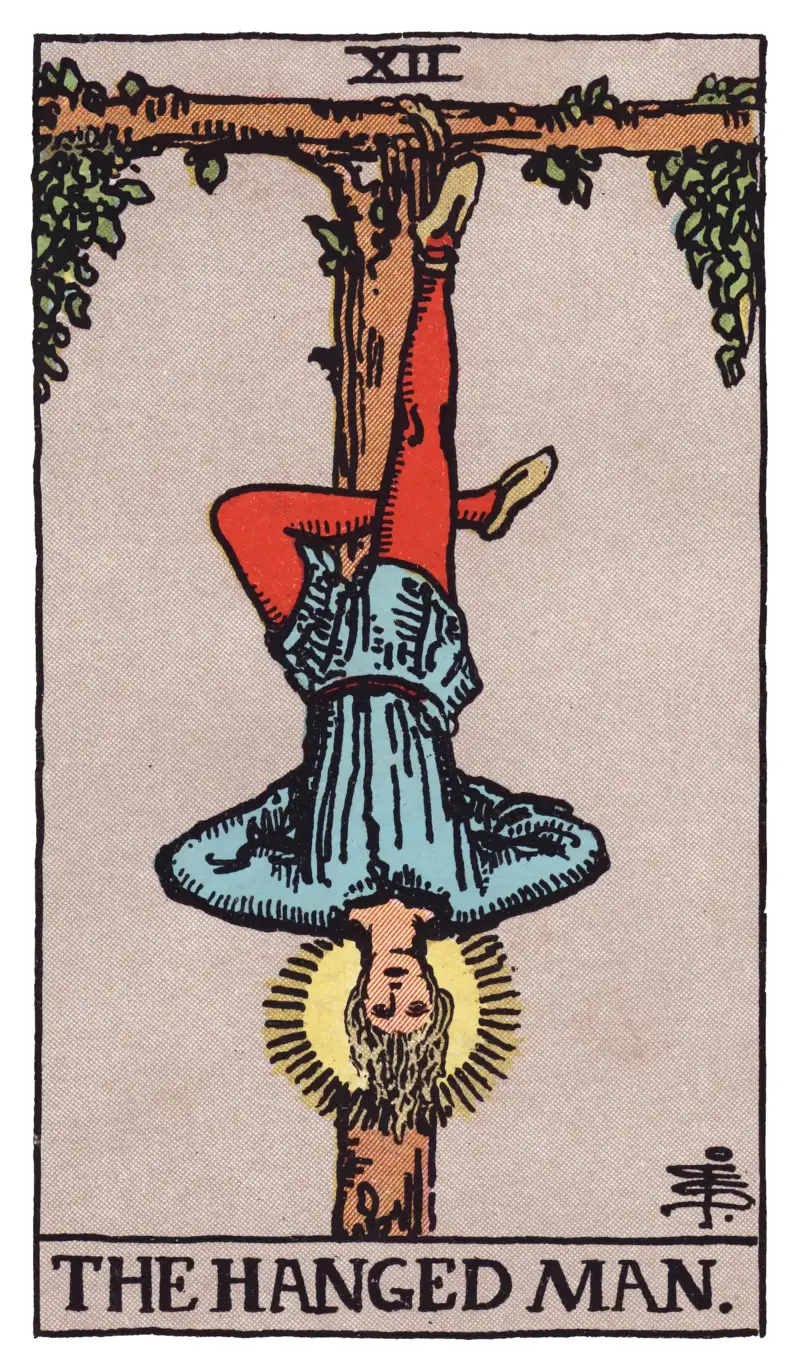
The Hanged Man of the Rider-Waite-Smith deck shows a calm figure suspended upside-down from a living tau cross by one foot, the other leg crossed behind, a halo of light around the head.
Upright vs reversed
| Upright | Reversed | |
|---|---|---|
| Keyword | SURRENDER | STALLING |
Upright meaning
In the Rider-Waite-Smith tradition, The Hanged Man is read as the card of willing pause — the suspension of forward motion in order to see from a different angle. Waite was careful to note that the figure is not in distress; the expression is composed, the halo bright. The card is the tradition's image of voluntary surrender, not of defeat. Practitioners often read this card as a sign that the question is calling for a change of view rather than a change of action — a willingness to hang in place long enough for what has been hidden to become visible.
The crossed leg and the halo are associated in modern RWS commentary with discipline turned inward: not passivity, but the active practice of staying present in a position one would normally rush to leave. The card resists the impulse to do something just to ease the discomfort of waiting. As an upright card, The Hanged Man is most often interpreted as the counsel to let go of control over the immediate, and to let understanding catch up with circumstance.
Reversed meaning
Reversed, The Hanged Man is traditionally read as suspension that has soured: surrender that is not voluntary, sacrifice without meaning, or — at the other extreme — a refusal to pause when the situation plainly asks for it. Waite associated the reversal with selfishness and missed lessons; many modern practitioners read it as a prompt to examine whether the reader is enduring without insight, or rushing past the very pause the question needs.
In a reading
In a situation position, The Hanged Man is often read as naming a moment in which forward motion is genuinely impossible or unwise. In an action position, it is interpreted as a call to release the urge to act and let the question settle. In an outcome position, the card is commonly read as a perspective shift — a different way of seeing rather than a different fact.
In combination
The Hanged Man and The High Priestess together form one of the most interior and patient combinations in the Major Arcana — both associated with receptivity, with the willingness not to know yet. The Hanged Man with Death names a natural sequence that many RWS practitioners recognize: the suspension that precedes a fundamental transformation, the pause that is the threshold of an ending. When The Hanged Man appears with The Chariot, the tradition reads a sharp contrast: directed force in tension with surrender — the question of whether what is needed is to press forward or to stop entirely.
Frequently asked questions
- What does The Hanged Man mean in a love reading?
- In a love reading, The Hanged Man is most often read as a period of suspension — a relationship that is on hold, or a phase in which the reader is called to wait rather than act. The tradition does not read this waiting as failure; it reads it as the card of the view that becomes available only when one stops trying to control the outcome. Some practitioners read the card as a period in which the relationship reveals something the reader could not have seen while still trying to direct it.
- What does The Hanged Man mean in a career reading?
- In a career reading, The Hanged Man typically names a pause in forward motion — a period between roles, a project in limbo, or the deliberate choice to step back in order to reassess. The RWS tradition reads this as potentially generative rather than merely frustrating: the perspective available from the suspended position may be what is actually needed before the next action becomes clear.
- What does The Hanged Man reversed mean?
- Reversed, The Hanged Man is traditionally read as the refusal or inability to surrender to the pause that is needed — continued striving in a situation where striving is not what serves, or a period of limbo that has become stagnation rather than reflection. Modern practitioners sometimes read the reversal as the end of the necessary pause: the card upright signals time to stop and see; reversed, when the pause has served its purpose and movement is again possible.
These notes follow the Rider-Waite-Smith tradition. They describe what the card is associated with — not predictions about your life.