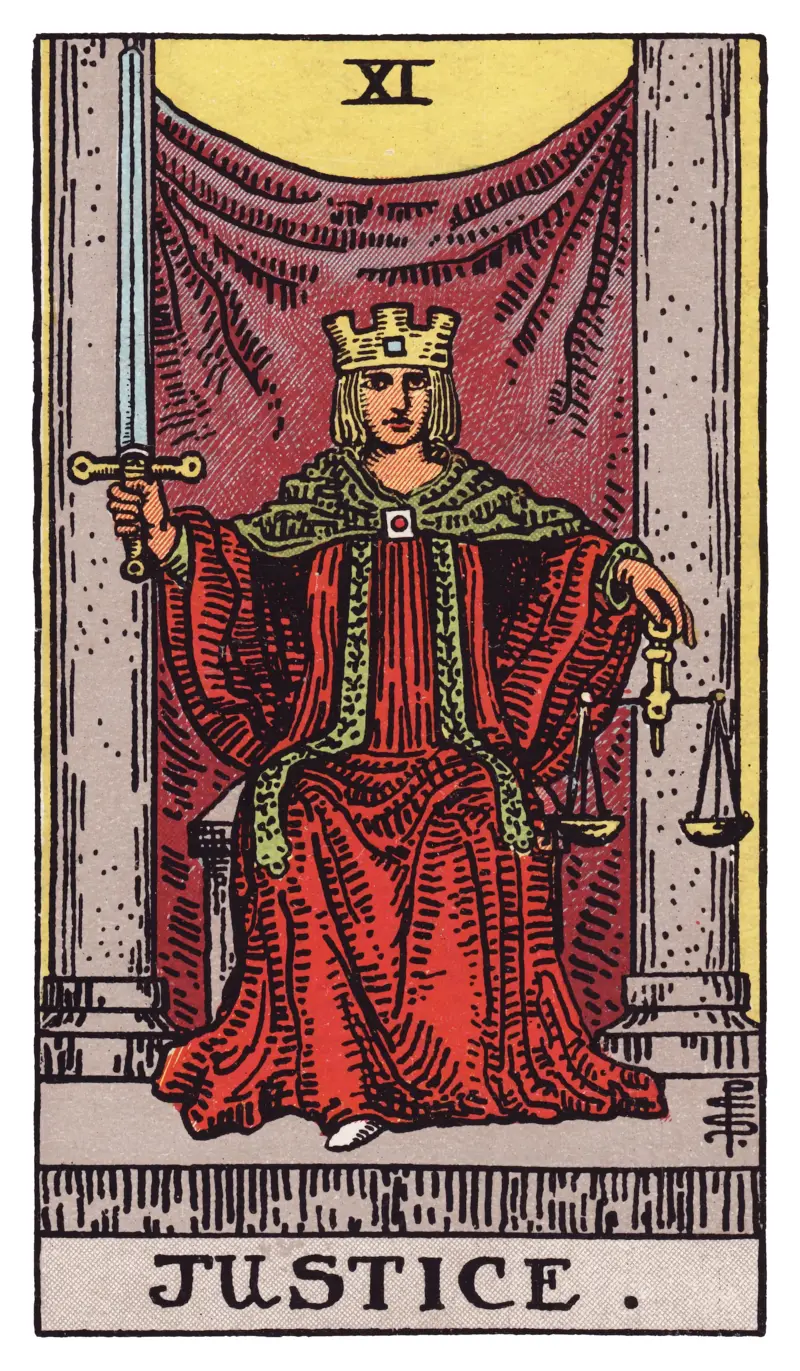
What the card shows
Justice in the Rider-Waite-Smith deck shows a crowned figure seated between two pillars, holding an upright sword in one hand and a balanced scale in the other.
Upright vs reversed
| Upright | Reversed | |
|---|---|---|
| Keyword | BALANCE | UNFAIRNESS |
Upright meaning
In the Rider-Waite-Smith tradition, Justice is read as the card of consequence and clarity: the recognition that actions have weight, that decisions create commitments, and that the truth of a situation is what it is, regardless of how one wishes it were. Waite emphasized that the card depicts the principle of justice in itself, separate from any particular court or law. Practitioners often read this card as a sign that the question turns on alignment between what has been done and what is now due, in either direction.
The sword and scale are associated in modern RWS commentary with discernment and proportion: the willingness to cut clean and to weigh fairly, including against one's own preferences. The Golden Dawn correspondence to Libra grounds the card in the symbolism of balance and considered judgment. As an upright card, Justice is most often interpreted as a call to face facts plainly and to take responsibility for them — including the responsibility of asking for what one is owed.
Reversed meaning
Reversed, Justice is traditionally read as imbalance or distortion: facts ignored, accountability dodged, scales tipped by self-interest, or — at the other extreme — punishment that exceeds what the situation calls for. Waite associated the reversal with bias and false judgment; many modern practitioners read it as a prompt to examine where the reader's reading of the situation is being shaped by what they want to be true rather than by what is.
In a reading
In a situation position, Justice is often read as naming a context shaped by the consequences of prior decisions. In an action position, it is interpreted as a call to act fairly, plainly, and in proportion. In an outcome position, the card is commonly read as a clear-eyed result — what is owed, given, and acknowledged on both sides.
In combination
Justice and The High Priestess together are read as two different modes of knowing: Justice through explicit, weighable evidence, and The High Priestess through the signal that cannot yet be cited. The combination often raises the question of which mode of assessment is actually available in the current situation. Justice with The Judgment card names a moment of comprehensive reckoning — the individual account meeting the larger evaluation. When Justice appears with The Wheel of Fortune, the tradition tends to read the pairing as the mechanism of consequence within cycles — what turns, and what is exact about the turning.
Frequently asked questions
- What does Justice mean in a love reading?
- In a love reading, Justice is most often read as the card of honest accounting within a relationship — the moment when what has actually been given and received becomes visible, and when that assessment shapes what comes next. The tradition does not read Justice as a punishing card in love; it reads it as the card of relationship clarity. For some, it names a legal matter — a formal separation or commitment. For others, it names the internal reckoning that precedes any significant relational decision.
- What does Justice mean in a career reading?
- In a career reading, Justice most often names a situation in which consequences are proportional: effort is rewarded, breach has its cost. It is read as a confirmation that the current professional situation is not arbitrary — what is present reflects what has been done. The card can also appear when a legal or contractual matter is at play, or when a formal evaluation or decision is pending.
- What does Justice reversed mean?
- Reversed, Justice is traditionally read as the scales off — a situation in which the consequences being experienced do not match what the reader has actually done, or in which an honest assessment is being avoided. Modern practitioners sometimes read the reversal as a prompt to examine where the reader has been accepting an unfair accounting of their own worth or conduct, or where they have declined to reckon honestly with the full picture.
These notes follow the Rider-Waite-Smith tradition. They describe what the card is associated with — not predictions about your life.