What the card shows
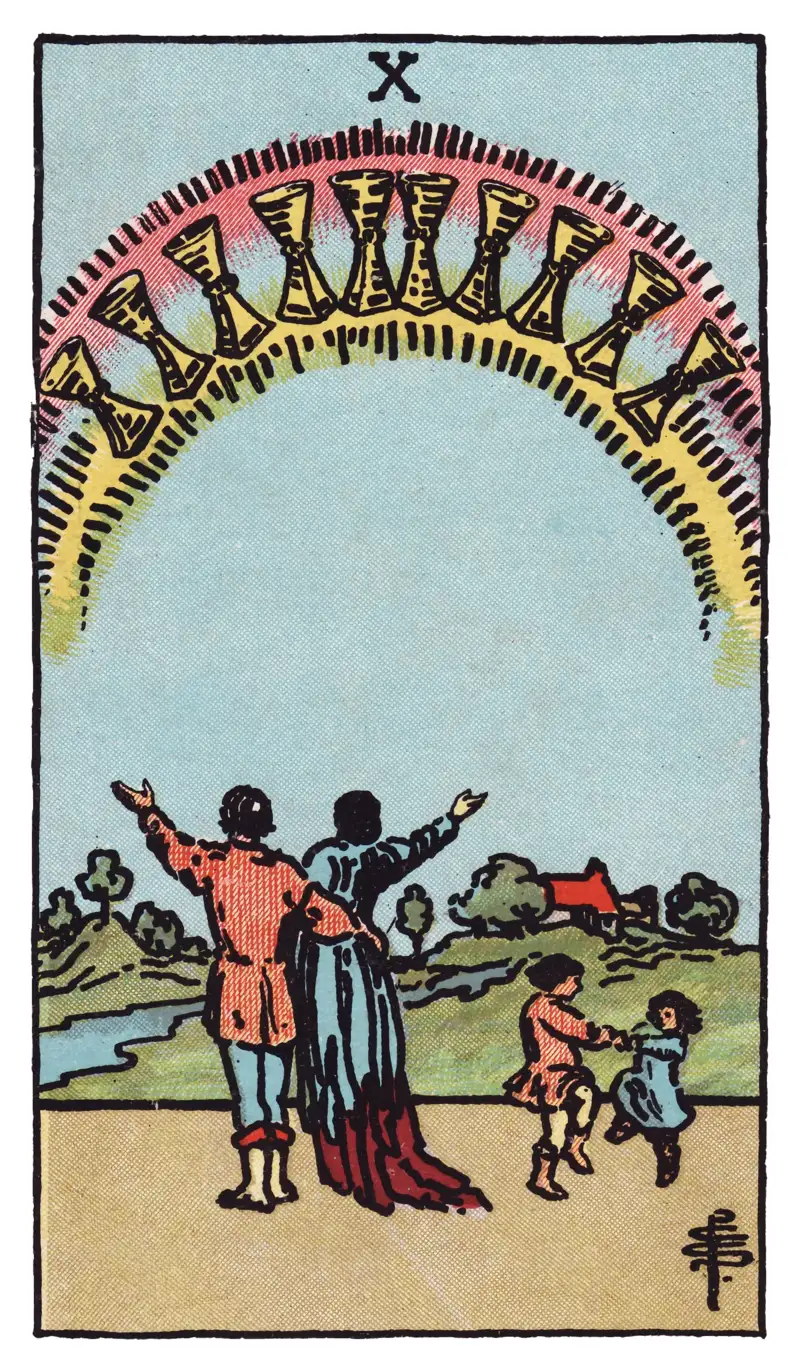
A couple stands side by side with arms raised in a gesture of joy and gratitude beneath a rainbow arc of ten cups; two children play nearby on the grass, and behind the group a house sits peacefully in a green pastoral landscape, completing a scene of familial abundance and emotional fulfillment.
Upright vs reversed
| Upright | Reversed | |
|---|---|---|
| Keyword | HARMONY | DISCORD |
Upright meaning
In the Rider-Waite-Smith tradition, the Ten of Cups is read as the card of emotional completion — the fullest possible realization of what the suit of Cups has been building toward from the Ace. Where the Ace offered the potential of emotional life, the Ten shows that potential realized: a family together, a home rooted in a living landscape, joy expressed in the body through raised arms and dancing children, and above it all a rainbow of cups that carries the sense of something blessed and whole. Waite described this card in terms of contentment and perfection — strong words, and rare in his commentary — suggesting that the Ten of Cups represents the emotional life arriving at its natural destination. The rainbow in particular has attracted sustained attention: it marks the covenant, the end of the storm, the appearing of color after difficulty.
Contemporary RWS readers note that the Ten of Cups is distinctive in the suit because its joy is not private. The Nine of Cups shows a solitary man before his arranged cups; the Ten shows a couple, children, a home, a community implied by the landscape. What is being celebrated here is not individual satisfaction but shared flourishing — the emotional life embedded in relationship, in family, in belonging to a place. Many practitioners read this card as the arrival at lasting happiness rather than momentary pleasure, a condition rather than an event. It appears when emotional foundations are genuinely secure and the structures of belonging are intact.
Reversed meaning
Reversed, the Ten of Cups in the RWS tradition points to fracture within the picture of family or community harmony — an alignment that appears whole from the outside but contains unspoken tension, unmet needs, or values that have diverged beneath the surface. Some practitioners read this as the discovery that the happy family or fulfilled life is a performance rather than a reality, the image maintained at the cost of genuine connection. Others describe it as a temporary disruption to a relationship or community that is otherwise sound — a conflict that must be moved through rather than denied. The reversal does not negate the card's fundamental promise but marks the work that remains.
In a reading
In the situation position, the Ten of Cups identifies deep emotional fulfillment, family, or a sense of true belonging as the ground of the present moment — the foundations are secure and the emotional life is, by most measures, whole. In the action position, it counsels honoring and tending to the relationships and communities that provide this sense of home. In the outcome position, the Ten of Cups is among the most affirming cards in the deck: it points toward lasting happiness and emotional completion as the likely resolution.
In combination
The Ten of Cups beside The World is read in the RWS tradition as completion in two registers — emotional fulfillment joined to the closing of a whole life cycle, arrival in both the heart and the story. Paired with The Lovers, the combination often traces the arc from choice to consequence: the commitment once made now visible as home, family, and shared ground. With the Two of Cups, practitioners read the suit's own trajectory made explicit — the original meeting of two people and the fullness it was always reaching toward, held in a single spread.
Frequently asked questions
- What does the Ten of Cups mean in a love reading?
- In a love reading, the Ten of Cups is among the most affirming cards the suit can offer: it names love embedded in a life — partnership matured into home, family, and belonging. For someone in a relationship, it often confirms that the foundations are genuinely sound and worth tending. For someone single, it tends to name the destination the heart is actually oriented toward, clarifying what the search is for. Reversed, it asks whether the harmony shown outward matches what is lived inside.
- What does the Ten of Cups mean in a career reading?
- In a career reading, the Ten of Cups usually points to work in right relation with life — a role that supports rather than consumes the sense of home, or a working community with genuine emotional bonds. Practitioners often read it as a card that reframes the question: the measure being invoked is not advancement but whether the whole arrangement lets the emotional life flourish. It can also mark family considerations as decisive in a professional choice.
- What does the Ten of Cups reversed mean in a reading?
- The Ten of Cups reversed is traditionally read as fracture inside the picture of harmony — a family or community that appears whole from the outside while carrying unspoken tension, unmet needs, or quietly diverging values. Some practitioners read it as the image maintained at the cost of genuine connection; others as a temporary conflict within a fundamentally sound bond. The reversal does not cancel the card's promise — it marks the honest work remaining before the picture and the reality match.
These notes follow the Rider-Waite-Smith tradition. They describe what the card is associated with — not predictions about your life.