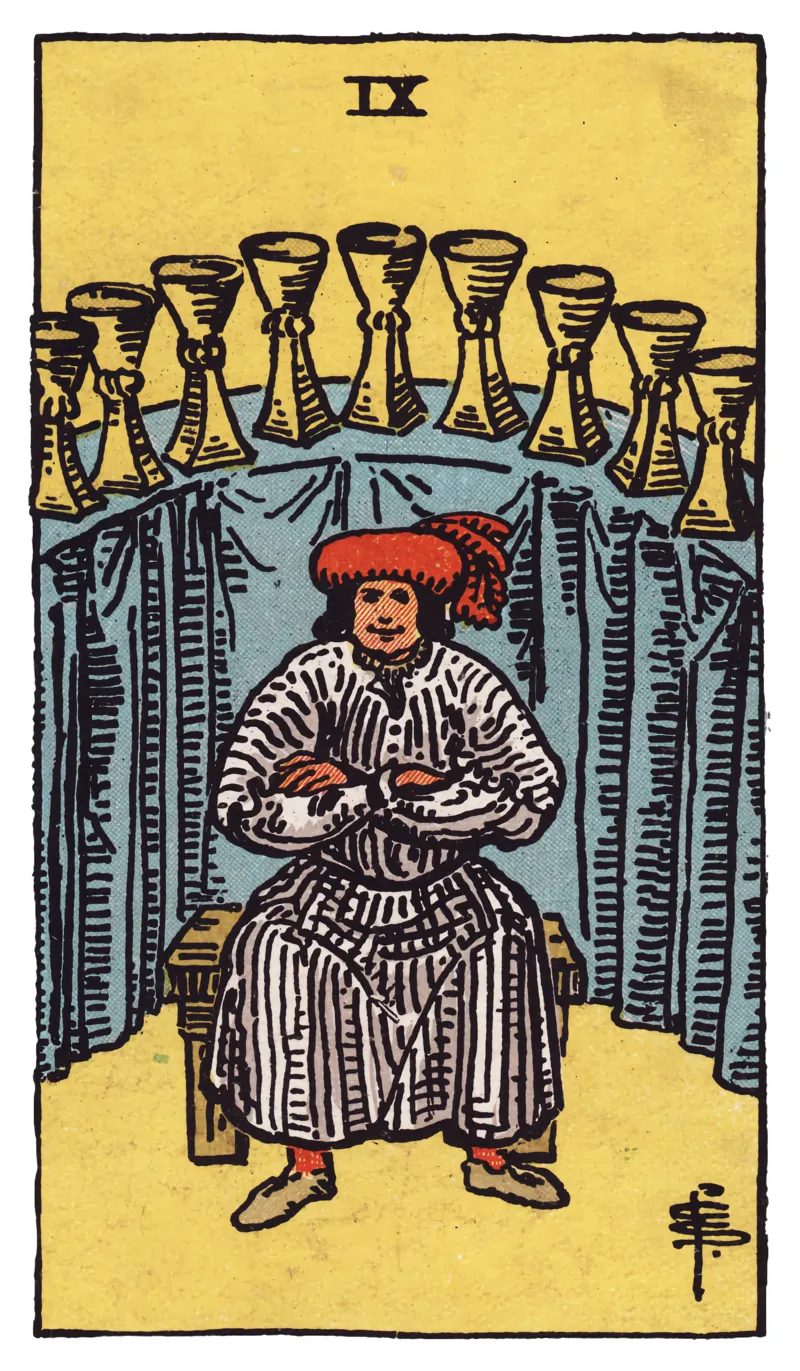
What the card shows
A prosperous, well-fed man sits on a wooden bench with his arms folded and an expression of evident self-satisfaction; behind him, a curved shelf draped in blue cloth displays nine cups in a neat arc, arranged like trophies in a display, and the figure surveys the scene with unmistakable pleasure.
Upright vs reversed
| Upright | Reversed | |
|---|---|---|
| Keyword | CONTENTMENT | DISSATISFACTION |
Upright meaning
In the Rider-Waite-Smith tradition, the Nine of Cups is widely known as the 'wish card' — a designation that points to its reputation as the card of desires fulfilled, of contentment achieved, of emotional life that has arrived at a state of genuine satisfaction. The nine cups arranged behind the central figure like a display of accomplishments carry the sense of things gathered and secured. Waite was notably restrained in his description of this card, noting simply that it represents material and social success, and that his 'contentment' was a quality of the outer as much as the inner life. The figure's crossed arms and self-satisfied expression have attracted considerable commentary: some readers find in them a warmth of genuine pleasure; others have noted a quality of complacency.
Contemporary RWS readers approach the Nine of Cups with considerable nuance. The card appears when material circumstances are genuinely good, when a creative project has reached completion, when emotional life is stable and pleasurable. Many practitioners read it as an invitation to receive satisfaction fully rather than minimizing it — to let good things be good without immediately anticipating their loss. At the same time, the tradition notes that the figure is alone: the nine cups are not being shared, and the pleasure here is fundamentally personal. The card marks a genuine peak while leaving open the question of what comes next.
Reversed meaning
Reversed, the Nine of Cups in the RWS tradition introduces a questioning of the satisfaction the upright position celebrates. Some practitioners read this as smug complacency: the figure has arranged the cups to be seen, and the pleasure being taken is more in the appearance of contentment than in the thing itself. Others describe the reversal as a moment when the wish has been granted but the person discovers it was not quite what they wanted — the arrival at the desired destination that turns out to be slightly wrong. The reversal also surfaces questions of overindulgence, of appetite that has become compulsive rather than pleasurable.
In a reading
In the situation position, the Nine of Cups identifies contentment, achievement, or fulfilled desire as the current context — things are, by measurable standards, good. In the action position, the card counsels receiving what is good with genuine openness rather than deflecting satisfaction. In the outcome position, it points toward a resolution in which the desired outcome is achieved and the emotional life comes to rest in a place of genuine, if quiet, pleasure.
In combination
The Nine of Cups beside The Devil is read in the RWS tradition as pleasure crossing into bondage — enjoyment hardening into appetite, the cups no longer savored but needed. Paired with the Ten of Cups, the combination contrasts the suit's two summits: private satisfaction beside shared flourishing, and the question of whether the wish fulfilled opens outward or stays arranged on its shelf. With The Sun, practitioners often read contentment at its cleanest — joy that needs no display, warmth that is what it appears to be.
Frequently asked questions
- What does the Nine of Cups mean in a love reading?
- In a love reading, the Nine of Cups names emotional life that has arrived at genuine satisfaction — a relationship that is, by honest measure, good, or a personal contentment that no longer depends on being chosen. For someone single, it often describes wholeness before partnership: the wish fulfilled may be one's own company. The tradition also notes the figure sits alone before his cups — in a love context, the card can ask whether satisfaction is being shared or displayed. Reversed, it asks whether the granted wish was the right one.
- What does the Nine of Cups mean in a career reading?
- In a career reading, the Nine of Cups marks achievement that can be honestly enjoyed — a project completed, recognition earned, material circumstances genuinely good. Practitioners often read it as counsel to receive the accomplishment fully rather than deflecting it or immediately raising the bar. The card's shadow question travels with it: whether the pleasure is in the work itself or in the display of its trophies — the arranged cups admired more than used.
- What does the Nine of Cups reversed mean in a reading?
- The Nine of Cups reversed is traditionally read as satisfaction under question — complacency wearing the face of contentment, pleasure taken in the appearance of fulfillment more than in the thing itself, or the wish granted that turns out to be subtly wrong. Some practitioners read overindulgence: appetite that has become compulsive rather than pleasurable. The reversal invites an honest audit of the cups on the shelf — which ones actually hold something, and which are arranged to be seen.
These notes follow the Rider-Waite-Smith tradition. They describe what the card is associated with — not predictions about your life.