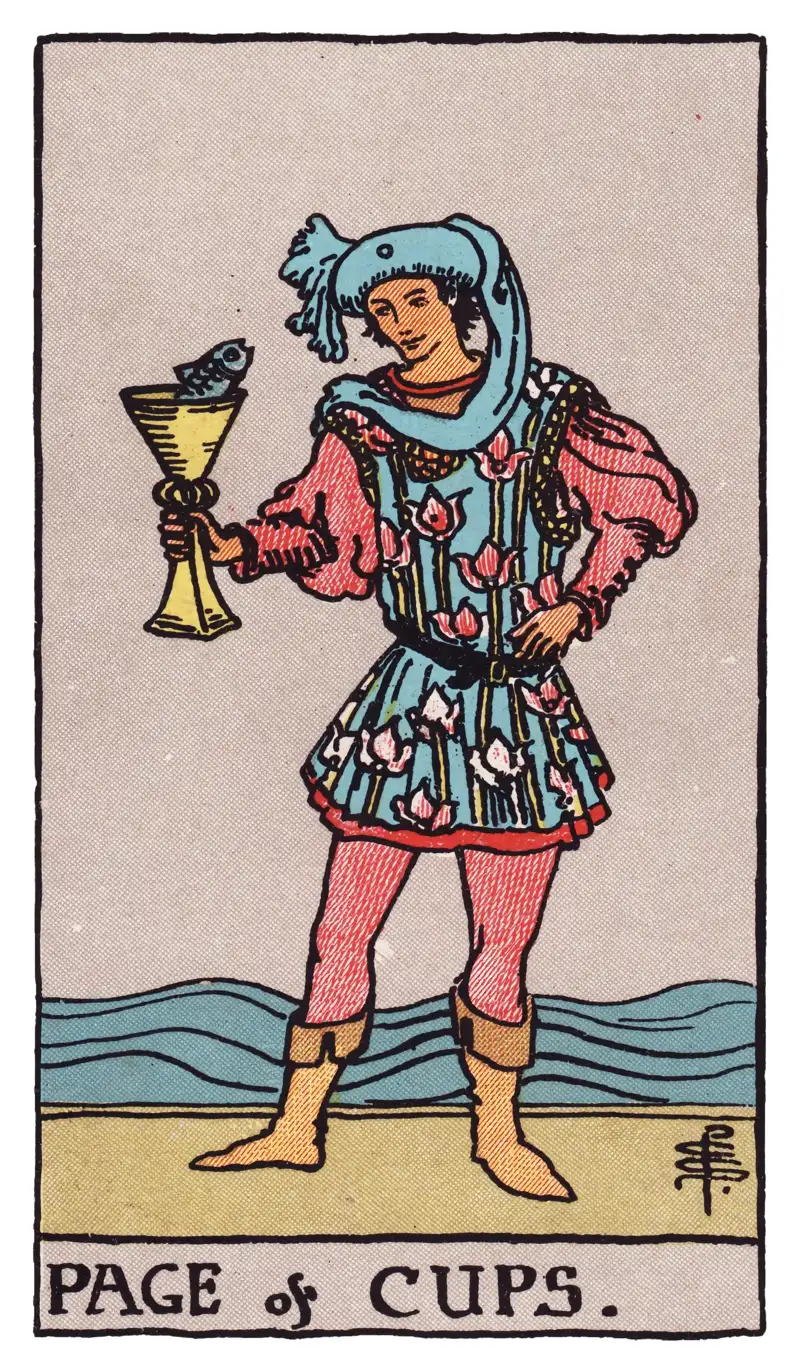
What the card shows
A dreamy youth dressed in a floral tunic and beret stands at the edge of the sea, holding up a cup from which a small fish peers out directly at the figure; the youth regards the fish with an expression of curious surprise, as though the encounter were unexpected, which it plainly is.
Upright vs reversed
| Upright | Reversed | |
|---|---|---|
| Keyword | CURIOSITY | MOODINESS |
Upright meaning
In the Rider-Waite-Smith tradition, the Page of Cups is read as the messenger of the emotional realm — a figure who receives communications from the inner life with openness and wonder rather than resistance. The fish peering from the cup is one of the more unusual images in the court cards: it represents something emerging from the unconscious, from the deep water of the suit, and surfacing in a form that can be perceived. The Page does not dismiss the fish or put the cup down; he looks at it with genuine curiosity, which the tradition reads as the defining quality of this figure. Waite's interpreters have described the Page of Cups as representing the beginning of emotional intelligence — the capacity to be surprised by one's own inner life and to receive that surprise as information rather than disturbance.
Contemporary RWS readers encounter this card in contexts of creative inspiration, of intuitive messages that arrive from unexpected directions, of emotional sensitivity in its most receptive and undefended form. The Page appears when someone is beginning to develop their inner life — when dreams, intuitions, and emotional responses are being taken seriously for the first time, or when a creative project is in its earliest, most tender stages. The figure's youth in the tradition does not imply inexperience to be overcome but a quality of freshness to be honored: the capacity to be genuinely moved, to encounter the world of feeling without having learned to manage it away.
Reversed meaning
Reversed, the Page of Cups in the RWS tradition points to emotional immaturity that has become problematic — a sensitivity that has not learned to discern between genuine intuition and wishful thinking, a creative openness that has become emotionally manipulative or self-dramatizing. Some practitioners read this reversal as the figure who receives the fish from the cup and either ignores it or makes a performance of the encounter rather than simply being present to it. Others describe it as a message that has been misread, an intuition that has been confused with desire. The reversal asks where receptivity has slipped into credulity.
In a reading
In the situation position, the Page of Cups identifies a quality of emotional openness and creative receptivity as the dominant feature of the present moment — something is arriving from the inner life and deserves careful, curious attention. In the action position, the card counsels meeting what arises from the imagination or the emotions with genuine curiosity rather than judgment or skepticism. In the outcome position, it suggests that what comes will be delivered through the unexpected — through intuition, dream, or an inner knowing that bypasses the logical mind.
In combination
The Page of Cups beside The Moon is read in the RWS tradition as the intuitive message under uncertain light — something genuine is surfacing, and discernment must accompany the wonder. Paired with the Ace of Cups, the combination often names the opening and its messenger together: a new emotional chapter announced in a form that can be perceived. With The High Priestess, practitioners read the deepening of the same current — the Page's fresh curiosity about the inner life maturing toward stillness and trained inner knowing.
Frequently asked questions
- What does the Page of Cups mean in a love reading?
- In a love reading, the Page of Cups often names the first stirrings of feeling — an attraction still tender, a message or gesture arriving unexpectedly, or the return of the capacity to be genuinely moved. For someone single, it can mark an admirer or an invitation that deserves curiosity rather than immediate judgment. For someone in a relationship, it often points to a renewal of playfulness and emotional openness. Reversed, it asks whether sensitivity has slipped into moodiness or wishful reading of signals.
- What does the Page of Cups mean in a career reading?
- In a career reading, the Page of Cups usually names creative beginnings — a project in its earliest, most tender stage, an intuitive nudge about a direction, or news arriving from an unexpected quarter. Practitioners often read it as counsel to take imaginative impulses seriously before they can justify themselves: the fish in the cup is information, not decoration. It can also describe a younger colleague or a beginner's sensibility whose freshness the situation needs.
- What does the Page of Cups reversed mean in a reading?
- The Page of Cups reversed is traditionally read as emotional immaturity in motion — sensitivity that has not learned to distinguish genuine intuition from wishful thinking, receptivity slipped into credulity, or feeling turned into performance. Some practitioners read a message misread: an intuition confused with a desire. The reversal does not dismiss the inner life; it asks for discernment about which of its messages are information and which are wishes wearing information's clothes.
These notes follow the Rider-Waite-Smith tradition. They describe what the card is associated with — not predictions about your life.