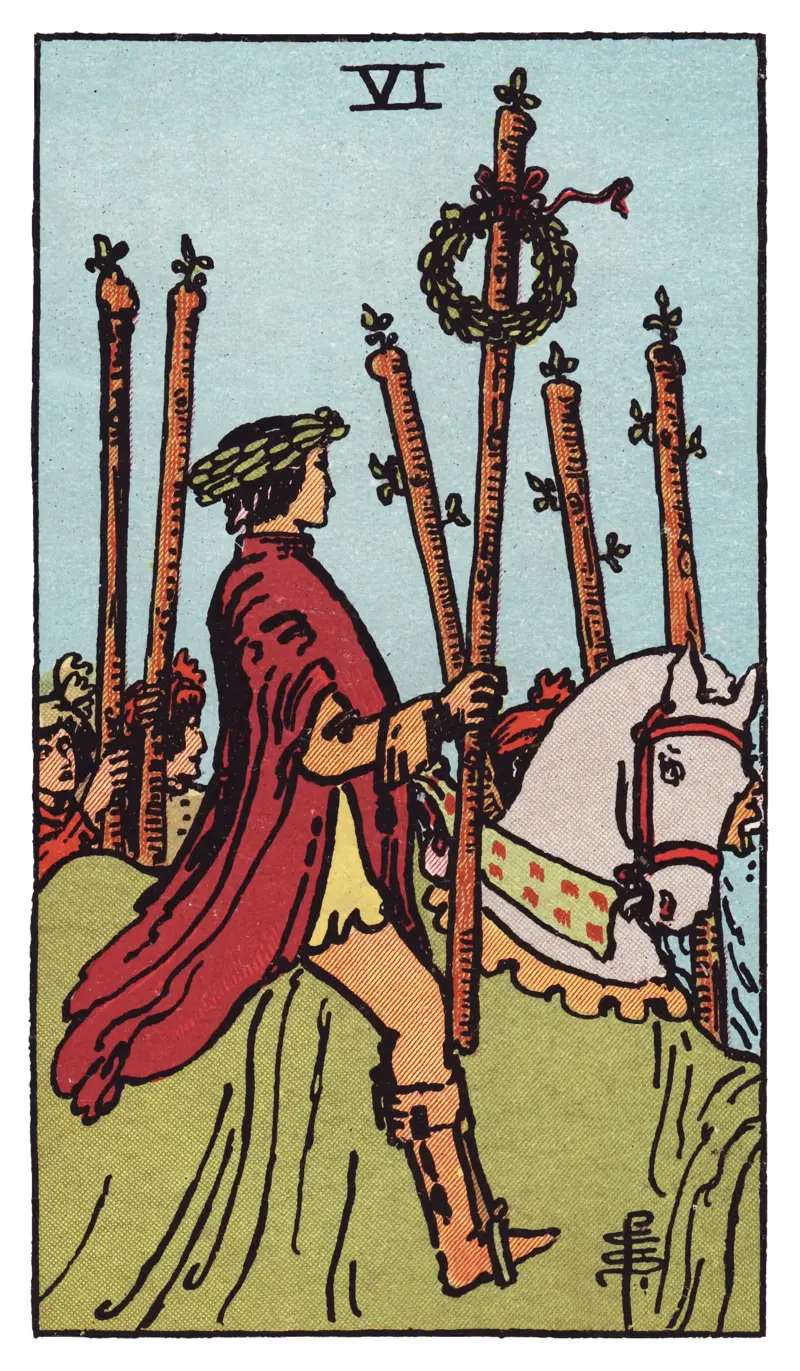
What the card shows
A crowned rider advances on a white horse, wearing a victory wreath and holding a wand crowned with a laurel; figures on foot march alongside, their wands raised upright in escort.
Upright vs reversed
| Upright | Reversed | |
|---|---|---|
| Keyword | VICTORY | SETBACK |
Upright meaning
In the Rider-Waite-Smith tradition, the Six of Wands is read as the card of public triumph — the contest of the Five has produced a winner, and the community is acknowledging it. The details of the image are deliberate: both the rider and the wand are crowned with laurel, doubling the signal of victory; the white horse elevates the figure above the crowd without separating them entirely; the attendants are not defeated but are actively participating in the procession. Waite described this card as one of great news, of advancement and good tidings, and practitioners read the public dimension as essential — this is not a private satisfaction but a recognized achievement. The Six of Wands marks the moment when inner confidence finds external confirmation.
In contemporary RWS practice, the Six of Wands tends to appear when recognition is arriving or is warranted — when a project has succeeded publicly, a reputation has been established, or leadership has been accepted by the group. The tradition reads it as a favorable card for anything that requires an audience: a creative release, a professional milestone, a campaign. Practitioners note, however, that the card carries a subtle test: the rider who receives recognition must be able to hold it without becoming dependent on it. The laurel is real, but the procession will eventually reach its destination, and then the querent must know what they are without the crowd.
Reversed meaning
Reversed, the Six of Wands in the RWS tradition points to recognition delayed, withheld, or arrived in diminished form. The triumph that was expected has not materialized publicly, or the confirmation has come with conditions attached. In some lineages, the reversed Six is read as a warning about vanity: the pursuit of recognition for its own sake rather than as a byproduct of genuine achievement. Practitioners also read it as a fall from a visible position — not catastrophic, but a shift from public elevation to a more ordinary footing.
In a reading
In the situation position, the Six of Wands describes a moment of public recognition or visible momentum — something that the querent has worked toward is receiving external acknowledgment. In the action position, the card counsels stepping into recognition with confidence rather than deflecting it; the tradition reads false modesty here as its own kind of avoidance. In the outcome position, the Six of Wands points toward a visible success — one that will be witnessed by others, not only felt internally.
These notes follow the Rider-Waite-Smith tradition. They describe what the card is associated with — not predictions about your life.