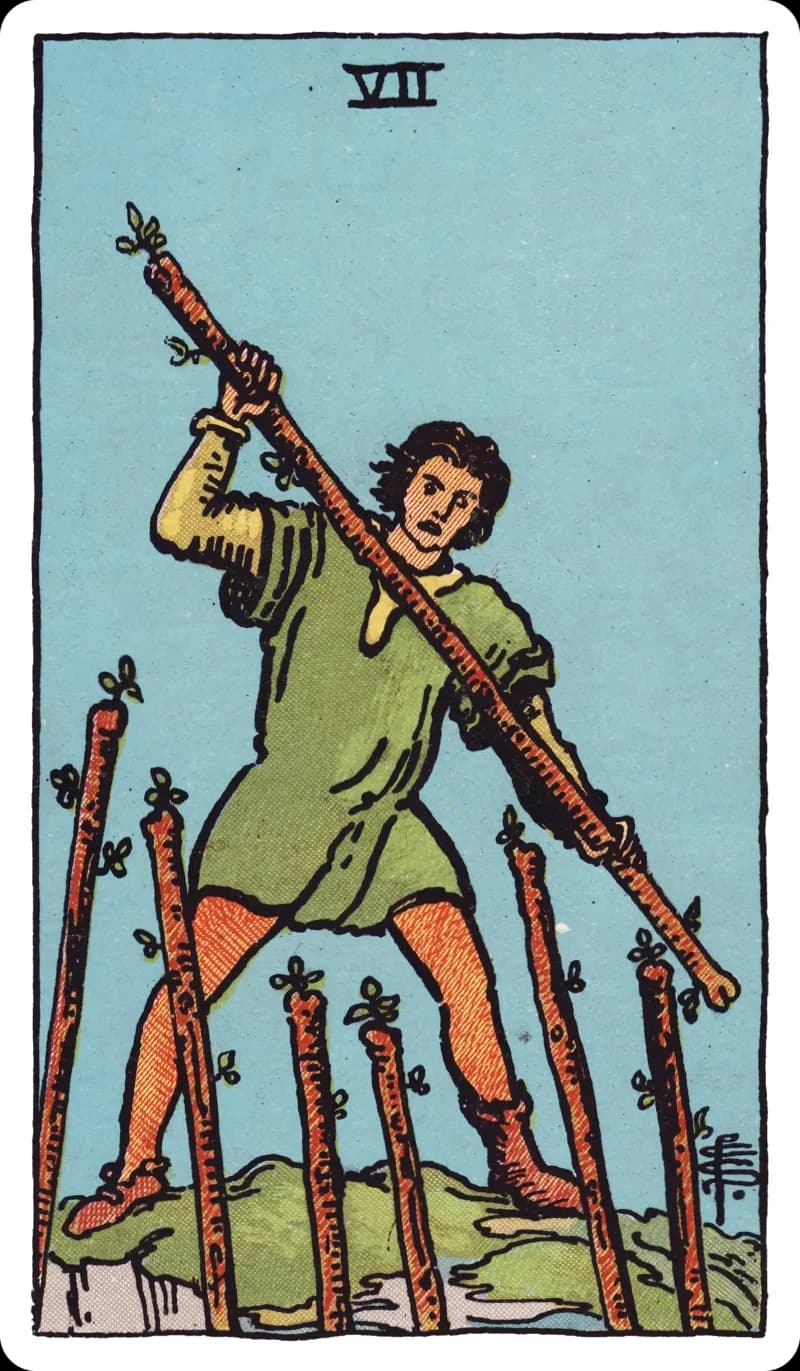
What the card shows
A figure stands on a raised height, gripping a wand with both hands to defend against six wands being thrust upward from unseen challengers below; the posture is active, slightly off-balance but holding.
Upright vs reversed
| Upright | Reversed | |
|---|---|---|
| Keyword | DEFENSE | OVERWHELM |
Upright meaning
In the Rider-Waite-Smith tradition, the Seven of Wands is read as the card of the defended position — the six wands of challenge have arrived from below, and the figure on the height must hold the ground. The elevation is significant: this is not a position of equal combat but of someone who has reached a height and is now being pressed to justify it. Waite read this card as one of valor and success, specifically the success that comes from pressing on under pressure rather than retreating. The slight imbalance in the figure's stance — they appear to be wearing mismatched footwear in many readings of the image — is often noted by practitioners as a sign that the defense is real, not comfortable, not guaranteed.
In contemporary RWS practice, the Seven of Wands frequently appears when a querent has achieved something visible and is now experiencing the scrutiny, competition, or opposition that achievement tends to attract. It is a card of maintenance under pressure: the conviction that the position is worth holding. Practitioners read this card as a call to persistence, but a specific kind — not the persistence of someone who has never been challenged, but of someone who has felt the pressure and is choosing to stand anyway. The tradition asks: what is being defended, and is it genuinely worth the effort?
Reversed meaning
Reversed, the Seven of Wands in the RWS tradition points to a position that is being abandoned under pressure — not always without reason, but with the risk that what is being surrendered had real value. This may manifest as caving to criticism too quickly, retreating from a creative or professional stance before giving it adequate defense, or exhaustion that has eroded the will to maintain what was earned. In some readings, the reversed Seven signals an overcorrection: defending a position so rigidly that flexibility, which might have preserved it, is lost.
In a reading
In the situation position, the Seven of Wands identifies a moment of active defense — the querent holds a position that is being challenged, and the challenge is real enough to require a deliberate response. In the action position, the card counsels holding the ground with clarity about what is worth protecting; the tradition does not read it as stubbornness but as discerned persistence. In the outcome position, the Seven of Wands suggests that current conditions will require a sustained stand before resolution arrives.
These notes follow the Rider-Waite-Smith tradition. They describe what the card is associated with — not predictions about your life.