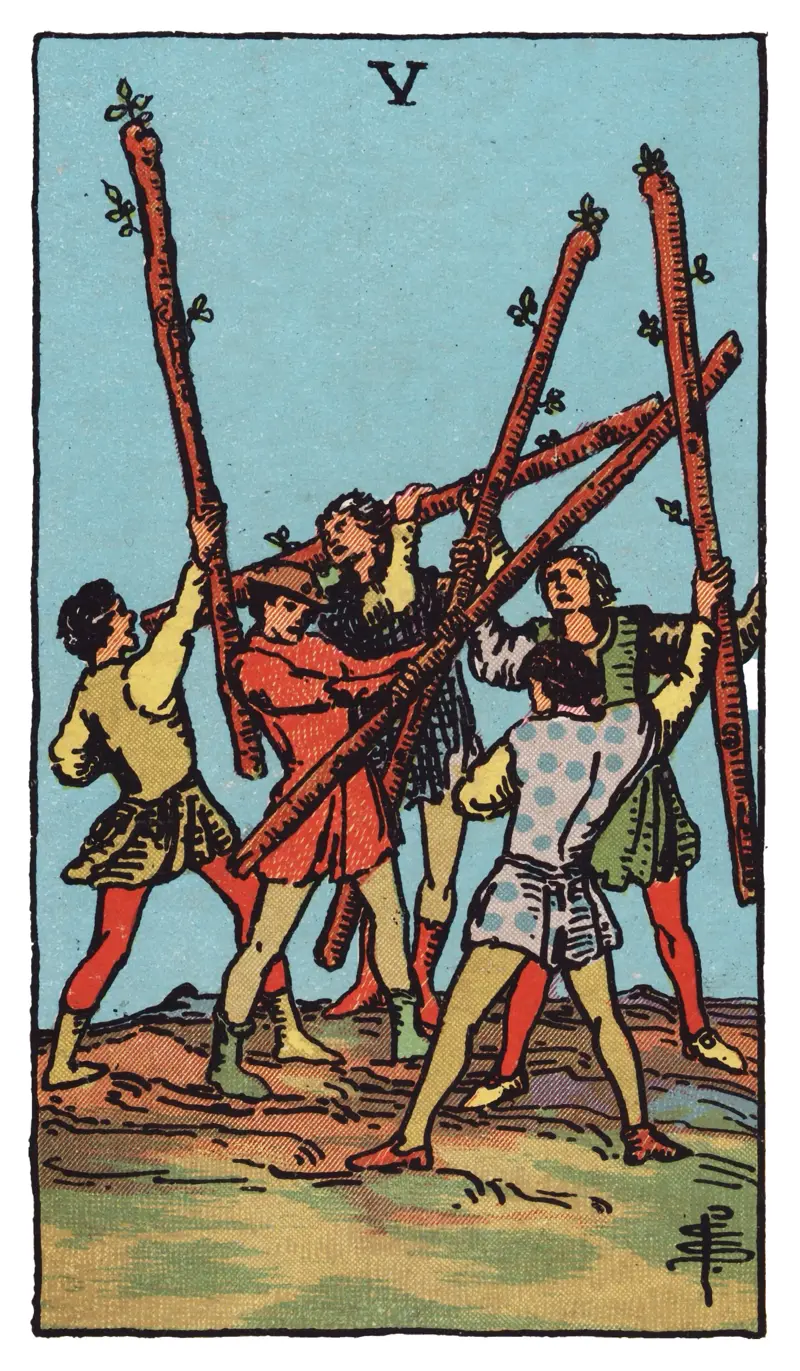
What the card shows
Five young figures, each gripping a long wand, clash in a chaotic melee on open ground; their staves cross in all directions, but no one is clearly striking or yielding.
Upright vs reversed
| Upright | Reversed | |
|---|---|---|
| Keyword | CONFLICT | RESOLUTION |
Upright meaning
In the Rider-Waite-Smith tradition, the Five of Wands is read as the card of competitive friction — the energy of the suit has multiplied into five distinct wills, and none of them is yet organized enough to prevail. Waite was careful about this card: he noted that it need not represent outright conflict, but rather a scrimmage, a contest, a test of strength that has a generative dimension. The figures are young, the blows are not landing cleanly, and the arrangement suggests a mock battle as much as a real one. Practitioners often read the Five of Wands as the moment when ambition meets opposition — not malicious opposition, but the natural resistance that arises when multiple energies are in competition for the same space, the same audience, or the same resources.
In contemporary RWS practice, the Five of Wands tends to appear around situations of active competition, group conflict, or the friction that accompanies any attempt to assert an individual vision within a crowded field. It is not a card of defeat — none of the figures is on the ground. But it is a card that requires the querent to examine whether the contest they are in is productive or merely exhausting. The tradition reads the Five of Wands as a prompt to understand the nature of the friction before deciding how to respond to it: sometimes competition sharpens the edge; sometimes it only depletes.
Reversed meaning
Reversed, the Five of Wands in the RWS tradition often points to conflict that has gone underground — disputes that are no longer being aired openly but are still active beneath the surface. There may be a retreat from necessary competition, an avoidance of the friction that would actually clarify the situation. In some lineages, the reversed Five is read as the end of an overt contest, which may signal resolution or simple exhaustion. Practitioners also read it as internalized conflict: the five figures all wearing the same face, the battle being waged within a single person.
In a reading
In the situation position, the Five of Wands identifies a field of active competition or friction — multiple energies are in play, and the querent is among them rather than above them. In the action position, the card asks whether engaging or disengaging from the contest is the more honest choice; the tradition does not assume that fighting is always the answer. In the outcome position, the Five of Wands suggests that current dynamics are heading toward a period of testing — one that may prove generative if approached with clear eyes.
These notes follow the Rider-Waite-Smith tradition. They describe what the card is associated with — not predictions about your life.