What the card shows
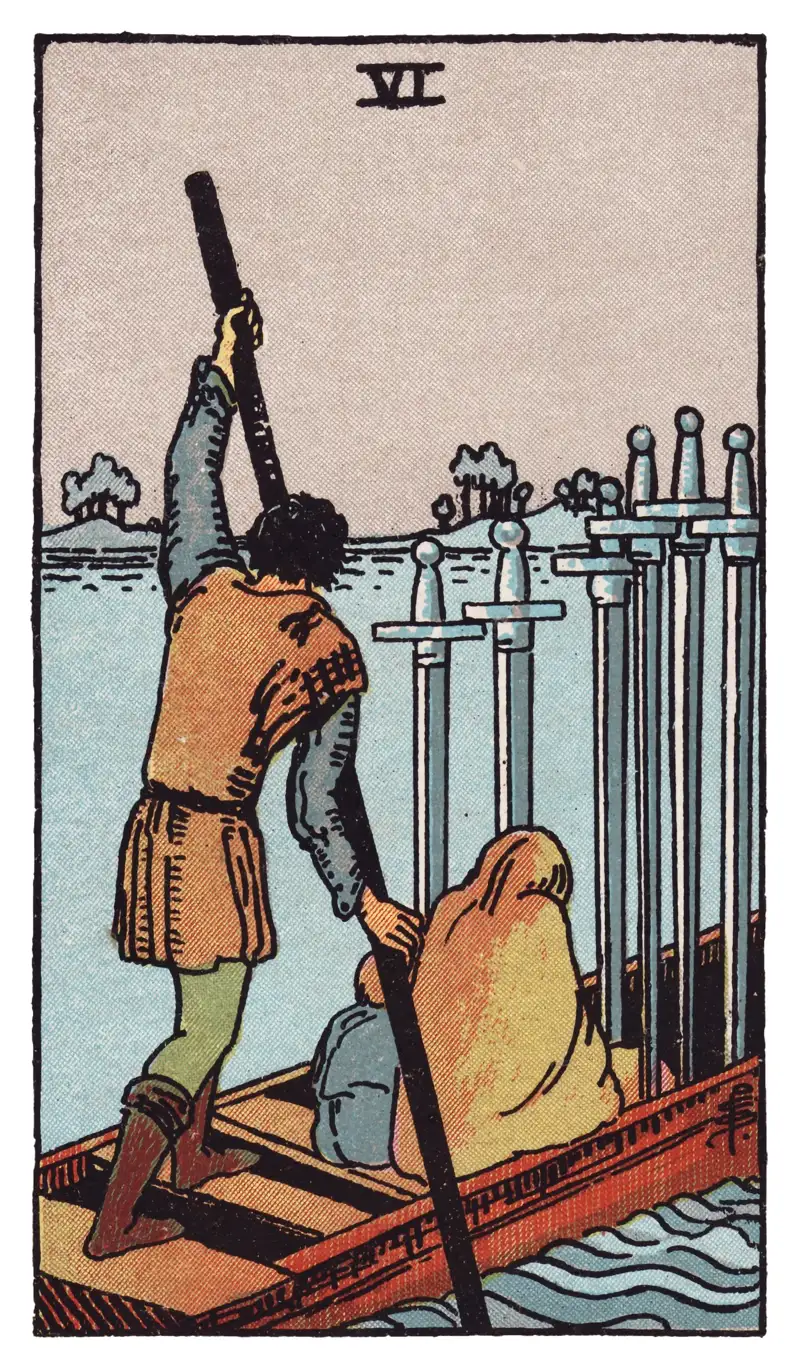
A ferryman poles a small boat carrying a hooded adult and a child across still water toward a distant shore; six swords stand upright in the bow, their points embedded in the hull, and the water on the near side is choppy while the far side is calm.
Upright vs reversed
| Upright | Reversed | |
|---|---|---|
| Keyword | PASSAGE | STUCK TRANSITION |
Upright meaning
In the Rider-Waite-Smith tradition, the Six of Swords is read as a passage — not a triumphant one, but a necessary and deliberate movement away from turbulence toward something more stable. The hooded figures do not face the viewer; they face where they are going, which practitioners read as a quality of the transition itself: there is no looking back at what is being left, and the journey is not undertaken lightly. The six swords in the bow are the mental burdens or unresolved matters carried into the crossing — the passage does not erase them, but it moves them to a place where they can settle. Waite connected this card to the idea of journey by water, and in RWS symbolism water is consistently associated with the emotional and unconscious realms. The ferry crossing, then, is also an emotional one: a movement from one interior landscape to another.
In contemporary RWS practice, the Six of Swords is read as transition out of difficulty — not escape, because the swords are still present in the boat, but passage. Practitioners often see it in readings where the querent has already made the decision to move on and is in the process of doing so, whether in a literal or metaphorical sense. The card does not promise that the far shore will be without problems; it promises that the immediate turbulence will ease. Some readers note the ferryman as a figure of help received: the transition is not made alone, and there may be a guide, a process, or a structure facilitating the crossing.
Reversed meaning
Reversed, the Six of Swords in the RWS tradition is read as a transition blocked or delayed — the boat cannot leave the shore, or it is moving back toward the troubled waters rather than away from them. The querent may feel unable to leave a difficult situation despite recognizing that departure is necessary. Some practitioners read the reversal as turbulence that follows the querent even after a move has been made: the difficult water on the near side of the crossing has not been left behind as hoped. Others read it as the need to return to something that was left unresolved — the passage cannot be completed until unfinished business is addressed.
In a reading
In the situation position, the Six of Swords describes a transition already underway — the querent is between where they were and where they are going, carrying the weight of the crossing with them. In the action position, the card counsels moving forward rather than resisting the passage; this is a moment to trust the direction, not reverse it. In the outcome position, the Six of Swords points toward calmer waters ahead — not resolution of everything, but relief from the immediate intensity.
In combination
The Six of Swords beside The Star is read in the RWS tradition as passage opening into recovery — the crossing that arrives, at last, at the deck's image of replenishment. Paired with the Ten of Swords, practitioners often read the sequence in order: an ending completed, and then the leaving it makes possible. When the Six of Swords appears with The Chariot, the contrast is instructive — two cards of movement, one willed and armored, one quiet and ferried, asking which kind of departure the situation calls for.
Frequently asked questions
- What does the Six of Swords mean in a love reading?
- In a love reading, the Six of Swords is traditionally read as a relationship in transition — a couple moving out of a turbulent chapter together, or one person crossing away from a connection that has ended. For someone in a relationship, it often names the quiet work of leaving a hard season behind without pretending it did not happen. For someone single, it can mark the passage out of an old grief toward readiness. The swords travel in the boat: what was learned comes along.
- What does the Six of Swords mean in a career reading?
- In a career reading, the Six of Swords usually names a professional transition already underway — a change of role, field, or working environment undertaken deliberately rather than in flight. Practitioners read the ferryman as significant here: help received, a process trusted, a structure that carries the change. The card does not promise the new shore is effortless; it indicates that the direction is right and the turbulence eases with distance.
- What does the Six of Swords reversed mean in a reading?
- The Six of Swords reversed is traditionally read as a crossing blocked or delayed — the departure recognized as necessary but not yet possible, or turbulence that follows even after the move is made. Some practitioners read it as unfinished business calling the boat back: something left unresolved that must be addressed before the passage completes. The reversal names the drag on the transition, not the failure of it.
These notes follow the Rider-Waite-Smith tradition. They describe what the card is associated with — not predictions about your life.