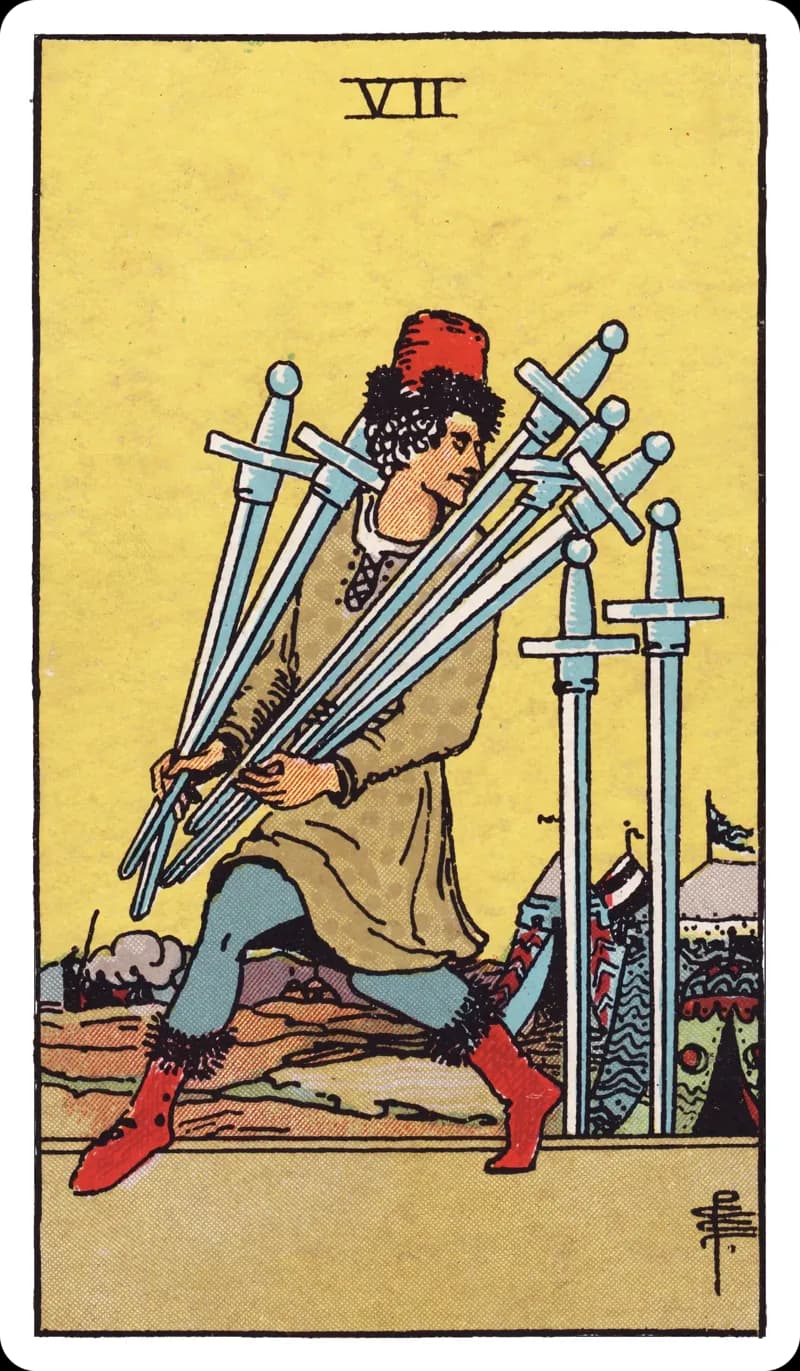
What the card shows
A figure tiptoes away from a military encampment carrying five swords, glancing back over one shoulder with an expression of sly confidence; two swords remain planted upright in the ground behind him, and the tents of the camp are visible in the background.
Upright vs reversed
| Upright | Reversed | |
|---|---|---|
| Keyword | STEALTH | CONFESSION |
Upright meaning
In the Rider-Waite-Smith tradition, the Seven of Swords is read as the card of strategic withdrawal, cunning, and the ethics of operating outside direct confrontation. The figure is not fleeing — the posture is too deliberate, too pleased — but neither is this an open engagement. Waite's image raises a persistent question that practitioners have long debated: is the figure a thief, a spy, a diplomat, or someone retrieving what is rightfully theirs? The card does not resolve this ambiguity, and that ambiguity is its meaning. The two swords left behind suggest that the plan, whatever it is, cannot be fully completed — something must be abandoned or left for another time. In RWS practice, the Seven of Swords consistently points toward situations where the conventional approach is unavailable or inadvisable, and where the mind is being used as the primary instrument.
In contemporary RWS readings, the Seven of Swords appears in contexts of strategy, evasion, and the calculated management of information. Practitioners read it as a card of tactical intelligence: knowing what to reveal and what to keep back, choosing which battles to fight openly and which to avoid. It can represent the querent or another figure in the situation who is not operating transparently. Some readers emphasize the self-aware quality of the glance over the shoulder — the figure knows what they are doing and accepts the risk. Others focus on what is being left behind: the two swords in the ground suggest that even the most skillful strategy involves a concession.
Reversed meaning
Reversed, the Seven of Swords in the RWS tradition is read as the unraveling of a strategy or the moment a deception is brought into the light. What was being managed in private is now visible; what was being withheld is now disclosed. Some practitioners read the reversal as the querent coming clean — choosing transparency over continued concealment. Others read it as exposure that is not chosen but forced: the plan has failed, the deception has been discovered, or the strategy has collapsed. The reversal can also indicate that the querent is the one being deceived, and that the veil is finally being lifted from their perspective.
In a reading
In the situation position, the Seven of Swords names a context where not everything is being said and not all players are operating directly — the querent should be alert to what is not visible. In the action position, the card may counsel strategic thinking, but it also asks whether the approach being considered is one the querent can sustain with integrity. In the outcome position, the Seven of Swords suggests the matter may be resolved through clever maneuvering rather than open confrontation — for better or for worse.
In combination
The Seven of Swords beside The Moon is read in the RWS tradition as concealment compounded by distortion — what is hidden growing stranger in the imagination than it is in fact. Paired with Justice, practitioners often read strategy meeting accountability: the maneuver measured, eventually, against fairness. When the Seven of Swords appears with the Page of Swords, the tradition tends to read a contest of information — one figure managing what is known, another watching closely enough to notice.
Frequently asked questions
- What does the Seven of Swords mean in a love reading?
- In a love reading, the Seven of Swords is traditionally read as something not being said inside the connection — information managed, feelings withheld, or one person operating on a plan the other has not seen. It does not automatically name infidelity; practitioners are careful with that leap. For someone in a relationship, it often points to the cost of strategy where openness was owed. For someone single, it can name self-protective evasion — presenting an edited version of oneself rather than an honest one.
- What does the Seven of Swords mean in a career reading?
- In a career reading, the Seven of Swords usually describes a strategic environment — negotiations, office politics, information held close, or a move being made without announcement. Practitioners read it in two directions: the querent may be the strategist, choosing what to reveal and when, or the one from whom something is being withheld. The tradition asks a single grounding question — whether the tactic in play is one the querent can sustain with integrity.
- What does the Seven of Swords reversed mean in a reading?
- The Seven of Swords reversed is traditionally read as the strategy unraveling — a concealment exposed, a plan collapsing, or a decision to come clean before either happens. Some practitioners read it as chosen transparency: the querent laying the swords down and speaking plainly. Others read it as forced disclosure, the deception discovered from outside. It can also mark the lifting of a veil the querent did not know was there.
These notes follow the Rider-Waite-Smith tradition. They describe what the card is associated with — not predictions about your life.