What the card shows
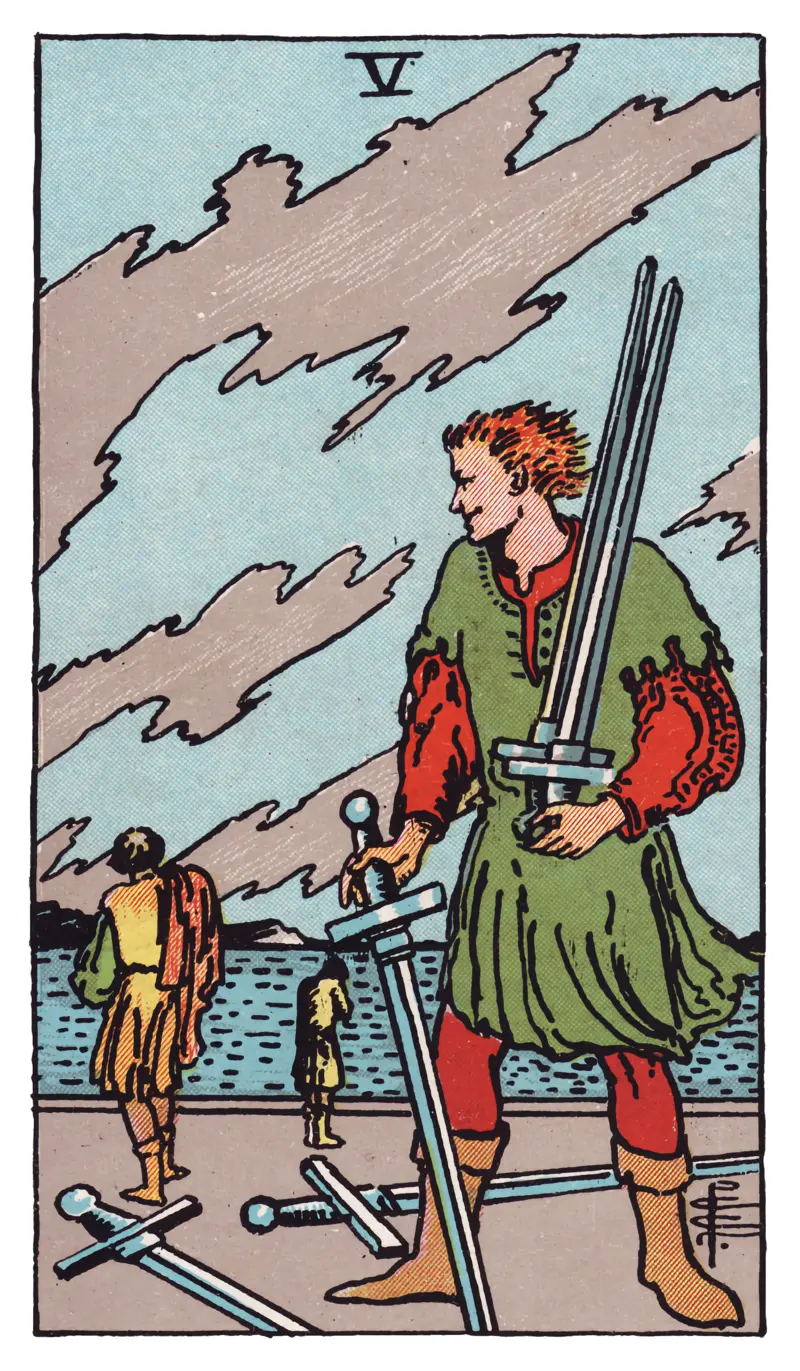
A sneering figure gathers three swords while two defeated companions walk away toward the sea, their postures conveying dejection; two swords remain on the ground, and the storm clouds in the background are beginning to clear.
Upright vs reversed
| Upright | Reversed | |
|---|---|---|
| Keyword | DEFEAT | RECONCILIATION |
Upright meaning
In the Rider-Waite-Smith tradition, the Five of Swords is read as the aftermath of a conflict in which someone has prevailed — but at a cost that complicates the victory. The central figure holds three swords and wears an expression that practitioners consistently describe as hollow or contemptuous: the win has been secured, but the departing figures suggest something has been permanently lost in the winning of it. Waite placed this card in a tradition of pyrrhic outcomes and moral complexity. Unlike the clean cut of the Ace or the decisive force of the Knight, the Five of Swords raises the question of what it means to win when winning requires the degradation or defeat of others. The clearing clouds suggest the conflict is over, but practitioners note that what the clearing reveals is not triumph — it is a field with fewer allies on it.
In contemporary RWS readings, the Five of Swords is often read in terms of the social and relational cost of winning. Practitioners ask: has the querent won the argument but damaged the relationship? Has a situation been resolved through force or cunning rather than genuine resolution? The card can also describe defeat — the querent may be one of the figures walking away, not the one gathering swords. In either position, the tradition reads the Five of Swords as a moment of reckoning: the immediate conflict is over, but the terms of the outcome are not as clean as they appeared.
Reversed meaning
Reversed, the Five of Swords in the RWS tradition is read as the recognition that a victory was not worth its price, or as the beginning of reconciliation after a destructive conflict. The figure cannot maintain the posture of contempt indefinitely; the reversal asks what the real cost has been. Some practitioners read it as an opportunity to lay down the swords — to choose repair over continued dominance. Others read the reversal as a conflict that refuses to end: grievances recycled, scores kept, wounds reopened. The common thread is that the hostilities of the upright card are no longer sustainable, whether they are being released or escalated.
In a reading
In the situation position, the Five of Swords names a conflict with a complicated outcome — someone has won, someone has lost, and the moral clarity is absent. In the action position, the card raises a pointed question: is the querent choosing winning over integrity, or does the situation call for recognizing when a fight is not worth having? In the outcome position, the Five of Swords suggests that resolution may come at a cost — the querent should be prepared for a win that does not feel like one.
In combination
The Five of Swords beside Justice is read in the RWS tradition as the gap between winning and being right — a victory examined against a standard the sneering figure did not consult. Paired with The Tower, practitioners often read escalation: a conflict pushed until it brings the structure down around both parties. When the Five of Swords appears with the Six of Swords, the tradition tends to read departure — the walk away from the battlefield becoming the crossing toward calmer water, the defeat transformed into a leaving.
Frequently asked questions
- What does the Five of Swords mean in a love reading?
- In a love reading, the Five of Swords is traditionally read as the aftermath of a fight in which someone won and the relationship lost — an argument carried past the point where being right stopped mattering. For someone in a relationship, it often asks who is keeping score and what the scorekeeping costs. For someone single, it can name a past conflict still shaping how new connection is approached. The card describes the field after the battle; it leaves the repair question open.
- What does the Five of Swords mean in a career reading?
- In a career reading, the Five of Swords usually names a workplace conflict with a complicated outcome — a dispute won through force or maneuvering, a rivalry that has poisoned the room, or a defeat the querent is still walking away from. Practitioners read it as an audit of cost: the argument may have been won, but colleagues, trust, or standing may have been spent in the winning. The tradition asks whether this fight was the one worth having.
- What does the Five of Swords reversed mean in a reading?
- The Five of Swords reversed is traditionally read as the recognition that a victory was not worth its price — or the first movement toward reconciliation after a damaging conflict. Some practitioners read it as swords being laid down: repair chosen over dominance. Others read it as a conflict that refuses to end, grievances recycled and reopened. The reversal marks the moment the hostility becomes unsustainable, whichever direction it resolves.
These notes follow the Rider-Waite-Smith tradition. They describe what the card is associated with — not predictions about your life.