What the card shows
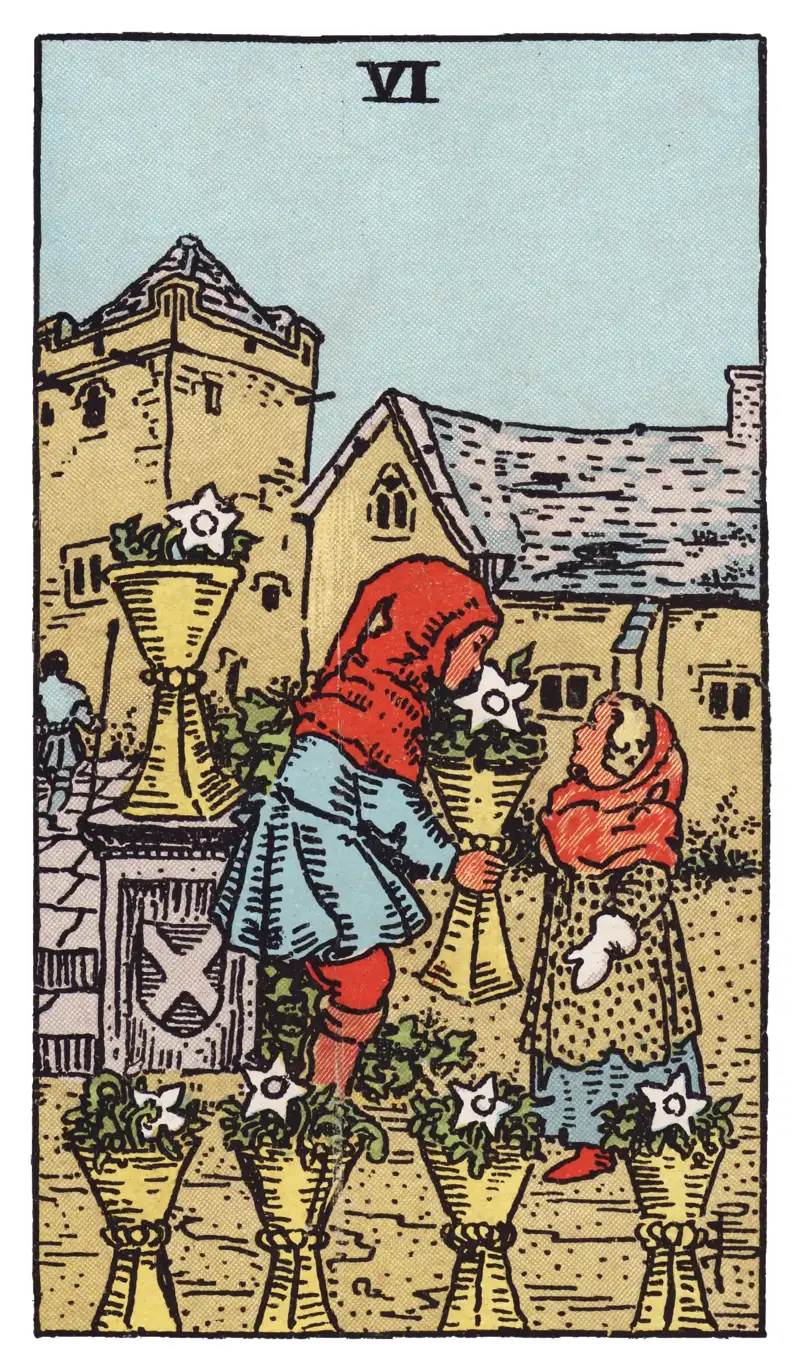
A boy in a medieval garden bends forward to offer a large cup filled with white flowers to a smaller girl; the scene carries a quality of tender nostalgia, and an older figure departs in the upper left of the image, moving away from the exchange taking place in the foreground.
Upright vs reversed
| Upright | Reversed | |
|---|---|---|
| Keyword | MEMORY | STUCK IN PAST |
Upright meaning
In the Rider-Waite-Smith tradition, the Six of Cups is read as the card of memory, of the past returning not as burden but as gift — the boy's offering of the flower-filled cup is a gesture of pure, uncomplicated giving, without expectation of return. The white flowers in the cups have been consistently associated by commentators with innocence, with the emotional states of childhood before they were layered over with adult complexity. The departing figure in the upper left introduces a subtle temporal dimension: something is leaving even as something from the past is being offered forward. Waite's interpreters have read this card as a description of the way certain early experiences — particularly those of warmth, care, and simple generosity — continue to move through a life long after their moment has passed.
Contemporary RWS readers encounter this card in contexts of nostalgia, of revisiting the past, of childhood memory that surfaces unexpectedly in adult life. The card appears when old friendships are renewed, when family history becomes relevant to a present decision, or when someone is drawing on the emotional resources formed early in life. Many practitioners distinguish between a healthy return to the past — recovering something that nourishes — and a retreat into nostalgia as an avoidance of the present. The Six of Cups in its upright position tends toward the former: the cup is offered forward, into the present, not hoarded in memory alone.
Reversed meaning
Reversed, the Six of Cups in the RWS tradition draws attention to the shadow side of nostalgia: an idealization of the past that prevents full engagement with the present, an inability to move forward because the return to earlier times has become a refuge rather than a resource. Some practitioners read the reversal as a pattern of living in memory at the expense of what is actually available now. Others describe it as unresolved material from childhood that continues to shape present choices without being recognized. The reversal can also simply name the need to release an old pattern or relationship that no longer serves.
In a reading
In the situation position, the Six of Cups identifies the past — memory, family, early experience, old relationships — as the ground on which the present stands. In the action position, the card counsels drawing on what was genuinely good in past experience without being detained by it. In the outcome position, it suggests that what is coming will be shaped or colored by the past — an old thread is still being woven into the present pattern.
In combination
The Six of Cups beside The Moon is read in the RWS tradition as memory under uncertain light — nostalgia that may be distorting as much as it recalls, and a call to examine what the remembered past actually was. Paired with the Ten of Cups, the combination often names continuity at its warmest: early experiences of care flowing forward into the family or belonging being built now. With the Eight of Cups, practitioners frequently read the tension between returning and leaving — the pull of what was once known set against the honest recognition that it can no longer hold what is needed.
Frequently asked questions
- What does the Six of Cups mean in a love reading?
- In a love reading, the Six of Cups often names the past inside the present bond — a former partner resurfacing, a relationship shaped by early emotional patterns, or a connection that carries the sweetness of long familiarity. For someone single, it can point toward love arriving through an old acquaintance or a return to a place once known. The card's question is whether the past is nourishing the present or substituting for it. Reversed, it leans toward the latter — nostalgia holding the heart where it can no longer live.
- What does the Six of Cups mean in a career reading?
- In a career reading, the Six of Cups usually points to the resources of the past: skills formed early, a return to work once loved, or a mentor or colleague from an earlier chapter re-entering the picture. Practitioners often read it as counsel to draw on what earlier experience genuinely taught without trying to reproduce the conditions in which it was learned. It can also mark work connected to children, memory, or heritage as the relevant terrain.
- What does the Six of Cups reversed mean in a reading?
- The Six of Cups reversed is traditionally read as nostalgia turned obstacle — the past idealized until the present cannot compete, or unresolved early material silently steering present choices. Some practitioners read it as the need to release an old pattern, relationship, or version of oneself that no longer serves. The reversal does not condemn memory; it asks whether the return to earlier times is functioning as a resource or as a refuge from what is actually available now.
These notes follow the Rider-Waite-Smith tradition. They describe what the card is associated with — not predictions about your life.