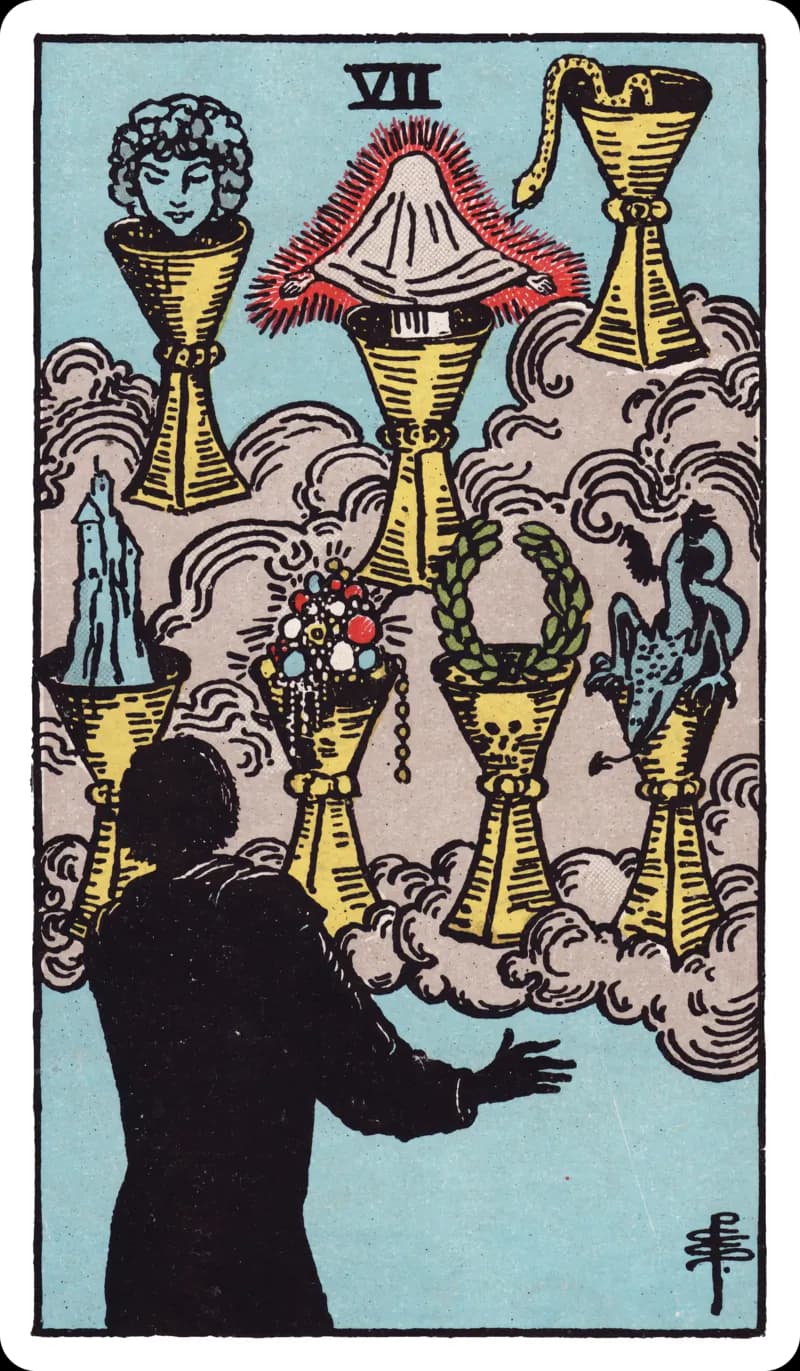
What the card shows
A silhouetted figure stands before seven cups floating in luminous clouds, each containing a different vision: a veiled figure, a castle, jewels, a laurel wreath, a dragon, a cloaked and shrouded form, and a snake; the figure's posture suggests both wonder and uncertainty before the proliferation of possibilities.
Upright vs reversed
| Upright | Reversed | |
|---|---|---|
| Keyword | CHOICE | DECISION |
Upright meaning
In the Rider-Waite-Smith tradition, the Seven of Cups is read as the card of imagination untethered from discernment — a state in which the inner life has generated so many possibilities, visions, and desires that choosing among them becomes impossible. Each cup in the image contains something that could be valued: beauty, power, triumph, spiritual mystery, danger, material wealth. What the tradition emphasizes is not the content of any individual vision but the fact of their multiplicity. Waite described this card as relating to the fantasies of the astral plane — experiences that are vivid and emotionally compelling but that do not yet have roots in the material world. The figure cannot act because the field of possibility has become so crowded that no single direction can be singled out.
Contemporary RWS readers often encounter this card in contexts of overwhelm, of wishful thinking, of a creative or romantic life that has become more fantasy than reality. The card appears when someone has many ideas but has not committed to any of them, or when desire has proliferated to the point of paralysis. Many practitioners also note a gentler reading: this card can describe the necessary early stage of a visionary process, the moment when the imagination is generating freely before the critical faculty begins to evaluate and select. The question the tradition presses is whether the figure will eventually step forward and choose — or remain transfixed by the vision.
Reversed meaning
Reversed, the Seven of Cups in the RWS tradition marks a clearing of the fog — the proliferation of visions is beginning to resolve, and the figure is becoming capable of choosing. Some practitioners read this reversal as the moment when illusions are seen clearly for what they are, when wishful thinking gives way to honest assessment. Others describe it as the return from creative or spiritual overwhelm to practical engagement. In either reading, the reversal introduces discernment where the upright position described diffusion. What was previously impossible — settling on a direction — is now becoming possible.
In a reading
In the situation position, the Seven of Cups identifies a proliferation of possibilities, visions, or desires as the dominant feature of the present context — there are too many options and no clear way to choose among them. In the action position, the card counsels a turn toward discernment: the work is not to add more visions but to evaluate what is already present. In the outcome position, it cautions that if imagination is not eventually grounded, the future will be shaped more by fantasy than by deliberate choice.
In combination
The Seven of Cups beside The Magician is read in the RWS tradition as vision meeting the workbench — the proliferation of possibilities finally subjected to focused will, one cup chosen and made real. Paired with The Moon, the combination deepens the fog: imagination and illusion reinforcing each other, and discernment becoming the urgent task. With the Knight of Cups, practitioners often read romantic or creative idealism at full tide — an offer or pursuit whose emotional beauty is genuine but whose substance has not yet been tested.
Frequently asked questions
- What does the Seven of Cups mean in a love reading?
- In a love reading, the Seven of Cups often names romantic fantasy outpacing romantic reality — an idealized image of a person or relationship that has not been tested against who they actually are. For someone single, it can describe many possibilities entertained and none pursued, or attraction to the vision of love rather than to an available person. For someone in a relationship, it asks whether the partner being loved is the one present or the one imagined. Reversed, it marks clarity arriving — choosing the real over the gallery of visions.
- What does the Seven of Cups mean in a career reading?
- In a career reading, the Seven of Cups usually describes options multiplied to the point of paralysis — many ideas, directions, or offers, none of which has been committed to. Practitioners often read it as the necessary early stage of a creative process that has overstayed: the imagination has generated freely, and the critical faculty must now select. The counsel is not to add more visions but to evaluate the ones present — and to ask which cup has substance behind its shine.
- What does the Seven of Cups reversed mean in a reading?
- The Seven of Cups reversed is traditionally read as the clearing of the fog — illusions seen for what they are, wishful thinking giving way to honest assessment, and the capacity to choose returning. Some practitioners read it as the return from overwhelm to practical engagement: one cup is finally lifted and the rest are set aside. The reversal introduces the discernment the upright card lacks; what was impossible — settling on a direction — is becoming possible.
These notes follow the Rider-Waite-Smith tradition. They describe what the card is associated with — not predictions about your life.