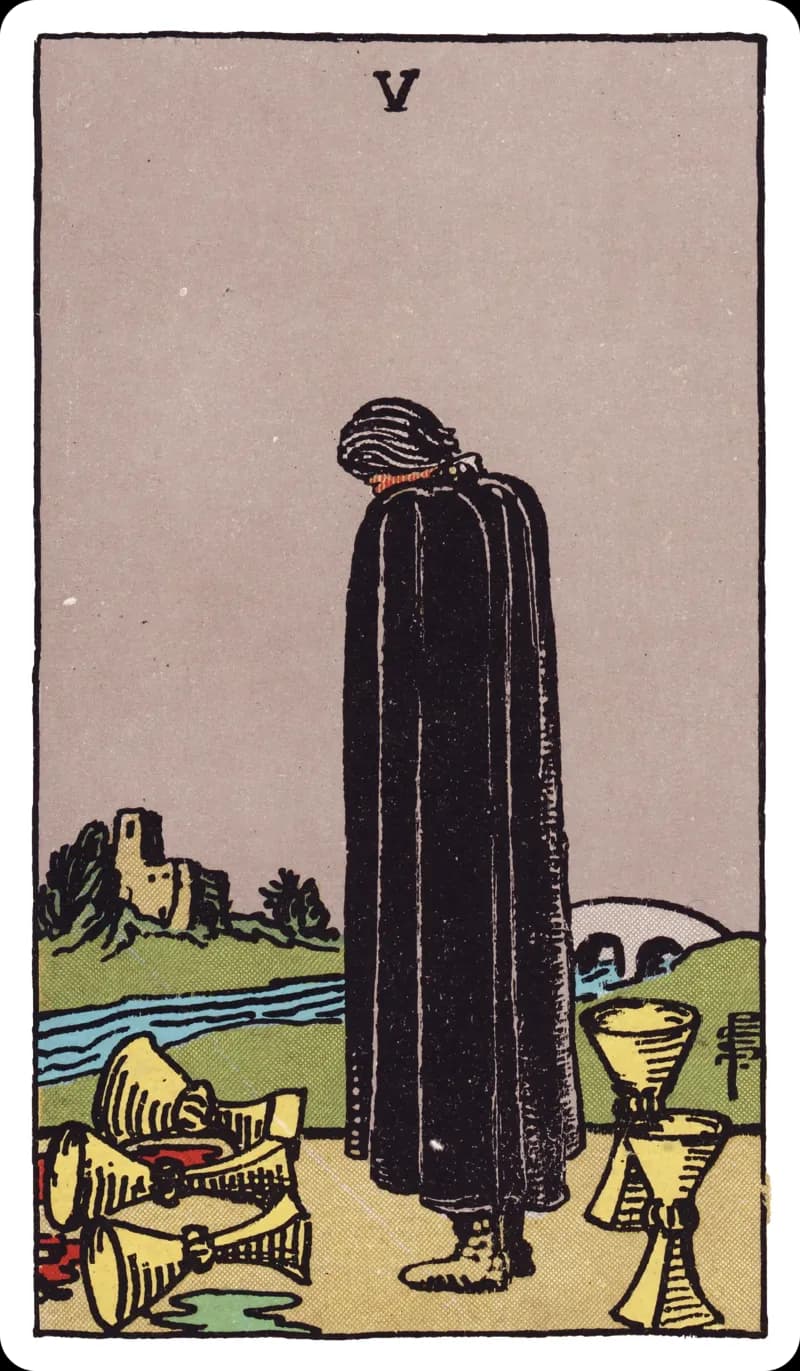
What the card shows
A figure cloaked in black stands over three spilled cups, their gaze fixed on the spilled contents while two upright cups remain behind them, unnoticed; in the far distance, a bridge spans a river leading toward a castle, the path forward still visible though not yet taken.
Upright vs reversed
| Upright | Reversed | |
|---|---|---|
| Keyword | LOSS | MOVING ON |
Upright meaning
In the Rider-Waite-Smith tradition, the Five of Cups is read as the card of grief that has not yet completed its movement — the figure's attention is consumed by what has been lost while what remains stands quietly behind them, still whole. The spilled cups at the center of the image represent genuine loss; the tradition does not minimize this. Waite's commentators have described this card as belonging to the experience of mourning, of disappointment, of a love or hope that did not arrive as it was imagined. The black cloak isolates the figure from the landscape around them, and the posture — head bowed, turned away from the upright cups — is one of the most psychologically precise images in the Minor Arcana: the spell of grief that narrows the visual field to what is broken.
Contemporary RWS readers consistently note the significance of what the figure cannot see: the two cups still standing, and the bridge in the background. The bridge in particular has attracted sustained commentary — it is the passage back to what continues, back to ordinary life after loss. Many practitioners read the Five of Cups not as a card of permanent sorrow but as a card describing a specific phase: the moment before the figure turns around. The loss is real and must be honored, but the tradition holds that the path forward — the bridge, the castle, the upright cups — remains available whenever the figure is ready to look.
Reversed meaning
Reversed, the Five of Cups in the RWS tradition is read as the beginning of recovery — the figure is starting to turn, to notice the cups still standing, to find the bridge. This position marks the transition out of acute grief rather than the grief itself. Some practitioners describe it as the moment when a person stops rehearsing what went wrong and begins to move again. Others note that the reversal can also name a grief that has been suppressed rather than moved through — loss that has been covered over without resolution. The direction matters: is the figure turning toward the upright cups, or simply looking away from the pain?
In a reading
In the situation position, the Five of Cups identifies loss, disappointment, or grief as the central emotional reality of the present moment — something has been spilled and the figure has not yet turned around. In the action position, the card counsels acknowledging what has been lost honestly before reaching for what remains. In the outcome position, it suggests a period of mourning that must be moved through rather than bypassed if the bridge in the background is to be reached.
In combination
The Five of Cups beside Death is read in the RWS tradition as loss set inside a larger ending — the grief in the foreground belonging to a transformation that has its own arc and completion. Paired with The Star, the combination is one of the more hopeful in the deck: mourning met by renewal, the spilled cups answered by water poured freely again. With the Six of Cups, practitioners often read grief entangled with memory — a loss that keeps returning through the past it is attached to, and the question of whether remembering is honoring or rehearsing.
Frequently asked questions
- What does the Five of Cups mean in a love reading?
- In a love reading, the Five of Cups names grief within the bond or after it — a breakup being mourned, or a disappointment inside a relationship that has narrowed the field of vision to what went wrong. For someone single, it often describes the phase after loss when new connection is not yet visible, though the two standing cups suggest it remains. For someone in a relationship, it asks whether what has been spilled is being honored — or whether what still stands is being forgotten. Reversed, it marks the turn toward recovery.
- What does the Five of Cups mean in a career reading?
- In a career reading, the Five of Cups usually names professional disappointment — a role lost, a project that failed, an opportunity that did not arrive as imagined. The tradition does not minimize the loss; it asks about the direction of attention. Practitioners often read the two upright cups as what survives the setback: skills, relationships, standing that remain intact. The bridge in the background is the return to ordinary work, available when the figure is ready to turn.
- What does the Five of Cups reversed mean in a reading?
- The Five of Cups reversed is traditionally read as the beginning of recovery — the figure starting to turn, to notice the standing cups, to find the bridge. It marks the transition out of acute grief rather than the grief itself. Some practitioners read it as the moment a person stops rehearsing what went wrong and begins to move; others caution that it can also name grief suppressed rather than moved through. The question the reversal asks is which of those two movements is actually happening.
These notes follow the Rider-Waite-Smith tradition. They describe what the card is associated with — not predictions about your life.