What the card shows
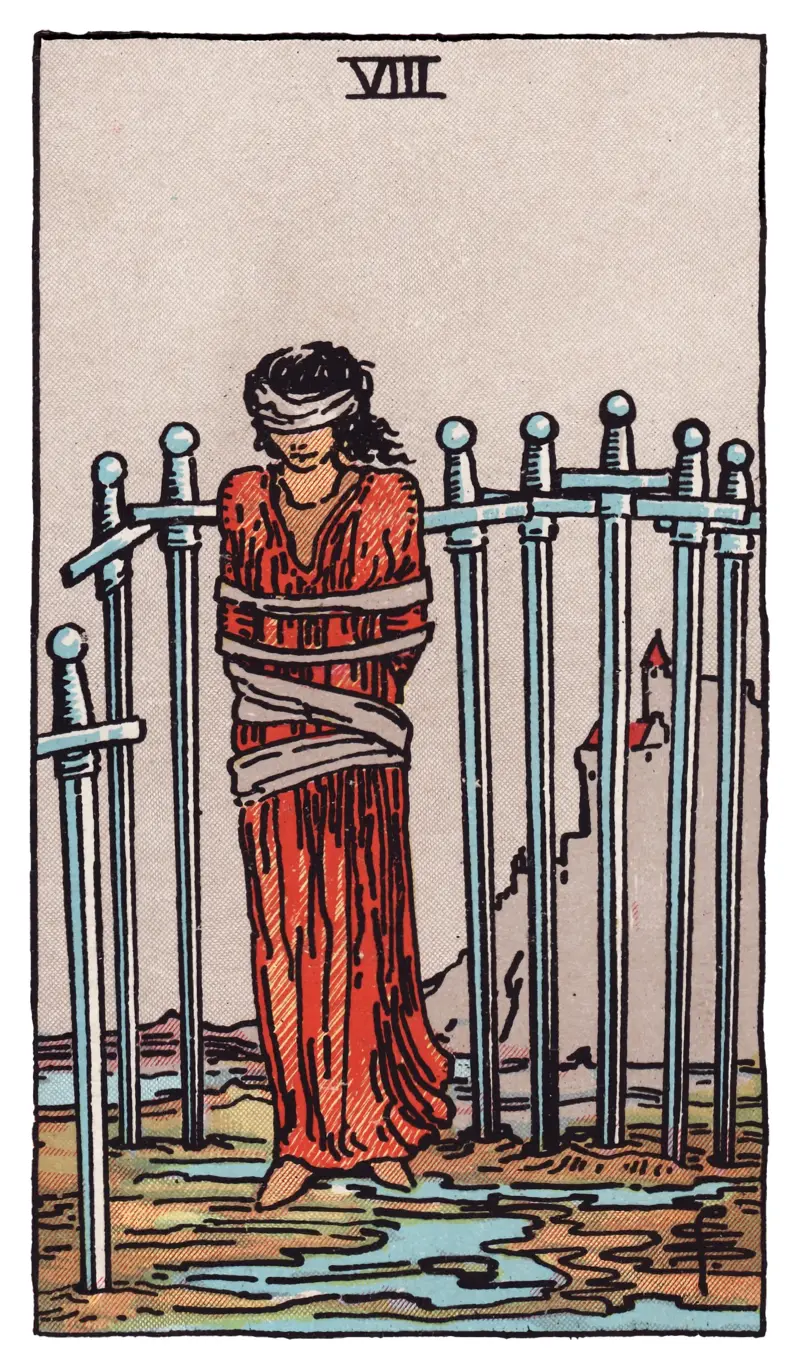
A bound and blindfolded figure stands in a marshy landscape surrounded by eight swords planted in the ground to form a loose enclosure; a puddle reflects the grey sky, and a distant castle sits on a bluff behind the swords.
Upright vs reversed
| Upright | Reversed | |
|---|---|---|
| Keyword | RESTRICTION | RELEASE |
Upright meaning
In the Rider-Waite-Smith tradition, the Eight of Swords is read as the card of self-imposed constraint — the experience of feeling trapped by a situation that, on examination, is not as inescapable as it appears. The figure is bound, but loosely; blindfolded, but the blindfold could be removed; surrounded by swords, but they do not form a solid wall. The castle in the background suggests that a place of safety or clarity exists and is visible — though not from where the figure stands, with the blindfold on. Waite associated this card with the mind's capacity to construct its own prison, and practitioners have long read it as a warning about the power of limiting beliefs, catastrophic thinking, or the paralysis that comes from focusing entirely on the restrictions rather than on the gaps between them.
In contemporary RWS readings, the Eight of Swords often appears when the querent feels stuck in a situation they believe they cannot change — a job, a relationship, a pattern of thought — where the actual constraints are less rigid than they feel. Practitioners note the water underfoot as significant: the terrain is unstable, and moving will require some willingness to step into uncertain ground. The card does not suggest the problem is imaginary; the swords are real and the binding is real. But it consistently points toward the role of perception in maintaining confinement: if the blindfold were removed, the exit might become visible.
Reversed meaning
Reversed, the Eight of Swords in the RWS tradition is read as the beginning of liberation from a self-imposed or externally enforced constraint. The blindfold is coming off, the bindings are being loosened, and the querent is beginning to see the situation with more clarity and less fear. Some practitioners read the reversal as a dramatic moment of release — the imprisonment suddenly over. Others read it as a gradual process: one sword at a time being removed, one layer of restriction at a time being recognized and dismantled. The reversal can also indicate that the querent is still in the process of recognizing their own agency — the exit is visible, but the courage to step through it is still being gathered.
In a reading
In the situation position, the Eight of Swords names a condition of felt restriction — the querent's circumstances may appear to offer no exit, but the tradition asks whether the walls are as solid as they seem. In the action position, the card invites the querent to examine which constraints are real and which are maintained by perception. In the outcome position, the Eight of Swords suggests that the way forward involves confronting a mental or emotional block before the path becomes clear.
In combination
The Eight of Swords beside The Devil is read in the RWS tradition as two studies in constraint — the loose chains of one echoing the loose bindings of the other, both asking how much of the holding is chosen. Paired with The Star, practitioners often read the sequence of release: fear easing until the exit that was always there becomes usable. When the Eight of Swords appears with the Two of Swords, the tradition reads the suit talking to itself about blindfolds — one worn by choice at a decision, one worn so long it began to feel imposed.
Frequently asked questions
- What does the Eight of Swords mean in a love reading?
- In a love reading, the Eight of Swords is traditionally read as feeling trapped inside a relationship story — convinced that leaving, staying, or speaking honestly is impossible, when the constraints are partly made of fear. For someone in a relationship, it often names a dynamic that feels inescapable but has not actually been tested. For someone single, it can mark beliefs about being unlovable or too late that function as the blindfold. The tradition insists the swords leave gaps — the card maps the enclosure, not a life sentence.
- What does the Eight of Swords mean in a career reading?
- In a career reading, the Eight of Swords usually names the job that feels like a trap — obligations, finances, or self-doubt experienced as walls. Practitioners read the loose bindings deliberately: some constraints in the situation are real, and some are assumptions that have never been examined. The card's work is the sorting of one from the other. The castle on the bluff matters too — a viable position exists and is visible, though not from inside the blindfold.
- What does the Eight of Swords reversed mean in a reading?
- The Eight of Swords reversed is traditionally read as the beginning of release — the blindfold coming off, the bindings loosening, the querent recognizing agency that was there all along. Some practitioners read it as sudden liberation; more often it is gradual, one sword at a time. The reversal can also name the in-between stage: the exit is visible now, and the remaining work is gathering the nerve to walk through it.
These notes follow the Rider-Waite-Smith tradition. They describe what the card is associated with — not predictions about your life.