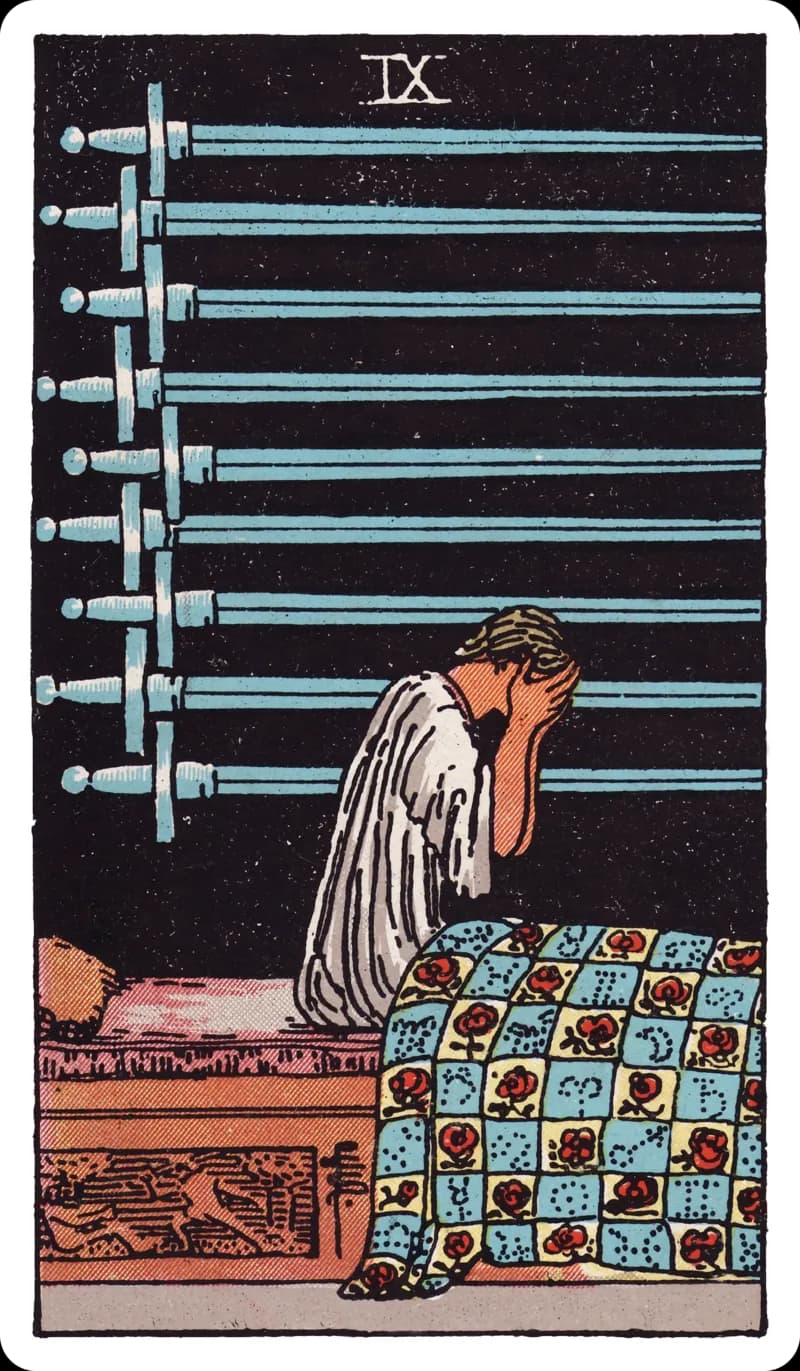
What the card shows
A figure sits bolt upright in bed in the middle of the night, head buried in both hands in an attitude of despair; nine swords are mounted horizontally on the dark wall behind, and the bedframe's carved relief depicts one figure striking another.
Upright vs reversed
| Upright | Reversed | |
|---|---|---|
| Keyword | ANXIETY | RELIEF |
Upright meaning
In the Rider-Waite-Smith tradition, the Nine of Swords is read as the card of midnight anxiety — the fears, regrets, and catastrophic thoughts that arrive most forcefully in the small hours when defenses are down and the mind produces its worst-case versions of reality. The figure has woken from sleep or cannot sleep; the nine swords on the wall are not weapons drawn against an enemy but the accumulated weight of worry, self-reproach, or dread made visible. Waite placed this card in a tradition of mental suffering that is real in its intensity even when it is not accurate in its content. The carved figure on the bedframe — one striking another — adds a layer of guilt or conflict to the image, and practitioners often read it as the suggestion that the suffering has a specific source: an act committed, a wrong remembered, a relationship in which harm occurred.
In contemporary RWS readings, the Nine of Swords is read with careful attention to the distinction between the feeling and the fact. The swords are on the wall, not in the body — the mind is generating the pain, not an external attack. Practitioners consistently note that the card does not predict disaster; it reflects the experience of anticipating disaster. This is not a small distinction. The card appears in readings where anxiety, guilt, or sleeplessness have become significant presences, where the querent's internal experience is outrunning the evidence. Some practitioners also read the Nine of Swords as an invitation to seek help: nine is a number near completion, and the suffering depicted is not sustainable.
Reversed meaning
Reversed, the Nine of Swords in the RWS tradition is read as the beginning of relief from mental anguish — the long night has not ended, but it is no longer total. Some practitioners read the reversal as the moment when the worst of the fear has passed and the mind begins to return to a more proportionate view of the situation. Others read it as anxiety that has been suppressed rather than resolved, driven underground where it continues to operate below consciousness. The reversal can also point toward the slow and difficult work of recovery from a period of significant mental or emotional distress — the acknowledgment that the suffering was real, combined with the recognition that it does not have to define what comes next.
In a reading
In the situation position, the Nine of Swords names anxiety, guilt, or mental suffering as the dominant texture of the querent's present experience — what is happening inside may be more intense than what is visible from the outside. In the action position, the card may counsel examination of what fears are driving the querent, and whether they are proportionate to the actual situation. In the outcome position, the Nine of Swords suggests that a difficult interior passage must be moved through before clarity is available.
In combination
The Nine of Swords beside The Moon is read in the RWS tradition as fear amplified by uncertainty — the night mind working without reliable light, imagination supplying what information cannot. Paired with The Star, practitioners often read the pair as night and its clearing: the anguish of the small hours answered by the deck's image of replenishment. When the Nine of Swords appears with the Four of Swords, the tradition reads the suit prescribing for itself — the rest the sleepless figure needs placed directly beside the sleeplessness.
Frequently asked questions
- What does the Nine of Swords mean in a love reading?
- In a love reading, the Nine of Swords is traditionally read as the relationship replayed at night — worry about where things stand, regret over words said or unsaid, or fear of loss that grows larger in the dark than the daylight facts support. For someone in a relationship, it often names anxieties that have not been spoken aloud to the partner. For someone single, it can mark self-reproach about past connections. The tradition's central move applies here: the swords are on the wall, not in the bond — the card mirrors the fear, it does not confirm it.
- What does the Nine of Swords mean in a career reading?
- In a career reading, the Nine of Swords usually names work that has followed the querent home — the 3 a.m. rehearsal of mistakes, dread of a review or a decision, or the weight of responsibility felt most heavily at night. Practitioners read it as a portrait of the worry rather than a verdict on the work: the card reflects how heavy the situation feels, and invites the daylight comparison between the fear's size and the facts on the ground.
- What does the Nine of Swords reversed mean in a reading?
- The Nine of Swords reversed is traditionally read as the beginning of relief — the worst of the night passing, proportion returning, the fears seen at last against evidence rather than in the dark. Some practitioners read it instead as worry driven underground, suppressed rather than resolved. Either way, the tradition treats the card as a mirror of inner experience, not a prediction — and the reversal marks that experience beginning to shift.
These notes follow the Rider-Waite-Smith tradition. They describe what the card is associated with — not predictions about your life.