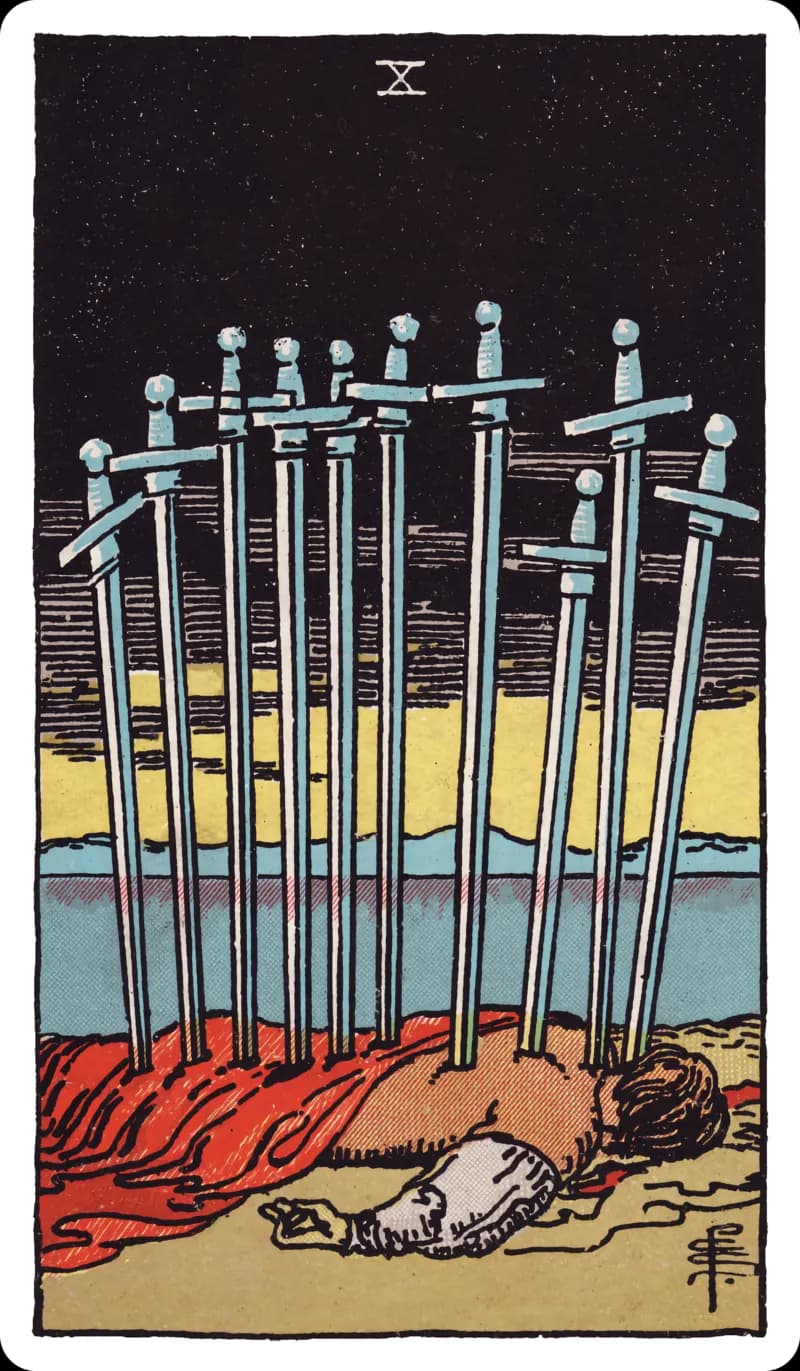
What the card shows
A figure lies face-down on the ground with ten swords embedded in the back; the scene is dark, with black water stretching to the horizon, but a thin band of golden-orange light glows along the far edge of the sky, suggesting the very beginning of dawn.
Upright vs reversed
| Upright | Reversed | |
|---|---|---|
| Keyword | ENDINGS | SURVIVAL |
Upright meaning
In the Rider-Waite-Smith tradition, the Ten of Swords is read as the end of a cycle carried to its most complete and painful conclusion. The figure has fallen, and the ten swords in the back suggest a finality that admits no ambiguity — this chapter is over, and it ended badly. Waite associated the tens with completion, and in the suit of Swords that completion is not triumphant but total: a situation has been pursued to its limit and the limit has been reached. Practitioners consistently note that the card, for all its visual severity, also contains a crucial element: the thin golden light on the horizon. That light does not minimize what has happened, but it introduces the possibility that this is not a permanent condition. The darkest moment of this card is at a specific temporal juncture — before dawn rather than in permanent night.
In contemporary RWS practice, the Ten of Swords is read as a card of painful endings that, precisely because they are complete, create the conditions for something genuinely new. Practitioners often note that there is a strange mercy in the absolute — when something ends this thoroughly, the question of whether it might be salvaged no longer needs to be carried. The card appears in readings where a loss is total: a relationship that cannot be revived, a plan that has definitively collapsed, a chapter that is closed. The ten swords are not a metaphor for something partial; they describe something that has run its full course. And the horizon line, faint as it is, belongs to the next chapter.
Reversed meaning
Reversed, the Ten of Swords in the RWS tradition is read as the slow and difficult emergence from a period of total loss or defeat. The worst has happened — the reversal does not undo that — but the figure is beginning to consider rising. Some practitioners read the reversal as a partial recovery, a tentative return to functioning after devastation. Others read it as resistance to accepting what has ended: the querent may be refusing to acknowledge the finality of a conclusion, trying to revive what the upright card made clear cannot be revived. The reversal can also indicate that the pain is being suppressed rather than processed — the ten swords are still present, just inverted.
In a reading
In the situation position, the Ten of Swords names a conclusive ending — something in the querent's circumstances has reached its final point, and the tradition asks the querent to accept that conclusion rather than work against it. In the action position, the card may counsel releasing what is already finished rather than sustaining the effort to save it. In the outcome position, the Ten of Swords points toward an ending that clears the ground — painful, but complete, with the horizon visible beyond it.
In combination
The Ten of Swords beside Death is read in the RWS tradition as an ending named twice — completion underscored, the change now beyond negotiation. Paired with The Sun, practitioners often read the card's own horizon fulfilled: the thin dawn light grown into full day, devastation followed by unambiguous renewal. When the Ten of Swords appears with the Ace of Swords, the tradition reads the suit closing its circle — the total ending clearing the ground for the clean first stroke of new clarity.
Frequently asked questions
- What does the Ten of Swords mean in a love reading?
- In a love reading, the Ten of Swords is traditionally read as an ending that is complete — a relationship, or a hope for one, that has run its full course and cannot be revived. For someone in a relationship, it can name the final form of a long deterioration, or the end of a specific version of the bond that must be mourned before anything else is possible. For someone single, it often marks the true close of an attachment that lingered. The tradition points to the horizon line: the finality is also the release.
- What does the Ten of Swords mean in a career reading?
- In a career reading, the Ten of Swords usually names a definitive professional ending — a role eliminated, a venture that has failed completely, a path closed rather than narrowed. Practitioners read the card's strange mercy here: when the ending is this total, the exhausting question of whether it might still be saved no longer needs carrying. The dawn at the card's edge is read as the next chapter's first light — visible from the ground, before the rising.
- What does the Ten of Swords reversed mean in a reading?
- The Ten of Swords reversed is traditionally read as the slow rising after total defeat — recovery beginning, but not yet complete. Some practitioners read it as resistance to an ending: trying to revive what the upright card declared finished, or refusing to acknowledge a conclusion already in effect. Others read pain suppressed rather than processed. The reversal asks whether the querent is genuinely getting up, or simply refusing to look at the ground.
These notes follow the Rider-Waite-Smith tradition. They describe what the card is associated with — not predictions about your life.