What the card shows
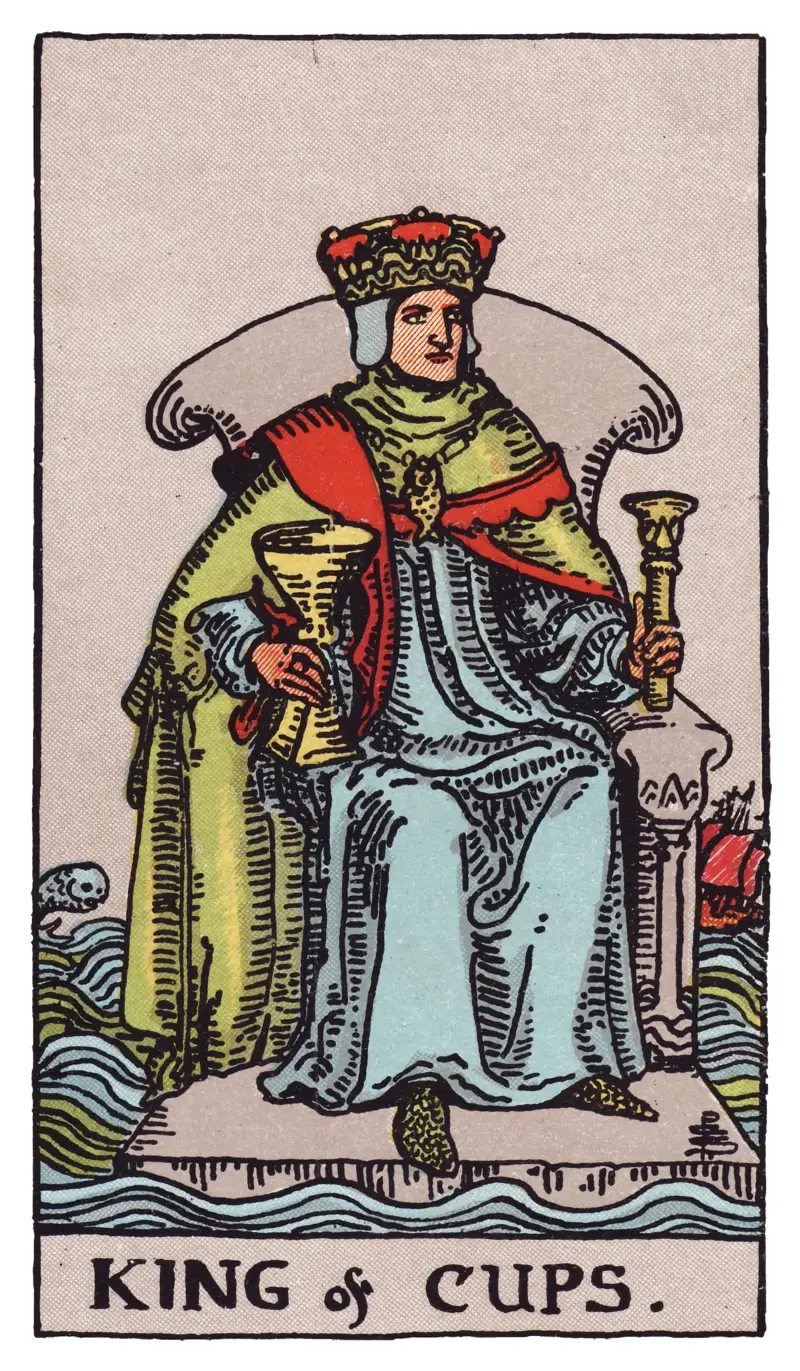
An emotionally composed king sits on a stone throne that appears to float on a turbulent sea; he holds a cup in one hand and a scepter in the other, and his expression is one of mastered calm; in the water around him, a fish leaps from the waves on one side and a ship navigates the distance on the other.
Upright vs reversed
| Upright | Reversed | |
|---|---|---|
| Keyword | COMPOSURE | VOLATILITY |
Upright meaning
In the Rider-Waite-Smith tradition, the King of Cups is read as the figure of emotional mastery — not the suppression of feeling but its conscious governance. The detail that has attracted the most sustained commentary is the throne on the open sea: unlike the other kings, who sit on solid ground, this king has placed himself in the middle of the emotional element itself and remains composed. The turbulent water around him is not a problem he has solved; it is the medium through which he rules. The fish leaping from the waves refers to the unconscious life that continues to move beneath the surface, and the distant ship navigates confidently — both images suggesting that things move and are kept moving even as the king maintains his equilibrium. Waite described this figure as the master of the feeling life, someone who does not require calm circumstances in order to remain calm.
Contemporary RWS readers encounter the King of Cups in contexts of leadership within emotional situations — the therapist, the mediator, the manager of difficult human dynamics, the person who can remain present and clear in the midst of another's crisis without being either dismissive or consumed. Many practitioners note that this king holds both the cup and the scepter: he brings together emotional intelligence and executive capacity, feeling and action. The tradition describes him as someone who has developed the capacity to act from feeling without being controlled by it — a distinction the suit considers the highest development of the emotional life.
Reversed meaning
Reversed, the King of Cups in the RWS tradition points to the collapse of the equilibrium the upright position celebrates: the throne is no longer stable on the water, and the mastery has been disrupted. Some practitioners read this as emotional volatility disguised as composure — the person who appears calm but is in fact suppressing rather than governing feeling, who may erupt when the suppression reaches its limit. Others describe the reversal as manipulation through emotional control, the use of apparent equanimity to dominate or withhold. A third reading names overwhelm: the king who has been asked to hold too much for too long and is finally flooded. The reversal asks what the apparent stability is costing.
In a reading
In the situation position, the King of Cups identifies mature emotional mastery, or the need for it, as the central quality shaping the present context — the seas are turbulent and what is called for is a capacity to remain centered within them. In the action position, the card counsels governing the feeling life with consciousness: neither suppressing what is felt nor being carried away by it. In the outcome position, it points toward the development or demonstration of emotional mastery as the resolution — the throne holds, even on the moving water.
In combination
The King of Cups beside The Emperor is read in the RWS tradition as two forms of sovereignty side by side — rule through structure and rule through feeling, and the question of which the situation actually requires. Paired with The Tower, the combination tests the card's central claim: composure on turbulent water meeting genuine upheaval, equilibrium proven or exposed. With the Queen of Cups, practitioners read the suit's mature pair in full — empathic depth and governed feeling holding the emotional realm between them.
Frequently asked questions
- What does the King of Cups mean in a love reading?
- In a love reading, the King of Cups names emotional steadiness inside the bond — a partner who can stay present through turbulence without dismissing it or drowning in it, or the call to become that presence. For someone in a relationship, it often appears when the seas are genuinely rough and what the moment needs is composure with feeling, not composure instead of it. For someone single, it can name the maturity being sought — or being asked for. Reversed, it asks what the apparent calm is costing.
- What does the King of Cups mean in a career reading?
- In a career reading, the King of Cups usually names leadership through emotional mastery — the mediator, the manager of difficult human dynamics, the person who remains clear in another's crisis without becoming cold. Practitioners often read it as counsel to bring both the cup and the scepter: feeling and executive capacity together. It can also describe a senior figure whose authority rests on steadiness rather than force, or the demand to become one.
- What does the King of Cups reversed mean in a reading?
- The King of Cups reversed is traditionally read as the equilibrium disrupted — composure that is actually suppression, calm maintained until it erupts, or emotional control used to dominate and withhold rather than to govern honestly. A third reading names overwhelm: the one who has held too much for too long, finally flooded. The reversal asks what the apparent stability is costing — and whether the mastery on display is governance of feeling or its quiet imprisonment.
These notes follow the Rider-Waite-Smith tradition. They describe what the card is associated with — not predictions about your life.