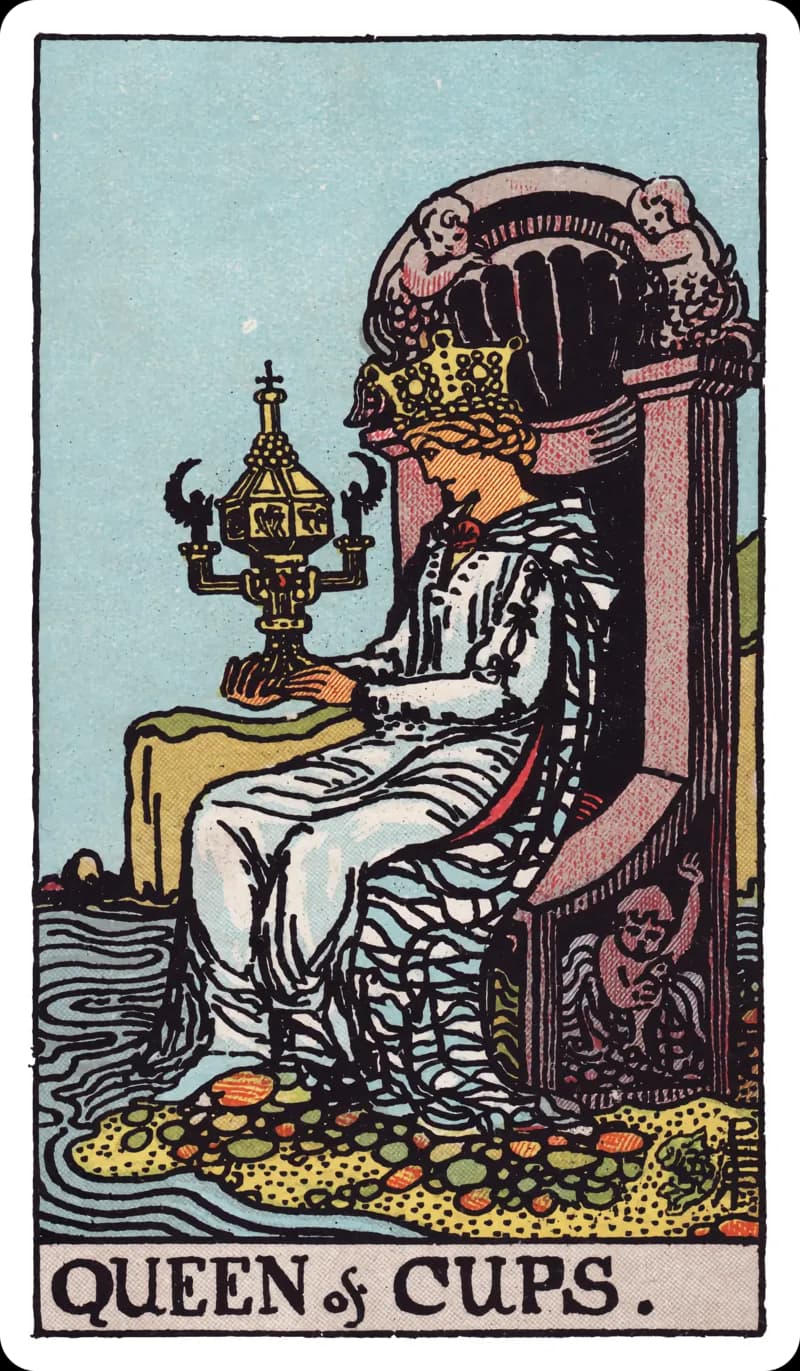
What the card shows
A fair queen sits on an ornate throne decorated with sea creatures and cherubs at the water's edge, her feet resting at the boundary between land and sea; she holds an elaborately closed and decorated cup before her and gazes at it with an expression of deep, absorbed attention, as though listening to what it contains.
Upright vs reversed
| Upright | Reversed | |
|---|---|---|
| Keyword | EMPATHY | EMOTIONAL OVERWHELM |
Upright meaning
In the Rider-Waite-Smith tradition, the Queen of Cups is read as the figure of deepest emotional intelligence in the suit — not simply a person who feels intensely, but one who has developed the capacity to hold the feeling life of others without being overwhelmed by it. The closed cup she holds is unique among the cup court cards: it is sealed, elaborately wrought, and she is looking at it rather than into it. Waite described this cup as the queen's own creation, suggesting that what she contains is not merely received but actively shaped. Commentators have read this as a sign of her mastery over the emotional realm: she does not pour her inner life out indiscriminately but holds it, tends it, and knows when to offer it. The boundary between land and sea at her feet is precisely where she sits — between the rational and the felt, between the known and the deep.
Contemporary RWS readers consistently describe the Queen of Cups as a figure of extraordinary empathic capacity, of the kind of emotional wisdom that can hold space for others without losing its own center. The card appears in contexts of healing, of counseling, of the ability to be with another person's pain or joy without trying to fix or redirect it. Many practitioners also note that this queen is deeply intuitive — her knowledge of a situation frequently arrives through feeling and image rather than through analysis. The tradition describes her as someone whose emotional life is not a vulnerability but a form of intelligence, refined and sovereign.
Reversed meaning
Reversed, the Queen of Cups in the RWS tradition points to the distortions that can arise when emotional sensitivity becomes untethered from the boundaries that give it form. Some practitioners read this as emotional codependency — the tendency to absorb others' feelings to the point of losing one's own ground, to confuse empathy with merger. Others describe the reversal as emotional manipulation: the use of sensitivity as a tool for controlling others rather than connecting with them. A third reading names simple overwhelm — the empathic capacity flooded to the point where the person can no longer function from a place of clarity. The reversal asks where feeling has lost its center.
In a reading
In the situation position, the Queen of Cups identifies deep emotional intelligence, empathic presence, or the capacity for profound inner knowing as the central quality at work in the present moment. In the action position, the card counsels bringing the full resources of emotional wisdom to bear — listening deeply, holding space, trusting intuition over analysis. In the outcome position, it suggests that what comes will require and reward a quality of empathic attention — the situation will be navigated through feeling rather than reason.
In combination
The Queen of Cups beside The High Priestess is read in the RWS tradition as inner knowing in two registers — the Priestess's veiled stillness paired with the Queen's active empathic presence, intuition both received and offered. Paired with The Moon, the combination cautions that deep sensitivity is navigating uncertain water: what is being felt is real, but its source needs discernment. With the King of Cups, practitioners often read the suit's mature pair — feeling held and feeling governed, empathy and composure completing each other.
Frequently asked questions
- What does the Queen of Cups mean in a love reading?
- In a love reading, the Queen of Cups names emotional depth as the active force — a partner or presence whose empathy holds the relationship steady, or the call to bring that quality oneself. For someone in a relationship, it often counsels listening beneath the words: what the bond needs is presence, not solutions. For someone single, it can name the work of tending one's own emotional life until it is sovereign rather than starving. Reversed, it asks where empathy has slid into absorption or lost its boundaries.
- What does the Queen of Cups mean in a career reading?
- In a career reading, the Queen of Cups usually names emotional intelligence as the professional instrument — work in counseling, care, teaching, or any role where holding space for others is the actual skill. Practitioners often read it as counsel to trust intuition over analysis in the situation at hand: the knowing that arrives through feeling and image is legitimate information. It can also point to a colleague or mentor whose steadiness comes from empathy rather than authority.
- What does the Queen of Cups reversed mean in a reading?
- The Queen of Cups reversed is traditionally read as sensitivity untethered from its boundaries — empathy sliding into codependency, the feelings of others absorbed until one's own ground is lost, or sensitivity used to manage and control rather than connect. A third reading names simple overwhelm: the empathic capacity flooded past clarity. The reversal does not condemn the gift; it asks where the cup's seal has broken — where feeling has lost the form that made it wisdom.
These notes follow the Rider-Waite-Smith tradition. They describe what the card is associated with — not predictions about your life.