What the card shows
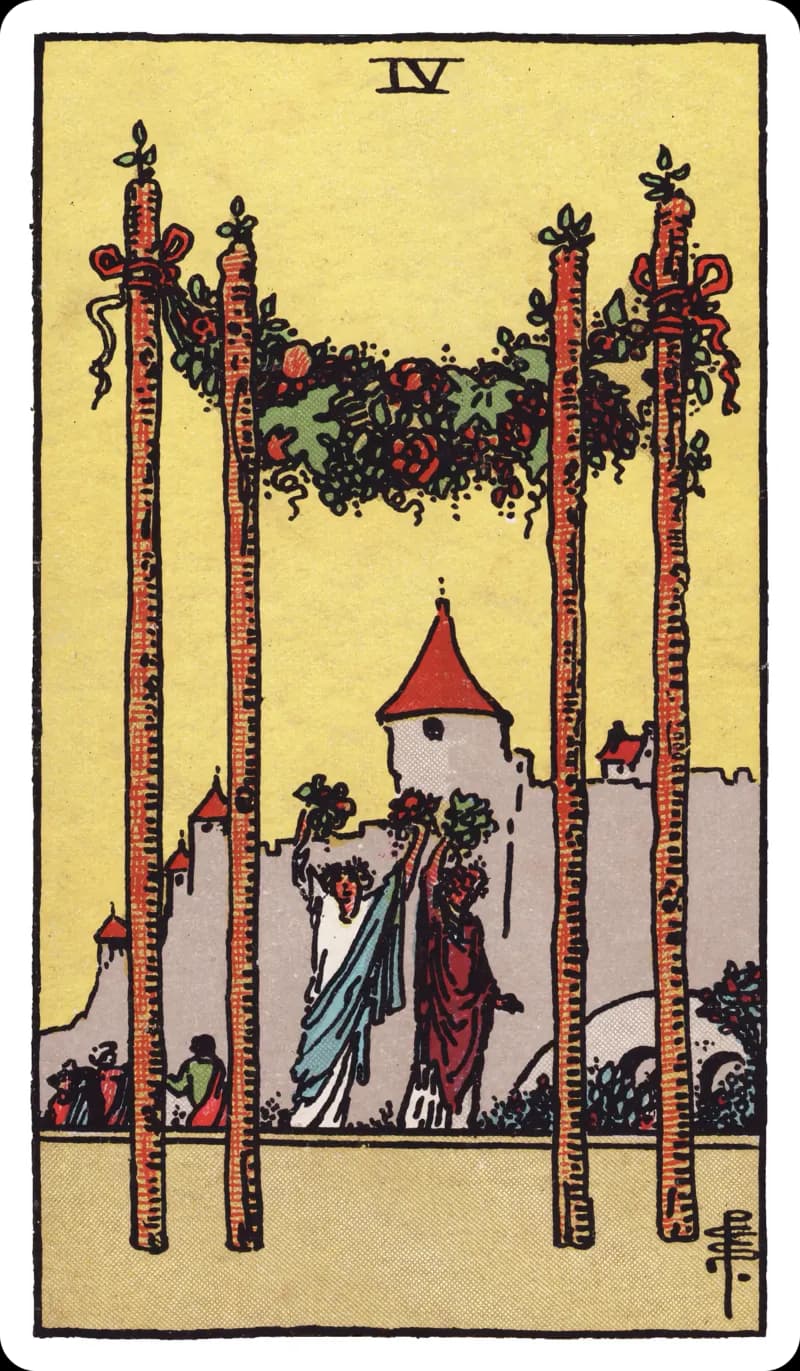
Two figures in celebratory dress raise bouquets beneath a garland of flowers and fruits suspended between four upright wands; a crowd and a castle with towers stand behind them.
Upright vs reversed
| Upright | Reversed | |
|---|---|---|
| Keyword | CELEBRATION | UNSETTLED HOME |
Upright meaning
In the Rider-Waite-Smith tradition, the Four of Wands is read as a card of earned celebration — the structure has been built, the threshold has been crossed, and the community has gathered to mark it. Unlike the solitary figures of the earlier Wands, this card is explicitly social: the garland requires the four posts to hold it, the celebration requires witnesses, the threshold requires people on both sides. Waite described this card as one of country life, of harmony and prosperity — a moment when the fire of ambition has produced something solid and shared. Practitioners frequently note that the Four of Wands is not merely a party; it is the acknowledgment of arrival, the formal recognition that a phase of effort has reached its natural completion.
In contemporary RWS practice, the Four of Wands tends to appear around milestones: a launch, a homecoming, a graduation, a rite of passage, a relationship reaching a new and more stable ground. The castle in the background matters — it is the permanent structure behind the temporary celebration, the enduring fact behind the festive moment. Practitioners often read this card as an invitation to actually receive what has been built, to let the moment of recognition land fully rather than rushing past it toward the next ambition. The fire is still present in this card, but it has found a hearth.
Reversed meaning
Reversed, the Four of Wands in the RWS tradition can point to a celebration deferred or disrupted — an arrival that feels incomplete, a milestone reached without adequate acknowledgment, or a community gathering that carries unresolved tension beneath its surface. In some lineages of RWS practice, the reversed Four is read as instability in what appeared to be solid ground: the posts are still standing, but the garland has slipped. The card may also point to difficulty in receiving, to an inability to mark completion even when completion has genuinely occurred.
In a reading
In the situation position, the Four of Wands indicates that the querent is in or approaching a moment of genuine arrival — something has been built and the community around it is ready to acknowledge it. In the action position, the card counsels receiving and celebrating what has been completed before moving to what is next. In the outcome position, the Four of Wands points toward a stable, shared milestone as the natural result of current efforts — a landing, not just a next step.
These notes follow the Rider-Waite-Smith tradition. They describe what the card is associated with — not predictions about your life.