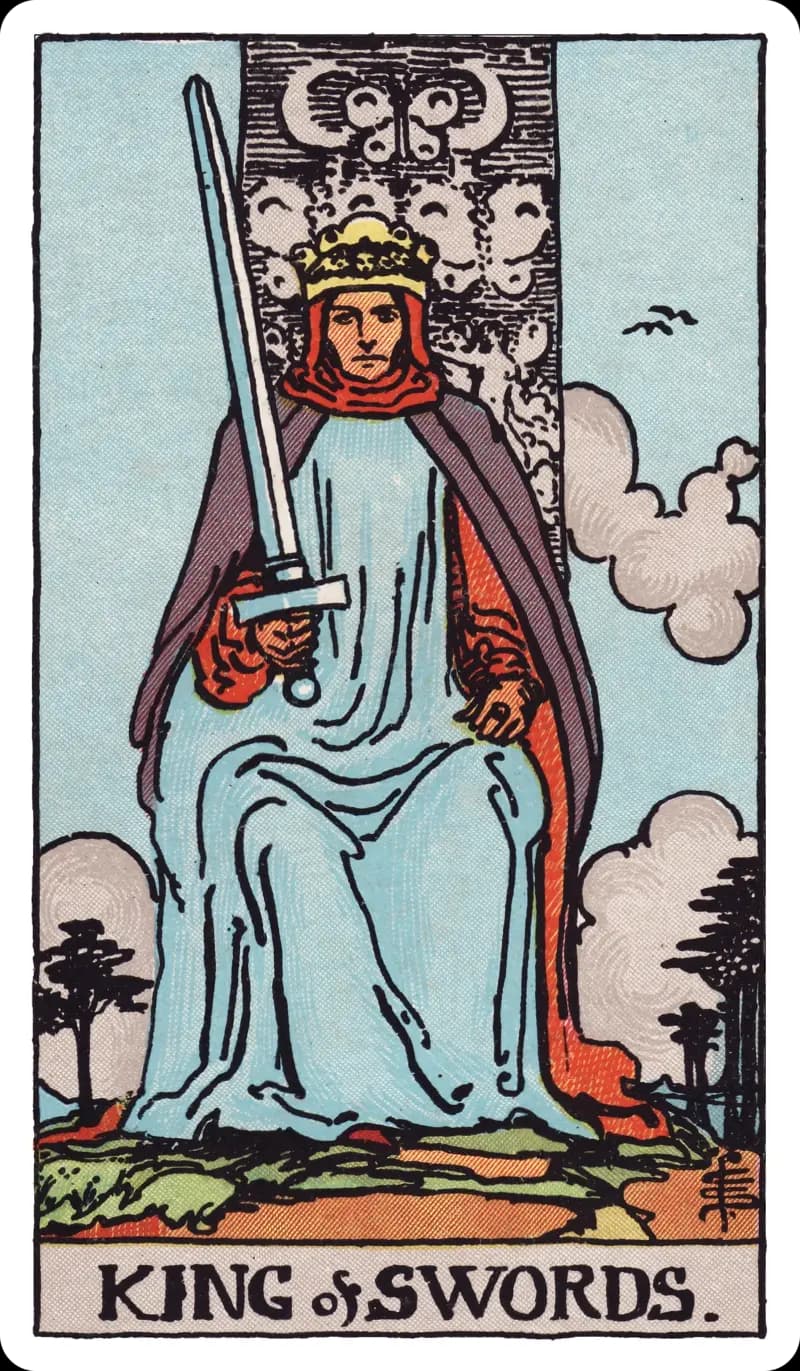
What the card shows
A crowned king sits on a stone throne in full armor, sword raised with the blade held vertically, his gaze direct and unsparing; storm clouds gather on one side of the sky but do not break, and two birds are barely visible in the upper distance.
Upright vs reversed
| Upright | Reversed | |
|---|---|---|
| Keyword | AUTHORITY | MISUSE OF POWER |
Upright meaning
In the Rider-Waite-Smith tradition, the King of Swords is read as the full maturity of the suit's intelligence — reason at its most authoritative, the mind that has moved from intuition through experience to the capacity for clear, principled judgment. The sword is not raised in combat but in a posture of authority: this is the power of someone who has earned the right to render verdicts, set terms, and hold others accountable to logic and fairness. Waite's King sits at the boundary between storm and clearing; the clouds gather but do not break, suggesting that the storms of lesser conflicts have been survived and that this figure is not undone by weather. The king's gaze, which practitioners consistently describe as direct and unsparing, belongs to someone who has stopped performing certainty and actually arrived at it.
In contemporary RWS practice, the King of Swords is read as the archetype of ethical authority — the figure who holds power through intellectual rigor and principled consistency rather than through force or manipulation. Practitioners often read this card in situations that require judgment: legal matters, institutional authority, the making and keeping of agreements, or any context where clarity of mind and clarity of principle must be held simultaneously. The King can represent a person in the querent's situation who embodies these qualities — a judge, a mentor, an authority figure — or the invitation for the querent to inhabit this archetype themselves: to think rigorously, communicate precisely, and hold their positions without flinching.
Reversed meaning
Reversed, the King of Swords in the RWS tradition is read as intellectual authority that has become tyrannical, manipulative, or corrupted by the misuse of power. The capacity for clear thinking, in the hands of the reversed King, becomes a tool of control — arguments deployed not to arrive at truth but to win; judgments rendered not from principle but from ego. Some practitioners read the reversal as the coldness of the suit reaching its most extreme form: a figure who is right by any measurable standard and yet causes harm through the manner of their rightness. The reversal can also indicate someone whose mental clarity has collapsed — a mind in disorder, authority that has been undermined, or the querent losing confidence in their own judgment.
In a reading
In the situation position, the King of Swords names a context where authority, clarity, and principled judgment are central — the querent is dealing with institutions, agreements, or figures who expect rigorous thinking and precise communication. In the action position, the card calls for the querent to engage with full intellectual authority: think clearly, communicate exactly, hold the line on what is fair. In the outcome position, the King of Swords points toward a resolution grounded in principle — a verdict, an agreement, or a clarity arrived at through reason rather than feeling.
In combination
The King of Swords beside Justice is read in the RWS tradition as principle formalized — verdicts, contracts, and decisions rendered under a standard larger than preference. Paired with The Devil, practitioners often read the shadow of intellectual power: reason turned to control, the sharp mind serving the chain rather than the truth. When the King of Swords appears with the Queen of Swords, the tradition reads the suit's full maturity in two figures — perception and authority, the seeing and the deciding, clarity governing the whole reading.
Frequently asked questions
- What does the King of Swords mean in a love reading?
- In a love reading, the King of Swords is traditionally read as reason presiding over the heart — a relationship approached through principle, clear agreements, and words that mean what they say. He can name a partner who is steady, articulate, and fair, though not effusive; the love is expressed in reliability more than in display. For someone single, he often marks the value of clarity about one's own terms before entering a connection. The tradition's caution is balance — a bond governed entirely by logic starves the parts of it that logic cannot reach.
- What does the King of Swords mean in a career reading?
- In a career reading, the King of Swords usually names authority exercised through intellect — contracts, legal matters, institutional decisions, or a figure whose word sets the terms of the professional situation. Practitioners read him as the standard of rigor: think precisely, communicate exactly, hold the line on what is fair. He can represent a decision-maker the querent must deal with, or the role the querent is being asked to step into — the one who renders the judgment others rely on.
- What does the King of Swords reversed mean in a reading?
- The King of Swords reversed is traditionally read as intellectual authority corrupted — arguments deployed to win rather than to find truth, judgment serving ego rather than principle, cleverness used to control. Some practitioners read a colder failure: rightness wielded so harshly that it causes harm despite being correct. The reversal can also name authority undermined from within — a mind in disorder, or confidence in one's own judgment giving way.
These notes follow the Rider-Waite-Smith tradition. They describe what the card is associated with — not predictions about your life.