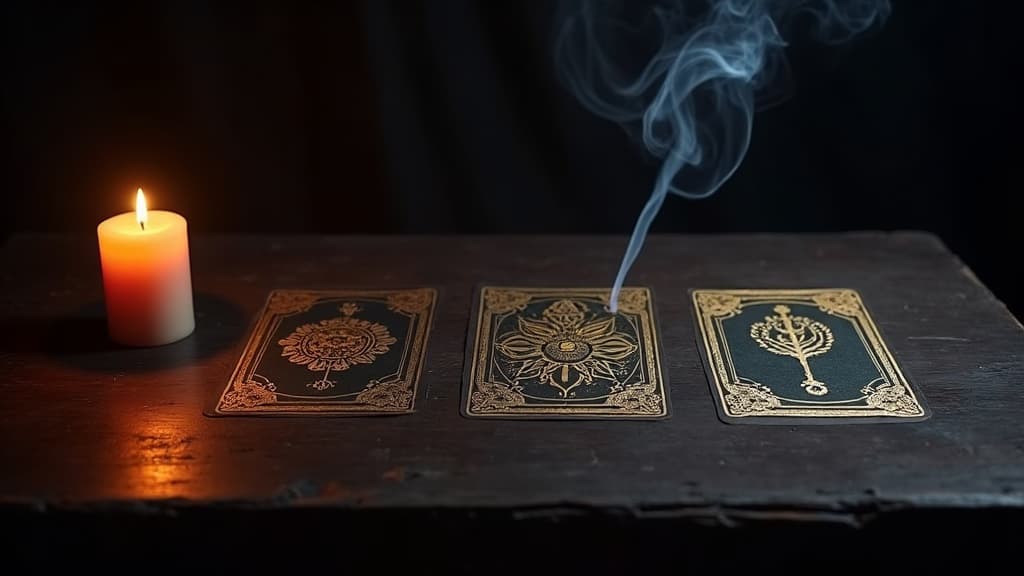
A tarot reading moves through a few clear steps: you settle on a question, the cards are shuffled and drawn, and each one is laid into a fixed position and interpreted in light of both that position and what you asked. At Vidastral a reading is three cards — situation, action, and outcome — revealed one at a time and then read together as a single short piece of writing. Nothing is foretold. The cards are a structured way of reflecting your own situation back to you.
Does a reading begin with a question or with the cards?
It begins with the question, and that first step shapes everything after it. Before a single card is drawn, you name what you actually want to look at — out loud, in writing, or just held clearly in mind. The most useful questions are open and point back at you: not "will he come back?" but "what is the honest state of this connection, and what is it asking of me?" A reading answers that second kind of question well and the first kind poorly. If you have never sat down with a reading before, our guide on what to expect from a first reading covers how to prepare and steady yourself beforehand; and if you want to sharpen the wording itself, the piece on how to write a tarot question walks through the pattern in detail.
What actually happens when the cards are drawn?
Once the question is set, the deck is shuffled and three cards are drawn at random from the full seventy-eight-card Rider-Waite-Smith deck, without replacement — each card can come up upright or reversed. At Vidastral they arrive face-down and are turned over one at a time, which has less to do with suspense than with attention: revealing them in sequence lets each card land before the next changes what it means. The cards themselves are not the reading. They are the raw material. The meaning lives in how the three relate to one another and to the positions they fall into, which is the part the interpretation does. The fuller mechanics of that layout — why the three positions read as one sentence rather than three separate omens — are laid out in our piece on the three-card spread.
What do the three positions mean as the reading unfolds?
Each of the three cards is read through the job of its position. The first is the situation: the ground you are actually standing on, which is not always the ground you assumed. The second is the action: a posture or response the reading suggests you consider, given that ground. The third is the outcome: the trajectory that tends to follow when the first two are taken seriously. To make that concrete, imagine a reading that opens with The Moon in the situation position. In the Rider-Waite-Smith image, a moonlit path runs between two towers while a dog and a wolf howl and a crayfish edges out of a dark pool — an atmosphere of things not yet surfaced. As a situation card, it suggests you cannot yet see the matter clearly, and that some of the fog may be your own.
Say the action position then turns up The Star — a kneeling figure pouring water from two vessels beneath one large eight-pointed star and seven smaller ones. As an action, it does not instruct you to do a particular thing; it points to a posture: tend to what has been depleted, stay open, replenish before you force a decision. And say the outcome is The Fool: a young figure at a cliff's edge with a white rose and a small dog, a bundle on a stick, about to step into open air. As an outcome, The Fool is not a promise of a happy ending. It describes a direction — a genuine beginning, taken one unhurried step at a time — that becomes available if you let the fog sit (The Moon) and tend to yourself (The Star) rather than lunging for certainty. Read in sequence, the three cards are one sentence with three clauses, not three separate verdicts.
The outcome card is never a sentence handed down. It is where the first two cards lean if they are taken seriously — a direction, offered while the direction is still yours to change.
Why does the reading come back as five paragraphs?
At Vidastral the interpretation arrives as plain prose — about five paragraphs, four hundred and fifty to five hundred words, no bullet points, no jargon, no markdown. The form has a reason. A list of card "meanings" reads like a dictionary and leaves the work of connecting them to you; a piece of continuous writing does that connecting out loud. The paragraphs tend to move in a shape: an opening that frames the question and the reading as a whole, then a passage for each position as it relates to the last, and a close that gathers them without tying the matter shut. The prose is deliberately interpretive — it says "this card invites you to consider" rather than "this will happen", and it attributes everything it draws to the Rider-Waite-Smith tradition rather than to any hidden knowledge about you.
Reading it as prose rather than as a chart also slows you down at the right moments. You notice which sentences land with a quiet click of recognition and which slide off as not-quite-right — and both are information. A reading is written to be sat with, not scanned.
What do you do with a reading once it is over?
When the last paragraph ends, the reading is not so much finished as handed to you. Nothing about it obligates you; it is a mirror, not an instruction. The most reliable thing you can do is notice your own reactions, especially resistance. The line you want to argue with is often the one pointing at something you would rather not look at directly, and it tends to be worth more than the line you nod along to. Much of a reading's value shows up not in the moment but in the hours and days after, which is why many readers keep a few notes: the cards drawn, the first reaction before you think too hard about it, and the question the reading raised but did not answer.
A reading obligates you to nothing. It is a mirror, not an instruction — and the face it shows you is worth returning to once the first surprise of it has passed.
You can come back to those notes a week later and see what actually held true and what was only fear or hope talking. That is also how a practice accumulates: Vidastral keeps your past readings so a later one can notice a pattern you might miss — a card that keeps returning, a theme you have circled more than once.
So what happens in a tarot reading is quieter, and more collaborative, than its reputation suggests. You bring a real question; three cards are drawn and turned over; each is read through its position and then woven into a single short piece of writing; and you leave with something to sit with rather than a verdict to obey. The cards do not know your life. You do. A reading is simply a careful, unusual frame for thinking it through — and the whole of it takes only a few minutes, though the part that matters can keep unfolding for days.