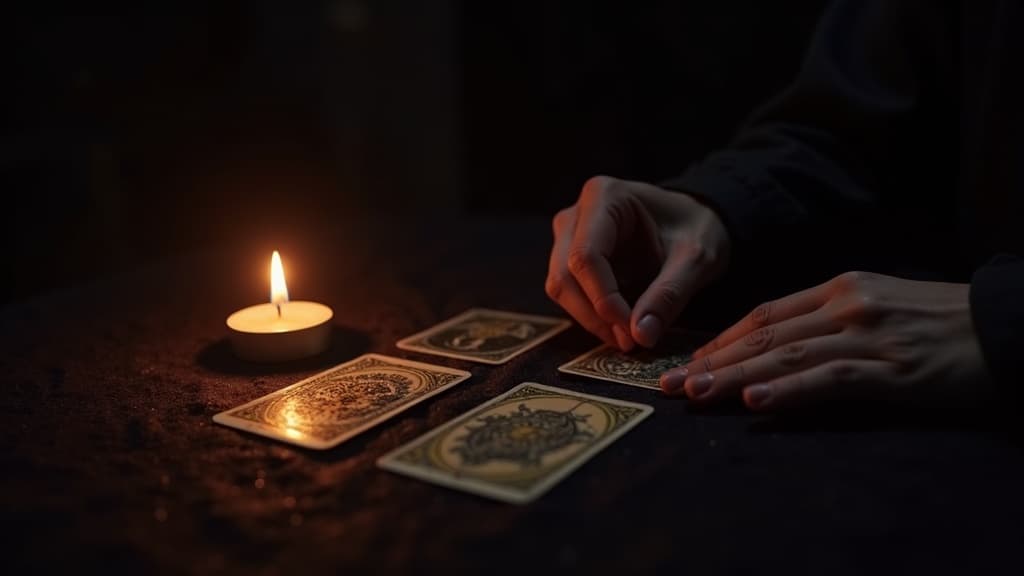
Yes — you can read tarot for yourself, and the honest objection to it is real: when the question is your own, you are too close to it to stay neutral, and it is tempting to read every card as the answer you were hoping for. What keeps a self-reading honest is not willpower but structure — a question written down before you draw, fixed positions, and a commitment to read the cards you actually pulled.
Won't I just see what I want to see?
It is the strongest objection to reading for yourself, and taken at face value it is largely true. When you read for a stranger, you have no stake in which card lands where — you can let the images say what they say. When you read for yourself, the question is one you already have a preferred answer to, and every card arrives in front of a mind that is quietly lobbying for that answer. This is ordinary confirmation bias, sharpened by emotional proximity. In the Rider-Waite-Smith tradition, The Moon is the card that names this exact hazard: a moonlit path between two towers where a dog and a wolf howl at the same light and a crayfish edges out of the water — an image of how easily intuition and wishful projection wear the same face. Reading for yourself, you are always somewhere on that path. The point is not to pretend otherwise; it is to build the reading so that the structure, not your hope, decides what each card gets to mean.
How does a written question and fixed positions keep a self-reading honest?
The first and most protective move is to write your question down before you touch the cards, and then leave it written. A question you only hold in your head is easy to revise after the fact: draw a card you like, and the question quietly reshapes itself into the one that card happens to answer. A question fixed on paper cannot be retrofitted. It also forces the reframing any good reading depends on — the same work our guide to writing a tarot question walks through — turning "will this work out?" into "what is my actual relationship to this, and what is it asking of me?" You commit to the question first, so the cards cannot talk you into a different one.
The second move is to keep the positions fixed. In a three-card spread the cards fall into situation, action, and outcome, and — this is the part that does the honest work — you assign the positions before you draw, not after you see what came up. You cannot slide a card you like into the "outcome" seat and a card you dislike into "the situation I'm leaving behind." Whatever lands in the outcome position is the outcome the reading is offering, whether or not it flatters you. If you want the fuller logic of why three fixed positions read differently than a single card, we cover it in our piece on the three-card spread. The structure does something your judgment, alone with a question you care about, cannot reliably do: it refuses to move the goalposts.
The discipline of a self-reading is simple to state and hard to keep: read the cards you actually drew, in the positions you set beforehand — not the reading you came in wanting.
The third move follows from the first two: read the cards you actually pulled, upright and reversed, including the ones you would rather set aside. A reversed card is not an inconvenience to be re-shuffled away; in the Rider-Waite-Smith tradition it carries its own interpretive layer — a blocked, delayed, or inward expression of the upright meaning — and in a self-reading it is often the reversal that has the most to say, precisely because it is the reading you did not order.
How do you read your own cards without softening them?
A practical trick that works better than trying to be objective by force: read each card as if it had come up for someone else. Ask what you would tell a friend who drew this exact card in this exact position before you ask what it means for you. The interpretation you would offer a stranger is usually the more honest one, because you have no investment in protecting them from it. Then bring that reading back to your own situation. The gap between what you would say to them and what you first wanted the card to mean is a good measure of how much your hope was doing the reading.
The second habit is to pay close attention to the cards you find yourself dismissing. A card you glance at and wave away — "that one doesn't really apply" — is worth stopping on, because resistance is often a sign the card has landed on something true that you are not ready to look at directly. The High Priestess, seated veiled between a dark pillar and a pale one with a crescent moon at her feet, is the tradition's image of knowledge you already hold but have kept behind a veil. Reading for yourself is largely the practice of noticing which cards you are quietly refusing to let past that veil, and asking why.
When should you not read for yourself?
There is a real limit here, and honoring it is part of reading well. When the emotional charge around a question is too high — you are in the middle of a loss, a rupture, a decision you are frightened of — a self-reading is unlikely to be useful, because there is no version of you present that can hold the cards at enough distance to interpret them. In that state you will read reassurance into a hard card or catastrophe into a gentle one, and the structure that usually protects the reading is overwhelmed. The honest move is to set the cards down and come back when the charge has cooled, or to let someone with no stake in your answer read for you instead. Knowing when not to read for yourself is a skill, not a failure.
When you do read for yourself, the reading does not have to end when you put the cards away. Writing down what you drew, in which positions, and what each card stirred — including the ones you resisted — turns a single self-reading into something you can return to. Weeks later you can see which lines held true and which were only fear or hope talking, and that record teaches you more about your own reading habits than any single spread can. A self-reading is not a way to hear the answer you want from a neutral source. It is a way to look at a question you are already close to, through a structure honest enough to show you where you are standing on the path — and, sometimes, which direction you have been refusing to look.