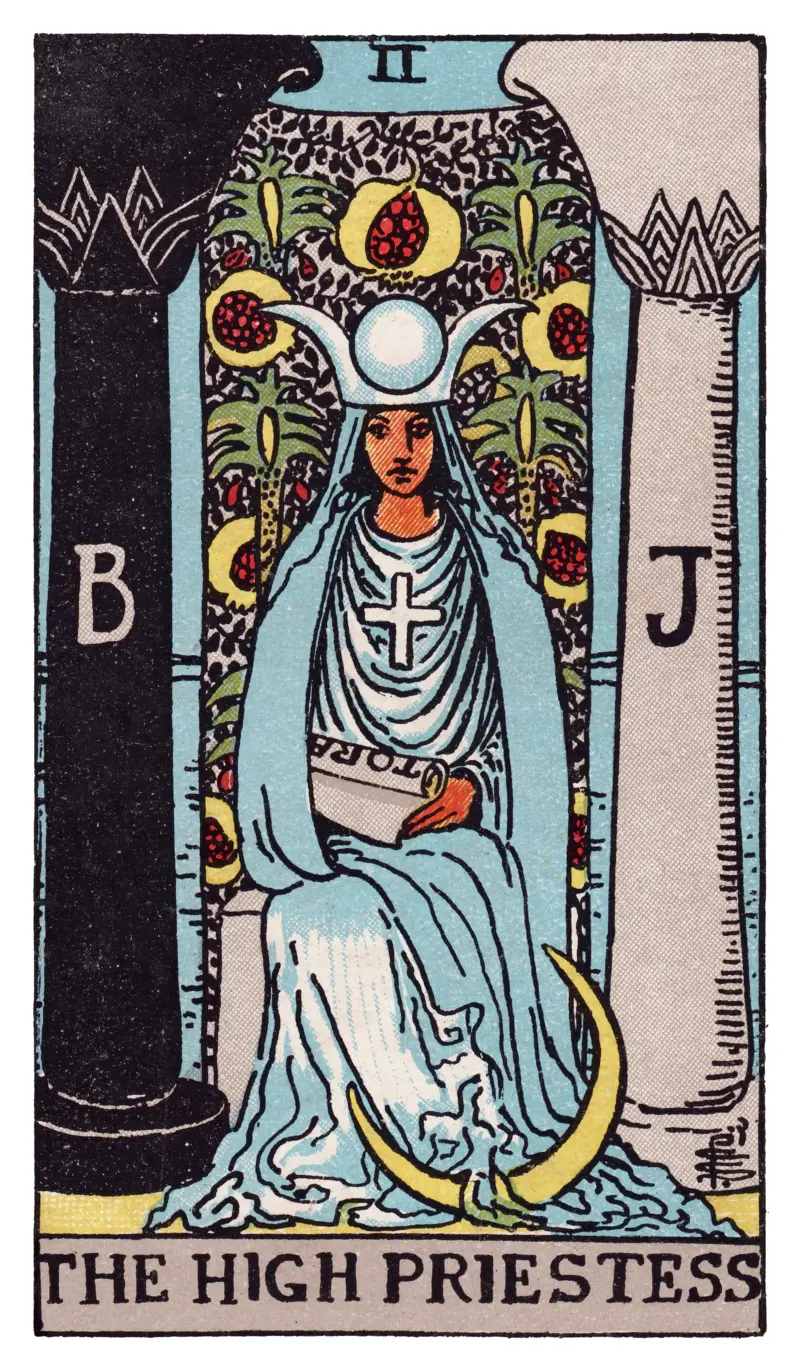
What the card shows
The High Priestess of the Rider-Waite-Smith deck shows a seated figure between two pillars marked B and J, a crescent moon at her feet, a partly hidden Torah scroll on her lap, and a veil patterned with pomegranates behind her.
Upright vs reversed
| Upright | Reversed | |
|---|---|---|
| Keyword | INTUITION | HIDDEN SECRETS |
Upright meaning
In the Rider-Waite-Smith tradition, The High Priestess is read as the card of inner knowing held back from speech — what is sensed but not yet said. Waite called her the guardian of the unwritten, and the veil behind her is the tradition's image of what is glimpsed rather than grasped. Practitioners often read the card as a sign that the question contains more than the surface offers, and that the reader's quieter responses to it deserve attention before the louder ones.
The two pillars frame her as a threshold figure: she sits between what has been formulated and what has not. Modern RWS commentary tends to associate her with intuition treated as discipline rather than as drift — patient listening, deliberate withholding, the practice of not deciding before one has truly heard. As an upright card, she is most often read as a counsel to slow down, observe, and trust signals that are not yet loud.
Reversed meaning
Reversed, The High Priestess is traditionally read as the inner channel obstructed: noise drowning out signal, secrets that have curdled, or surface activity that masks what one already knows underneath. Many modern practitioners read the reversal not as the absence of intuition but as inattention to it — a moment in which the reader has not yet given the inward voice the time and silence it requires.
In a reading
In a situation position, The High Priestess is often read as naming a moment when more is in motion beneath the surface than is visible. In an action position, it is commonly interpreted as a call to wait, to listen, and to refuse the pressure to speak before knowing. In an outcome position, the card is read as a future shaped by inward attention rather than by external event.
In combination
The High Priestess and The Moon together form one of the most interior pairings in the Major Arcana — both associated with what lies beneath the surface, with what is not yet articulated. The tradition often reads this combination as a sign that the central question is not yet ready to be answered from the outside in. The High Priestess with The Hierophant names a recognizable tension: formal teaching alongside inner knowing, institution alongside intuition. When The High Priestess appears alongside The Empress, RWS commentary tends to read the pairing as inner knowing becoming generative — intuition trusted long enough to bear fruit.
Frequently asked questions
- What does The High Priestess mean in a love reading?
- In a love reading, The High Priestess is most often read as the card of what is felt but not yet said — intuitions about a relationship that have not been spoken, dynamics that are sensed beneath the surface. The RWS tradition reads this not as a warning to stay silent but as a signal that the slower responses deserve attention before the decisive ones. Some practitioners also read the card as the presence of something in the relationship that has not yet been fully revealed.
- What does The High Priestess mean in a career reading?
- In a career reading, The High Priestess often names a moment when more information is available than is being consulted. The tradition reads it as a call to slow the rate of decision-making and to trust the quieter assessment — the initial read on a situation, the persistent unease, the thing that cannot be cited in a meeting but has not been wrong. It is not read as a reason to avoid deciding; it is read as a reason to decide from the right level of awareness.
- What does The High Priestess reversed mean?
- Reversed, The High Priestess is traditionally read as the inner signal being drowned out — by noise, by urgency, by the desire to appear certain when one is not. Modern practitioners often read the reversal as a moment when the reader has been cut off from their own knowing, whether by circumstance or by choice. The card reversed does not suggest the intuition is gone; it suggests it has not been given conditions to be heard.
These notes follow the Rider-Waite-Smith tradition. They describe what the card is associated with — not predictions about your life.