In a love reading, The High Priestess points to what is felt but not yet spoken. Upright, the Rider-Waite-Smith tradition links her to hidden feelings — yours, theirs, or both — and to a connection still forming beneath the surface, where intuition knows more than anything said out loud. Reversed, she tends to describe intuition being overridden, or a secret kept too long. She does not reveal what another person feels; she asks what you already sense.
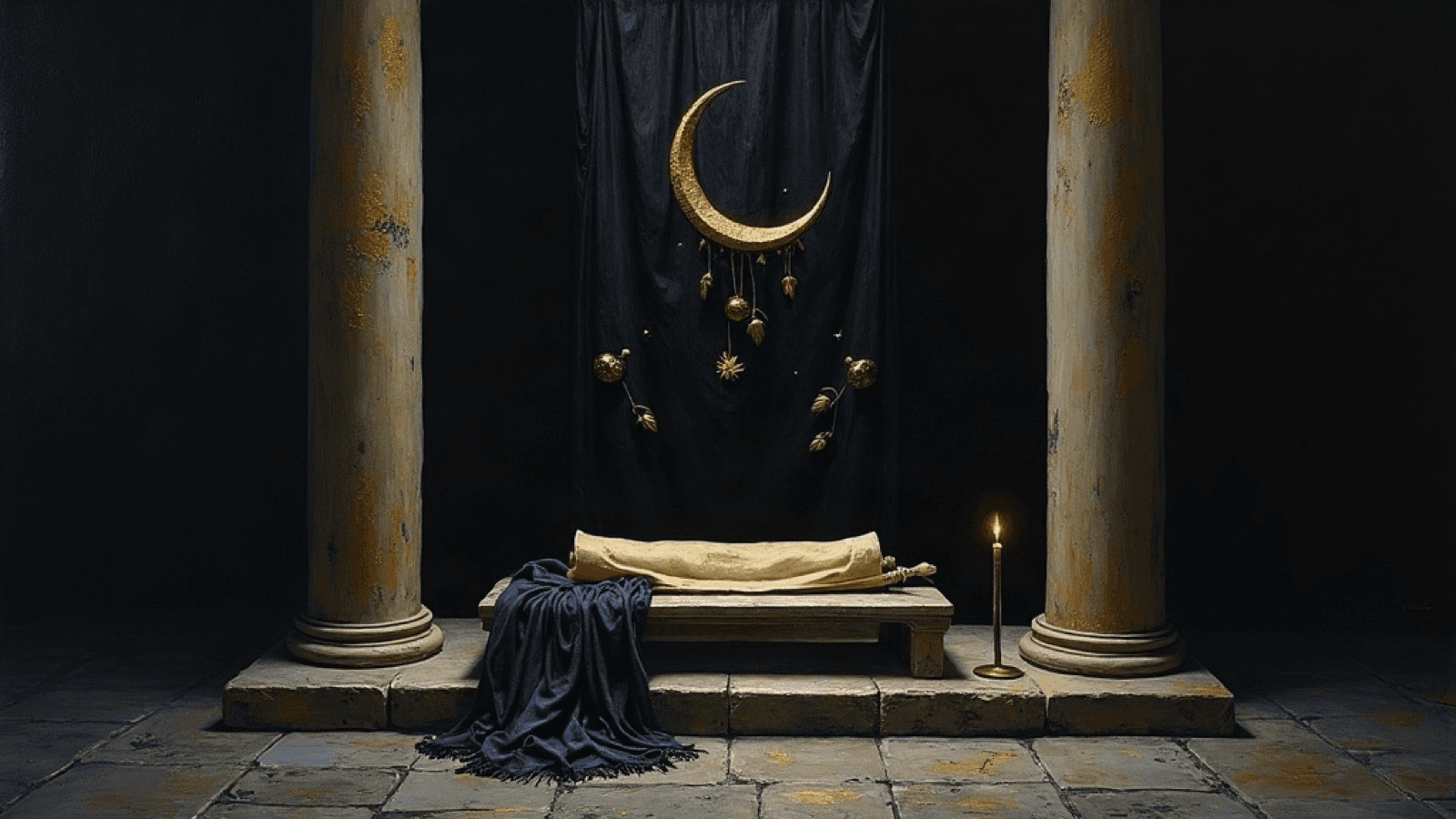
The image sets the tone. A woman in a long blue robe sits perfectly still between two pillars, one black and one pale. Behind her hangs a veil patterned with pomegranates, and past its edges you can glimpse water. A crescent moon rests at her feet, her crown echoes the moon's phases, and a scroll lies in her lap, partly covered by a fold of her robe. Nothing in the scene is moving. Nobody is speaking. Whatever she knows, she is not announcing it.
That stillness is the key to reading her in matters of the heart. The High Priestess is not a card of declarations, dates, or grand gestures. She stands for the part of a connection that exists before it has words — the pull you notice before you can explain it, the thing between two people that both of them feel and neither has named.
Does The High Priestess mean someone has hidden feelings for you?
This is the question most people bring to her, and it deserves a careful answer. Because the tradition ties the card to secrets, hidden knowledge, and the unspoken, it is tempting to read her as confirmation that someone is quietly holding feelings for you. But no card can see into another person's heart, and no honest reading can hand you that as a fact. What The High Priestess does point to is the presence of something unspoken in the situation. Whose it is, and what it holds, is left open.
Sometimes the unspoken thing is theirs: a hesitation, an attraction, a history you don't know about. Just as often it is yours — a feeling you haven't admitted to yourself, or one you've admitted privately but never aloud. The pomegranate veil hides what lies behind it without denying that anything is there. In a love reading, that is the posture the card invites: to take seriously what you sense, without mistaking a sense for proof. Intuition is information worth listening to. It is also worth checking — gently, directly, in the real world, with the real person.
The High Priestess does not tell you what is behind the veil. She tells you there is a veil, and that you are allowed to notice it.
What does The High Priestess upright suggest in a relationship reading?
Upright, the tradition reads her as a relationship — or a possibility — still taking shape beneath the surface. If you are single and she appears around a particular person, the reading may be reflecting a connection that runs on glances, silences, and timing more than on anything stated. There is meaning there, but it hasn't yet been tested by words, and the card suggests not rushing it into a shape before it is ready to hold one.
If you are in a relationship, she often points to what is understood between you without being said. That can be a sign of deep intimacy, or of a conversation that keeps getting postponed. The two pillars flank her, dark and light, and she sits in the space between them rather than choosing either. In a love question, that placement can speak to holding two truths at once: what you feel and what you have said, what you hope and what you know. The card invites you to trust your inner knowing enough to let it guide the next honest conversation — not to replace that conversation.
What does The High Priestess reversed mean in love?
Reversed, The High Priestess is not simply the opposite of intuition. In the Rider-Waite-Smith tradition, a reversal often describes the same energy blocked, turned inward, or pushed aside. In a love reading, that can look like overriding something you sensed early on because the facts seemed to argue against it, or talking yourself out of a quiet discomfort because naming it would change things.
It can also point to a secret that has stayed hidden past the point where hiding it protects anyone. Something unspoken that once gave a relationship its intimacy may now be putting distance between two people. And sometimes the reversal speaks less about disconnection from the other person than about disconnection from yourself — being so focused on decoding someone else's signals that you've stopped listening to your own. The scroll is still in her lap, partly covered. The reversal asks whether you've stopped looking at it.
How can you work with The High Priestess when she appears in a love spread?
The card rewards slowness. Before deciding what she means for your situation, it can help to sit with a few questions. What have I noticed about this person, or this relationship, that I haven't said out loud? Is there a feeling I keep returning to, even when I try to set it aside? What would I need to know to trust that feeling — and could I simply ask? Writing the answers down tends to separate intuition from anxiety more clearly than turning them over in your head.
Her neighbors in the spread shape the reading too. Beside The Moon, whose love meaning also turns on what hasn't surfaced yet, the emphasis shifts toward telling intuition apart from fear, since both cards live in half-light. Beside The Lovers, the unspoken current may be moving toward a moment of open choice. And if you are reading the cards for yourself, The High Priestess is a reminder that your own knowing is part of the reading — sometimes the part you are most tempted to skip.
In love, the question is rarely only what the other person feels. It is also what you have already noticed, and have not yet let yourself say.
There is a particular kind of patience in this card — not waiting for someone else to decide, but letting what you already sense come into focus before you act on it. So much effort in love goes into decoding the other person that it is easy to lose track of the quieter voice underneath. The High Priestess sits with that voice, the veil at her back, the scroll half-open. She doesn't ask you to guess what lies behind the veil. She asks you to notice what you already know, and to find the words for it when the time comes.