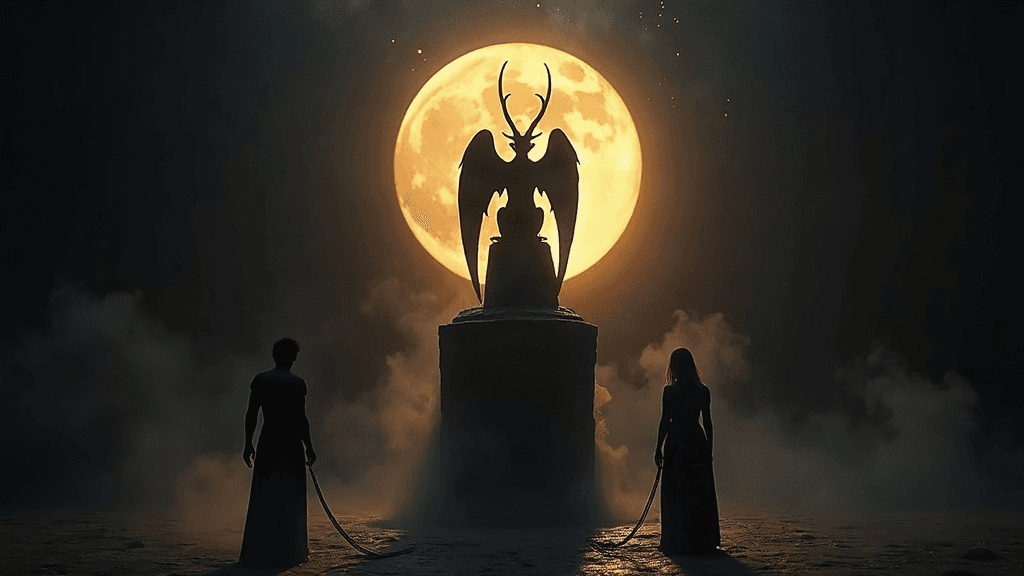
In a love reading, The Devil points to attachment — the pull between two people that has grown strong enough to feel as if it has a will of its own. In the Rider-Waite-Smith tradition it can describe intense passion, a dependency, or a pattern both people keep repeating without quite choosing it. The card does not condemn a relationship. It asks what is holding you in place, and whether you are still consenting to it.
The image itself carries most of the argument. In the Rider-Waite-Smith deck, a horned figure with dark, bat-like wings sits on a black pedestal, a torch lowered in one hand. Chained to a ring on that pedestal stand two figures, a man and a woman, each with small horns of their own. The chains around their necks hang loose — nothing stops either of them from lifting the loop over their head. Many readers treat that detail as the key to the card, and in love it matters most: the bond is real, but much of its hold is kept in place from the inside.
Why does The Devil look so much like The Lovers?
Set The Devil beside The Lovers and the resemblance is hard to miss: the same pair of figures appears in both. In The Lovers an angel spreads its wings above them under an open sky; in The Devil the winged presence has turned dark and the space has closed in. Readers in the RWS tradition often treat the two as the same bond seen at two different moments. The Lovers is connection chosen freely, with eyes open. The Devil is connection that has started to run on need, habit, or fear of what would happen without it.
That is why the card appears so often in love questions. It rarely describes something foreign entering a relationship. More often it reflects genuine desire that has quietly changed shape: longing turned compulsion, closeness turned condition, intensity now hard to tell apart from the difficulty of leaving.
What does The Devil upright mean in a relationship reading?
Upright, The Devil in a love reading tends to describe a strong pull that feels partly out of your hands. Sometimes that is simply heat — an attraction so vivid it crowds out everything else. The tradition does not treat desire as a problem, and the card can reflect a connection that is intensely alive. What it asks is whether that intensity still leaves room for choice.
In other readings the card reflects a dynamic rather than a feeling — a pattern two people keep returning to even when both can see where it goes. The same argument on a loop. Staying because leaving feels unthinkable, not because staying feels right. Jealousy that has quietly become a form of attention. The Devil upright invites you to name the pattern plainly, before deciding what to do about it.
If you are single and the question is about someone you cannot stop thinking about, the card points the same way — toward the difference between wanting someone and being held by the wanting itself. Neither is shameful, but they are not the same thing, and The Devil draws the line between them.
The chains in The Devil are loose enough to lift off. The card is less interested in whether you stay than in whether staying is still a choice.
Does The Devil mean a relationship is toxic?
No — and it helps to be precise about why. The Devil describes a pattern, not a verdict on a person or a relationship. It does not say your partner is bad for you or that the bond is doomed. In the RWS tradition, the card's focus is consent: where something once chosen freely now runs on habit, fear, or need. That can happen in loving relationships as easily as in difficult ones, and naming it is often the first step toward a healthier version of the same bond.
The card also rarely points in one direction only. Look again at the image: both figures wear the chain. In a reading about a relationship, The Devil tends to reflect the whole dynamic rather than hanging the chain on one person. The more useful question is seldom "who is doing this to me?" and more often "what am I holding onto, and what does holding on give me?" That question is uncomfortable, but it returns some agency to you. And if what you are living with involves fear for your safety, that is a question for people you trust and for support services, not for the cards.
What does The Devil reversed mean in love?
Reversed, The Devil is traditionally read as the chain beginning to loosen. In a love reading this can reflect the moment a pattern becomes visible, perhaps for the first time. It can also point to reclaiming agency: setting a boundary you have been circling, stepping back from a dynamic that has cost more than it gave, or simply admitting what you actually want.
A reversal is not a simple opposite, and release is rarely instant. The reversed Devil can describe the in-between stage, when you know the chain is loose but still feel its weight out of habit. The card does not say how that ends; it acknowledges that awareness is already a shift. Our guide to reading reversed cards explores why a reversal so often reads as a process rather than a switch.
How can you sit with The Devil when it appears in a love reading?
Position shapes the conversation. In a three-card spread, The Devil in the situation seat tends to name the pattern as the ground the question stands on. In the action seat, it can invite you to examine what you are consenting to and what you might be ready to set down. In the outcome seat, it is often read as where things lean if the pattern continues unexamined — a tendency, not a sentence.
Neighboring cards color it too. Beside The Tower — explored in our post on The Tower in a love reading — The Devil can suggest a binding pattern meeting sudden disruption: what was never examined by choice being examined by circumstance. Beside The Lovers, the pairing sharpens the card's central question — the free choice and what makes it difficult, side by side.
Whatever the position, a few questions tend to open the card up. What do I get from this pattern, even when it hurts? What would I be afraid of if the chain came off? Where in this relationship am I choosing, and where am I only repeating?
The Devil is one of the most feared cards in the deck, and in love it can land like an accusation. Read closely, it is closer to a mirror held at an honest angle. The figures at the foot of the pedestal are not bound by anything they cannot touch. The chain rests right there on their shoulders, and the card's quiet insistence is that you look at it closely enough to see whose hands could lift it.