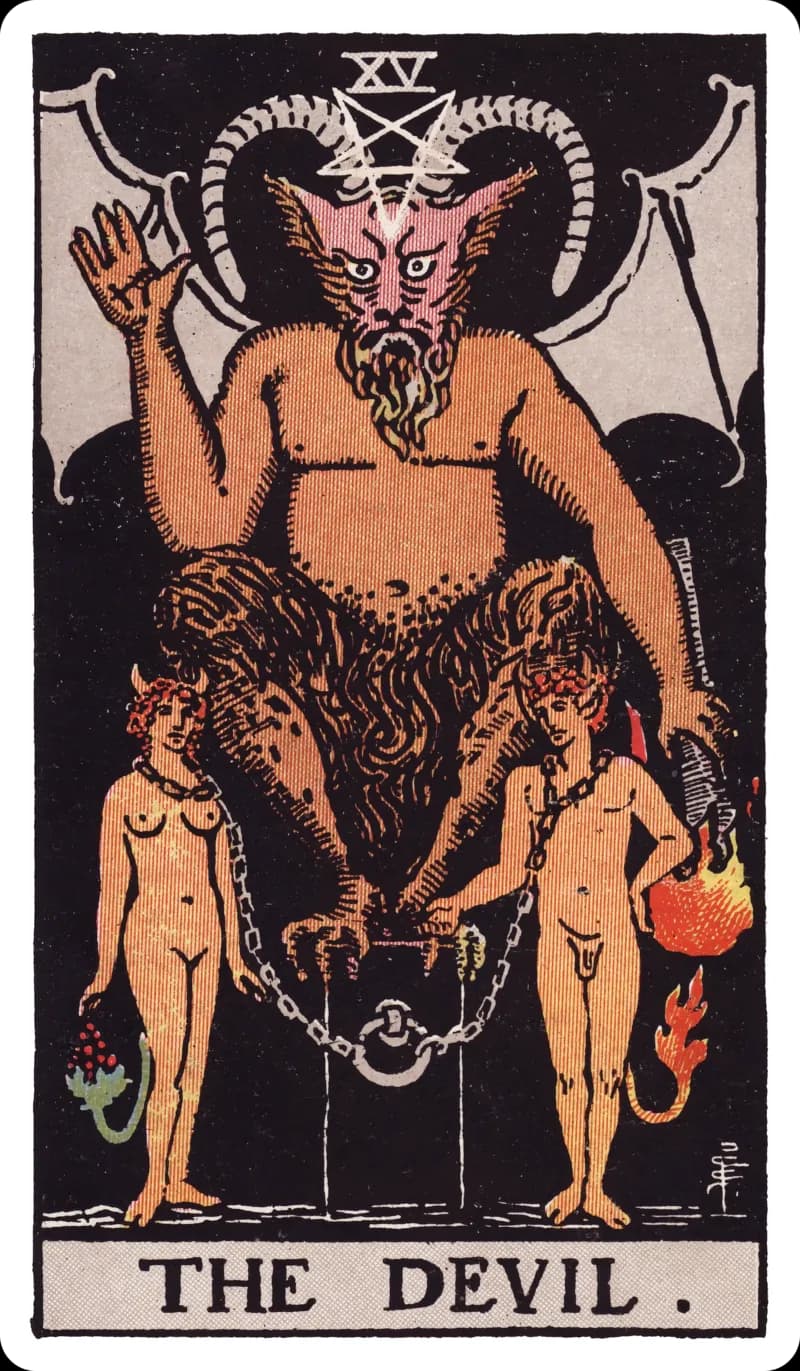
What the card shows
The Devil of the Rider-Waite-Smith deck shows a horned figure perched on a black cube, two nude figures chained loosely at its feet — their chains fitted around their own necks, but slack enough to lift off if they chose.
Upright vs reversed
| Upright | Reversed | |
|---|---|---|
| Keyword | ATTACHMENT | RELEASE |
Upright meaning
In the Rider-Waite-Smith tradition, The Devil is read as the card of attachment that has begun to bind — the recognition that something the reader is holding onto has, over time, started holding onto them. Waite was careful to note that the chains around the figures' necks are loose; his point was that bondage in the card is largely self-administered. Practitioners often read this card as a sign that the question concerns a relationship, habit, ambition, or fear that has begun to operate beyond the reader's clear consent.
The black cube and the inverted star above the figure's head are associated in modern RWS commentary with material concern that has become totalizing: a value that was once one among many is now the value through which everything else is filtered. The Golden Dawn correspondence to Capricorn grounds the card in themes of structure, ambition, and the heaviness of obligations one has helped to build. As an upright card, The Devil is most often interpreted as the counsel to look at what one is actually consenting to, and to notice where consent has been replaced by habit.
Reversed meaning
Reversed, The Devil is traditionally read as the loosening of the chain: a binding pattern recognized for what it is, an attachment that begins to lose its hold, or — in some readings — the early phase of breaking free in which the chain is still felt strongly even as it is being undone. Waite associated the reversal with weak temptation and beginnings of release; many modern practitioners read it as a prompt to name what one is willing to let go of, even before the letting go is complete.
In a reading
In a situation position, The Devil is often read as naming a context shaped by an attachment the reader has not yet looked at squarely. In an action position, it is interpreted as a call to examine consent, identify what is binding, and decide whether to keep wearing the chain. In an outcome position, the card is commonly read as a continuation of the binding pattern unless the reader actively addresses it.
In combination
The Devil and The Tower together are read in the RWS tradition as compulsion meeting sudden collapse — the binding pattern and the structure that held it meeting an unexpected disruption. The combination often reads as a forced reckoning: what the reader did not choose to examine is being examined by circumstance. The Devil with The Lovers names the central tension of the card: the choice that could be made alongside the patterns that are making it difficult. When The Devil appears with Strength, the tradition reads the pairing as the patient, non-coercive approach meeting the compulsive — the question of whether what has been binding can be met with steady presence rather than confrontation.
Frequently asked questions
- What does The Devil mean in a love reading?
- In a love reading, The Devil is most often read as a relationship operating through patterns of attachment that are not serving either party — compulsion, co-dependency, or the kind of bond that holds through need rather than through genuine choice. The tradition does not read this as the relationship being condemned; it reads the patterns within the relationship as being named. The chained figures in the card's imagery can step free; the question the card raises is why they have not.
- What does The Devil mean in a career reading?
- In a career reading, The Devil typically names a professional situation defined by a sense of being trapped — a role, a contract, or an addiction to a form of work that is damaging. The tradition does not read this as absolute; it reads it as the recognition that the condition feels inescapable but is not. Modern practitioners often note that the card appears when someone already knows they are in a harmful pattern but has not yet named it as something they have the capacity to change.
- What does The Devil reversed mean?
- Reversed, The Devil is traditionally read as the beginning of release from what has held — the recognition of a binding pattern, or the first real movement away from what has been compulsive. Modern practitioners often read this as one of the more hopeful reversals: the card reversed names the awareness that was absent when the card was upright. In some readings, it names the work of recovery or the gradual detachment from what has been addictive.
These notes follow the Rider-Waite-Smith tradition. They describe what the card is associated with — not predictions about your life.