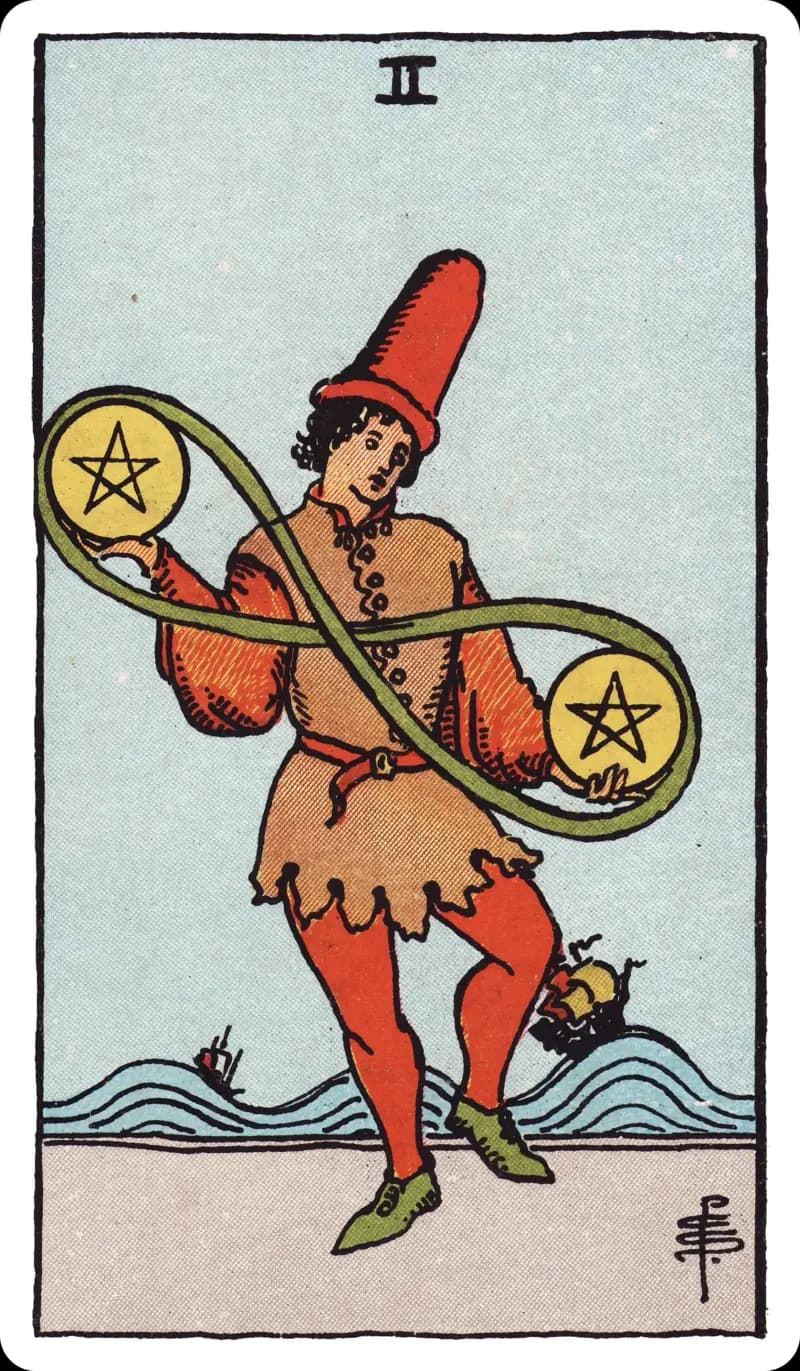
What the card shows
A young figure in a tall hat juggles two large pentacles connected by an infinity ribbon, or lemniscate; in the background, two ships ride enormous cresting waves under a turbulent sky.
Upright vs reversed
| Upright | Reversed | |
|---|---|---|
| Keyword | BALANCE | OVERCOMMITTED |
Upright meaning
In the Rider-Waite-Smith tradition, the Two of Pentacles is read as the art of holding two material demands in motion simultaneously without losing either. The lemniscate — the figure-eight ribbon connecting the two coins — is the card's central symbol: it is the sign of infinity, of continuous circulation, and of the balance that is not stillness but ongoing adjustment. The juggler is not standing still; the figure is in motion, and that motion is the balance itself. Waite read the Twos as the stabilization of the Ace's initial force, and in Pentacles that stabilization is not a fixed state but a practiced rhythm. The ships behind the figure ride extreme waves, a visual argument that turbulent conditions are the context in which this skill is being exercised — the background is not calm, and the card does not promise it will become so.
In contemporary RWS practice, the Two of Pentacles is commonly read as the everyday reality of managing competing financial or practical priorities — balancing work and personal obligations, cash flow between two income streams, or two projects pulling at the same resources. The card acknowledges that this management requires skill and attention; it is not criticism but description. Practitioners often note that the card advises adaptability over rigidity: the juggler who tries to hold both coins still will drop both. The lemniscate also suggests that what feels like conflict may be part of a larger, sustainable cycle.
Reversed meaning
Reversed, the Two of Pentacles indicates that the balancing act has become unsustainable — too many material demands are pulling in competing directions, and the juggler is beginning to lose rhythm. The tradition reads this as a signal that priorities need to be restructured before something drops. It may also indicate poor financial management, overextension, or a pattern of reactive firefighting rather than deliberate planning. Practitioners read the reversed Two as a call to choose: not everything can be held at once, and naming what matters most is the first form of recovery.
In a reading
In the Situation position, the Two of Pentacles describes a period of active juggling — multiple financial or practical demands competing for the same attention and resources. In the Action position, it advises flexible management and conscious prioritization rather than trying to fix all variables at once. In the Outcome position, it suggests the situation will require ongoing adaptation; a stable equilibrium is achievable, but it will be dynamic rather than permanent.
In combination
The Two of Pentacles beside The Chariot is read in the RWS tradition as competing demands brought under deliberate direction — motion mastered rather than merely endured. Paired with the Ten of Wands, the sequence sharpens into warning territory: juggling that has hardened into overload, the dance becoming a burden carried uphill. When the Two of Pentacles appears with Temperance, practitioners often read the possibility of genuine equilibrium — the art of proportion applied to a life that has been improvising its balance.
Frequently asked questions
- What does the Two of Pentacles mean in a love reading?
- In a love reading, the Two of Pentacles is traditionally read as a relationship being balanced against other demands — work, family, finances, or two commitments competing for the same hours. For someone single, it can name a season in which attention is too divided for a new connection to receive its share. For someone in a relationship, it often describes the practical choreography of a shared life rather than a problem with the bond itself. The card describes the juggling; it does not judge it.
- What does the Two of Pentacles mean in a career or money reading?
- In career and money questions, the Two of Pentacles usually names competing practical priorities — two income streams, two projects, or cash flow that requires constant adjustment. The tradition reads the lemniscate joining the coins as circulation rather than crisis: the balance is dynamic, sustained by motion. The card is interpretive, not advisory — it does not say which coin to set down. It observes that rhythm, not rigidity, is what keeps both in the air, and asks what the current rhythm is costing.
- What does the Two of Pentacles reversed mean in a reading?
- The Two of Pentacles reversed is traditionally read as the juggling act becoming unsustainable — too many material demands pulling in opposite directions, and the rhythm beginning to falter. It often appears when priorities have gone unexamined, when overextension is being managed by reaction rather than by planning, or when something is quietly being dropped. The tradition reads it as a call to name what matters most; it does not predict what will fall, only that not everything can be held at once.
These notes follow the Rider-Waite-Smith tradition. They describe what the card is associated with — not predictions about your life.