What the card shows
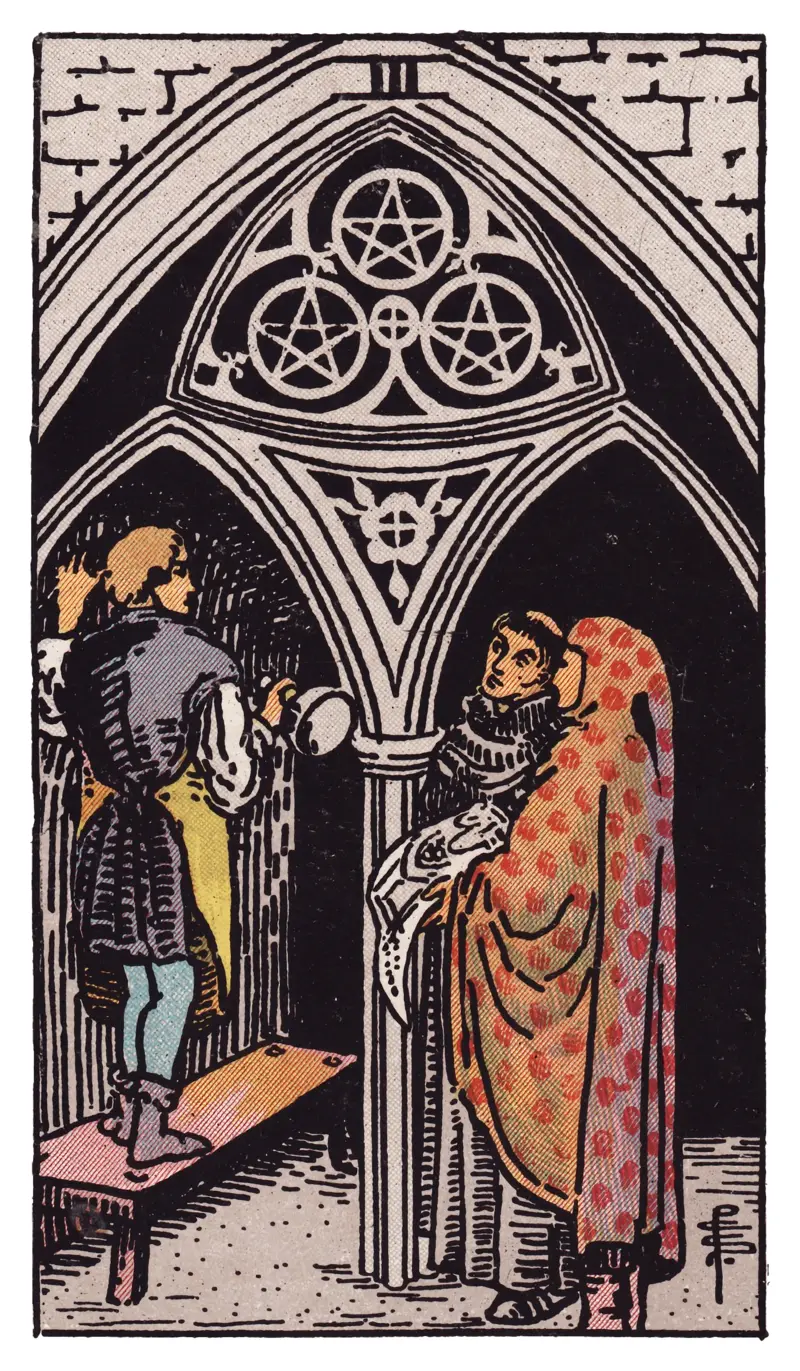
Three figures stand in the stone interior of a Gothic cathedral: an architect and a robed monk consult scrolls while a craftsman stands elevated on a workbench, tools in hand, having just carved the three pentacles visible in the stonework above them.
Upright vs reversed
| Upright | Reversed | |
|---|---|---|
| Keyword | CRAFT | POOR TEAMWORK |
Upright meaning
In the Rider-Waite-Smith tradition, the Three of Pentacles is read as the productive convergence of distinct skills toward a shared material goal. The cathedral setting is significant: this is not a small or provisional project but an enduring structure being built with intention and craft. Waite associated the Threes with the first tangible realization of a suit's energy, and in Pentacles that realization arrives through collaboration — the architect brings design, the monk brings purpose and patronage, the craftsman brings execution. Notably, the three figures are shown in conference rather than working in isolation; the card argues that quality material work is rarely a solo achievement. The craftsman is elevated — literally above the others — a detail that practitioners read as the card's acknowledgment that skilled labor and technical mastery are not subordinate to authority but integral to it.
Contemporary RWS readers frequently associate the Three of Pentacles with apprenticeship, teamwork, and the early stages of building something that will last. The card often appears when a project has moved past ideation and begun to take physical form — when the first real work has been done and its quality is being reviewed by collaborators. It is read as an encouragement to continue: the initial results are sound, the collaboration is functioning, and the structure being built is worth the effort. Practitioners also note that the card values craft for its own sake, not only as a means to income.
Reversed meaning
Reversed, the Three of Pentacles points to a breakdown in collaboration — team members working at cross-purposes, plans that are not being communicated clearly, or skilled work that is being dismissed or undervalued by those directing the project. The tradition also reads this reversal as a warning against mediocrity: cutting corners, rushing craftsmanship, or proceeding without adequate planning. Practitioners sometimes read the reversed Three as an indication that the wrong people are in the room — the expertise needed is either absent or not being consulted.
In a reading
In the Situation position, the Three of Pentacles identifies a collaborative material effort underway — a project that requires multiple skill sets and is beginning to take concrete form. In the Action position, it counsels seeking the right collaborators, reviewing plans carefully, and honoring the craft involved rather than rushing toward completion. In the Outcome position, it suggests that sustained teamwork and skilled execution will produce something durable and well-made.
In combination
The Three of Pentacles beside The Hierophant is read in the RWS tradition as craft meeting institution — skilled work carried out within an established structure, with its resources and its constraints. Paired with the Eight of Pentacles, the sequence traces a single arc of mastery: the apprentice's collaboration maturing into the discipline of solitary practice. When the Three of Pentacles appears with the Five of Wands, practitioners often read friction inside the team itself — competing visions that must become conference before the building can continue.
Frequently asked questions
- What does the Three of Pentacles mean in a love reading?
- In a love reading, the Three of Pentacles is traditionally read as a relationship in construction — two people building something durable through deliberate, cooperative effort rather than through intensity alone. For someone single, it can name a connection likely to grow from shared work, craft, or a common project. For someone in a relationship, it often marks a phase in which the partnership functions as a team: plans reviewed together, roles respected, the quality of the shared structure taken seriously. The card values collaboration over spectacle.
- What does the Three of Pentacles mean in a career or money reading?
- In career and money questions, the Three of Pentacles usually names collaborative work that is beginning to take real form — a project past ideation, early results under review, skill recognized within a team. The tradition reads the elevated craftsman as a statement that expertise deserves standing alongside authority. The card does not promise promotion or payment; it is interpretation, not career advice. It observes that what is being built is durable, and that the right collaborators are part of the material.
- What does the Three of Pentacles reversed mean in a reading?
- The Three of Pentacles reversed is traditionally read as collaboration breaking down — cross-purposes in a team, plans that are not being communicated, or skilled work dismissed by those directing it. It can also name mediocrity tolerated: corners cut, craftsmanship rushed, planning skipped. Practitioners sometimes read it as a sign that the expertise the situation needs is absent from the room or not being consulted. The reversal describes the state of the work; it does not assign permanent blame.
These notes follow the Rider-Waite-Smith tradition. They describe what the card is associated with — not predictions about your life.