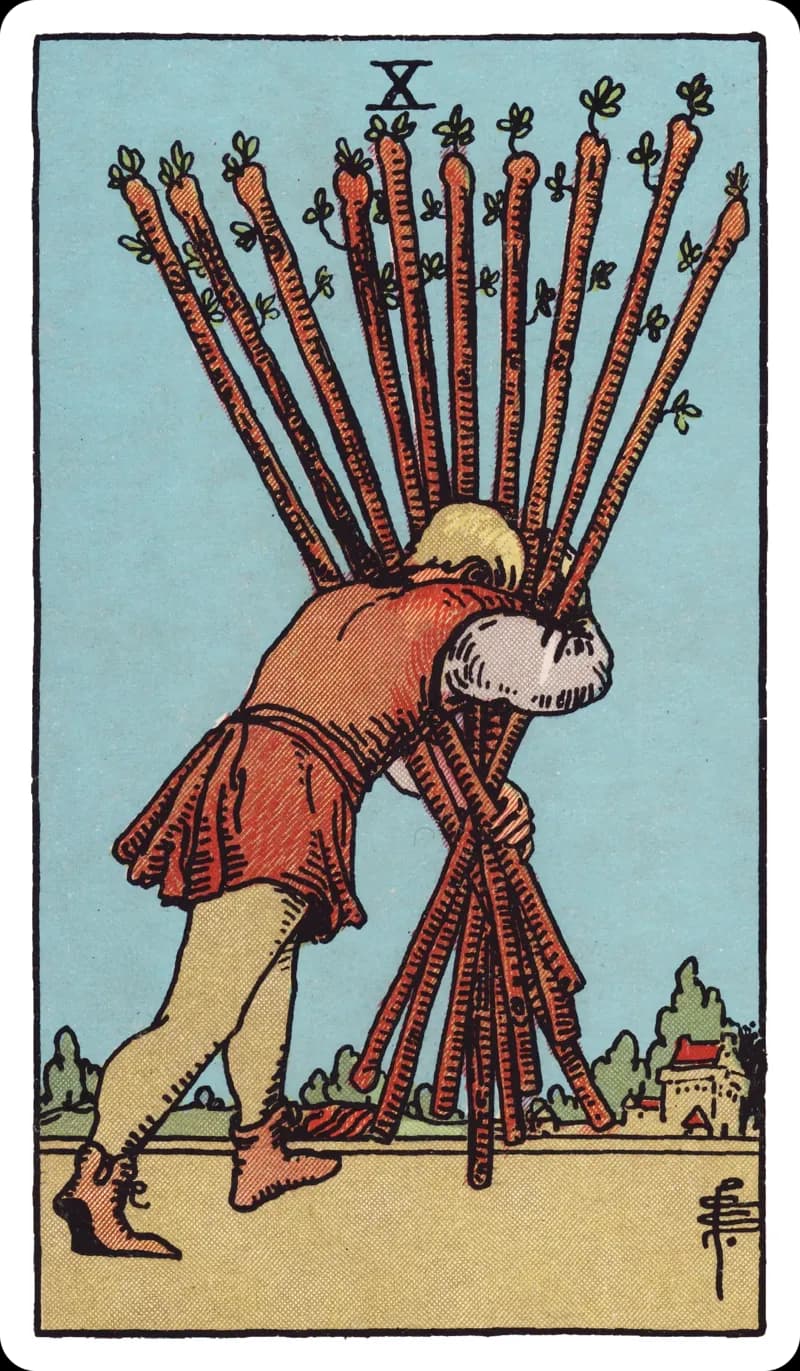
What the card shows
A bent figure trudges forward carrying ten wands bundled tightly against their body, their face obscured by the burden; a town with buildings is visible in the near distance.
Upright vs reversed
| Upright | Reversed | |
|---|---|---|
| Keyword | BURDEN | LETTING GO |
Upright meaning
In the Rider-Waite-Smith tradition, the Ten of Wands is read as the card of the burden that has become unsustainable — the fire of the suit has accumulated into a load too heavy for the figure to carry with any lightness, and they can no longer see where they are going. The face is hidden by the wands, the back is bent, and the town that represents the destination is visible and close, but the path to it is being walked in compressed endurance rather than joy. Waite described this card as one of oppression: not necessarily oppression from outside, but the self-imposed kind — the accumulation of responsibility, obligation, and effort beyond what can be borne with grace. Practitioners often note that the figure is carrying all ten wands alone, when they could be put down, redistributed, or simply set aside.
In contemporary RWS practice, the Ten of Wands tends to appear when overcommitment has become the defining condition of a person's life — when they are doing everything themselves, refusing delegation, holding on to every task and responsibility out of conviction that no one else can or will handle it. The tradition does not read this card as a mark of virtue; the burden is real, but so is the choice to carry it as it is currently being carried. Practitioners often read the Ten of Wands as an invitation to examine what can be set down — not as failure, but as the necessary act before the next cycle can begin cleanly.
Reversed meaning
Reversed, the Ten of Wands in the RWS tradition can signal that a burden is being released, whether through choice or circumstance — the wands are falling, scattering, no longer held in that oppressive bundle. This may be a relief or a disruption, depending on whether the release was chosen or imposed. Some practitioners read the reversed Ten as the moment of finally putting down what was never truly the querent's to carry. In other readings, the reversal suggests a refusal to acknowledge the weight: the figure insisting the load is manageable when the evidence says otherwise.
In a reading
In the situation position, the Ten of Wands identifies a moment of significant overload — more is being carried than the current structure can support without cost, and the destination is visible but not yet reached. In the action position, the card counsels examining what can be delegated, released, or simply put down; the tradition reads the continued solitary carrying as its own kind of choice. In the outcome position, the Ten of Wands warns that current patterns of accumulation are heading toward a point where something will give — and it is better to choose what yields than to have it decided by the weight.
These notes follow the Rider-Waite-Smith tradition. They describe what the card is associated with — not predictions about your life.