What the card shows
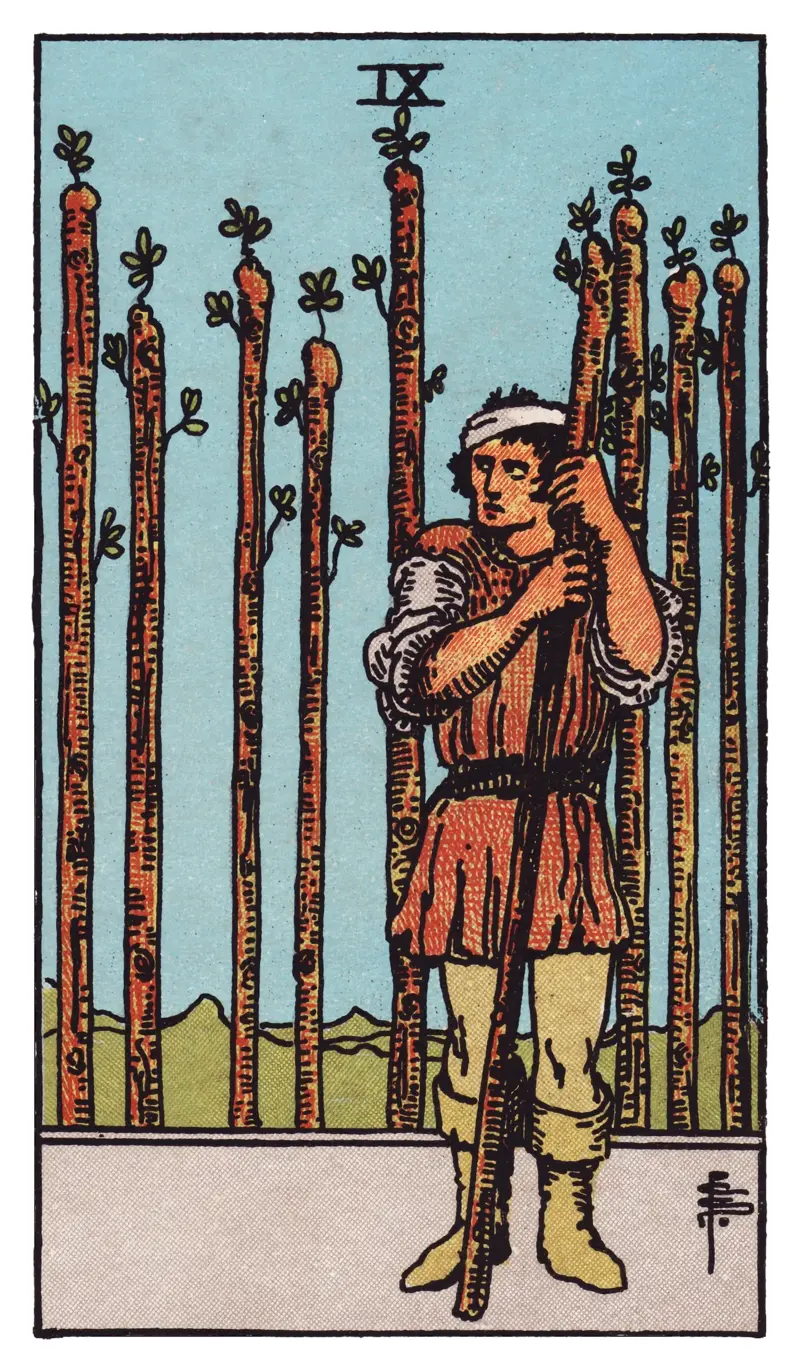
A bandaged figure leans on a wand, looking warily over one shoulder; behind them stands a row of eight more wands, forming a barrier at their back.
Upright vs reversed
| Upright | Reversed | |
|---|---|---|
| Keyword | RESILIENCE | EXHAUSTION |
Upright meaning
In the Rider-Waite-Smith tradition, the Nine of Wands is read as the card of the battle-worn guardian — not defeated, but marked by the struggle. The bandage on the figure's head is the card's central testimony: something has already been weathered, and the eight wands behind are not resources waiting to be used but a perimeter that has been constructed from experience. Waite described this card as one of preparation in the face of attack, of the kind of strength that arises not from ease but from having survived difficulty and choosing to continue. Practitioners read the backward glance as significant — this figure is watching for the next threat, not resting, not celebrating. The Nine is the penultimate card of the suit, and that position matters: it is not the end, but the figure does not know that yet.
In contemporary RWS practice, the Nine of Wands tends to appear when a querent is in the late stages of a long effort — close to completion, but exhausted and possibly doubting whether the final push is possible. The tradition reads it as a card of resilience: the strength to keep going is there, but it has been earned through difficulty, and the card acknowledges that difficulty explicitly rather than minimizing it. Practitioners often read this card as permission to feel the weight of the journey without letting that weight become the reason to stop. The wands behind the figure are built knowledge — hard won, stable, real.
Reversed meaning
Reversed, the Nine of Wands in the RWS tradition points to a guard that has become a prison — defenses that were once appropriate but are now preventing necessary movement or connection. This may manifest as excessive suspicion, an inability to trust even when trust is warranted, or an identity so built around surviving difficulty that the possibility of ease is no longer recognized when it arrives. The reversed Nine may also signal genuine depletion: the reserves that should be available are not, and the insistence on pushing forward regardless of the cost risks compounding the damage.
In a reading
In the situation position, the Nine of Wands acknowledges a moment of real fatigue — the querent is near the end of a sustained effort and is feeling it, but the position is not lost. In the action position, the card counsels drawing on proven resilience rather than manufactured optimism; the tradition reads honest endurance as more durable than performed confidence. In the outcome position, the Nine of Wands suggests that the final stretch is the current terrain — completion is close, but it will require one more deliberate stand.
These notes follow the Rider-Waite-Smith tradition. They describe what the card is associated with — not predictions about your life.