What the card shows
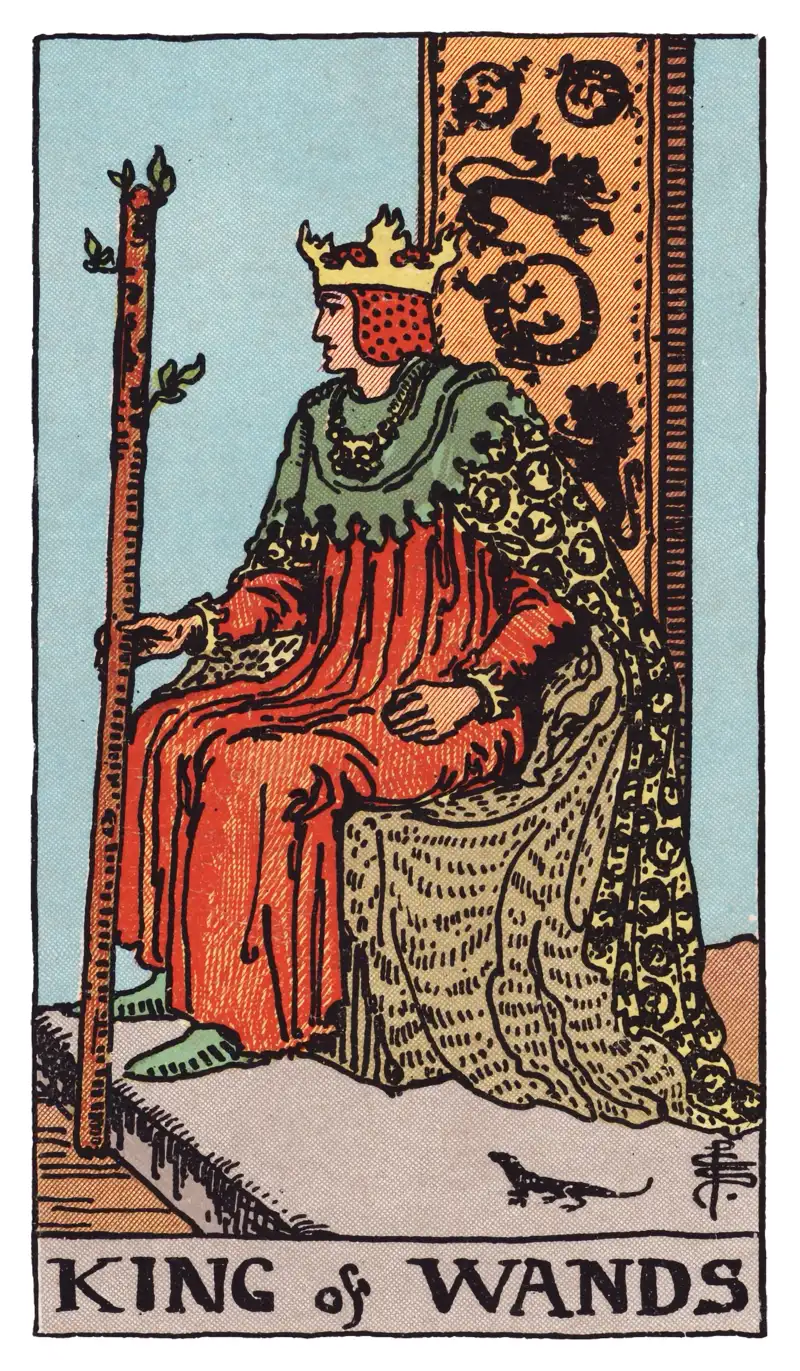
A crowned figure sits on a throne decorated with lions and salamanders, holding a wand that is beginning to bud; a small lizard appears near the base of the throne, and the King gazes forward with calm authority.
Upright vs reversed
| Upright | Reversed | |
|---|---|---|
| Keyword | VISION | IMPULSIVENESS |
Upright meaning
In the Rider-Waite-Smith tradition, the King of Wands is read as the fire element at its most sovereign and mature — the creative and entrepreneurial force that has been tested, survived challenge, built something lasting, and now governs from a place of experience rather than urgency. The salamanders on his robe and throne are an alchemical symbol of fire's capacity to survive its own intensity; the lizard at his feet is sometimes read as the salamander not yet completed in its circuit, a reminder that even mature fire has shadow. The wand he holds is still budding, unlike the settled staves of the earlier court cards — this King has not stopped creating; he has only learned to create from stillness rather than from agitation.
In contemporary RWS practice, the King of Wands tends to appear as a figure of visionary leadership — not the reactive momentum of the Knight, not the warm personal magnetism of the Queen, but the commanding overview of someone who can see where a creative or entrepreneurial endeavor is going and can hold the whole arc of it in mind at once. He may describe the querent's current capacity, an aspiration to embody, or a person in the querent's life. Practitioners often read the King of Wands as a card of mature creative authority: the kind that does not need to prove itself through constant motion, but that is capable of decisive, large-scale action when the moment calls for it.
Reversed meaning
Reversed, the King of Wands in the RWS tradition points to the distortions of mature fire authority — domineering rather than commanding, the vision becoming a fixed idea that cannot accommodate reality, or creative energy that has calcified into the insistence that one's own way is the only way. The reversed King may also indicate a figure who is impulsive in a way that does not befit their position: the urgency of the Knight reasserting itself in the place where the King's steadiness should live. Practitioners sometimes read the reversed King as a warning about how unchecked charisma operates when it no longer answers to anything outside itself.
In a reading
In the situation position, the King of Wands signals that the current moment calls for leadership of vision rather than reactive response — someone or something in the situation is capable of holding the whole picture and acting from that larger view. In the action position, the card counsels drawing on mature creative authority: acting decisively, with the full weight of experience, rather than from either hesitation or impulse. In the outcome position, the King of Wands suggests that the trajectory of current choices is toward mastery — not perfection, but the kind of grounded creative authority that can sustain a long arc.
These notes follow the Rider-Waite-Smith tradition. They describe what the card is associated with — not predictions about your life.