What the card shows
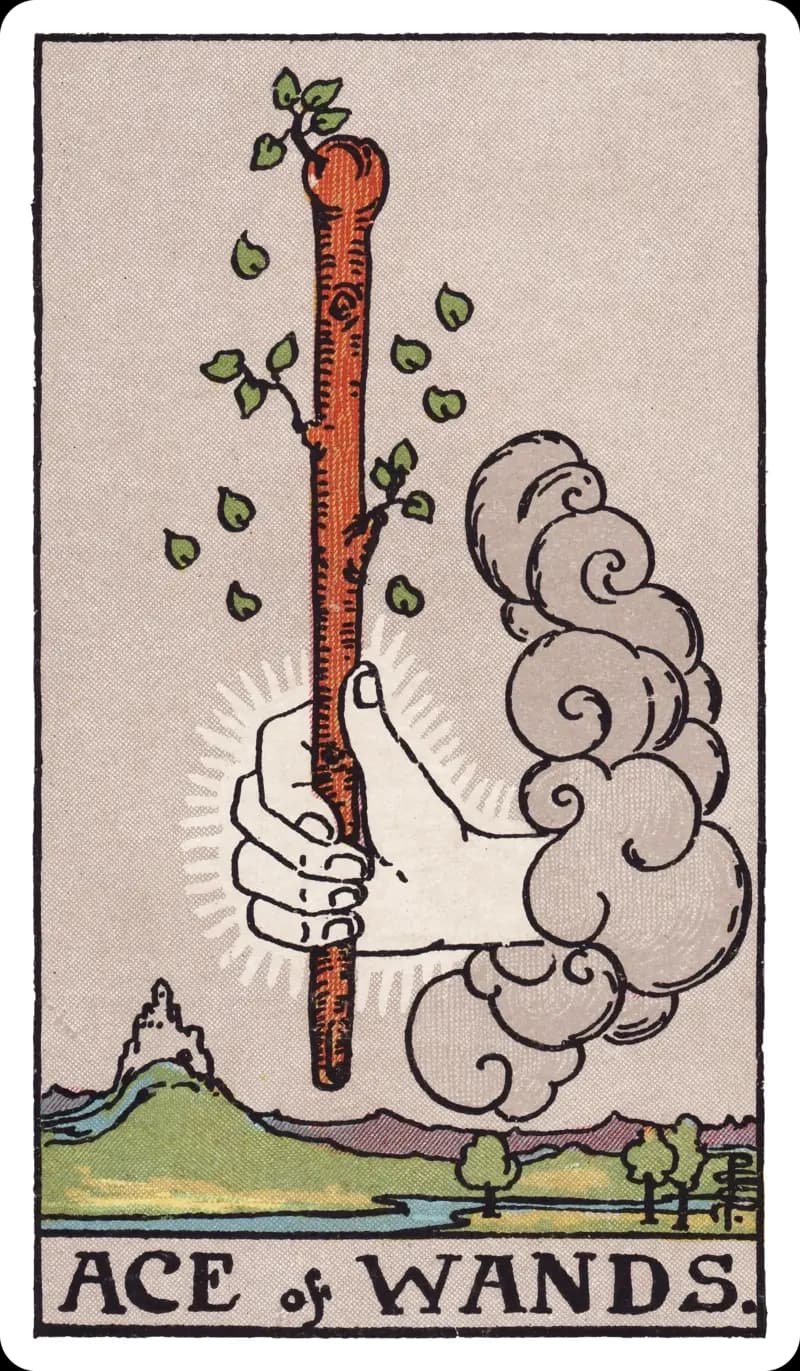
A hand emerges from a cloud grasping a thick, budding staff; small leaves sprout from the shaft, and a mountain landscape stretches beneath an open sky.
Upright vs reversed
| Upright | Reversed | |
|---|---|---|
| Keyword | INSPIRATION | DELAY |
Upright meaning
In the Rider-Waite-Smith tradition, the Ace of Wands is read as the primordial spark of the fire element — the impulse that precedes form, the creative charge before it has found a channel. Waite situated the Aces as the roots of their suits, and in Wands this root is pure will: not yet a plan, not yet an action, but the undeniable inner signal that something is ready to begin. The budding leaves on the staff matter here; they are not yet a full tree, but they are alive, and the tradition reads that aliveness as the card's central promise. Practitioners consistently point to the Ace of Wands as one of the most energetically clear cards in the deck — there is no ambiguity in the gesture, no hesitation in the hand that grips. Where other Aces can carry subtler tones, this one arrives with heat.
In contemporary RWS practice, the Ace of Wands is frequently read as the arrival of a creative or entrepreneurial impulse that demands to be taken seriously. It tends to appear when a new project, calling, or direction is knocking at the door of consciousness — and the card's counsel is to open that door. It does not guarantee success, nor does it detail the path; what it signals is readiness of spirit. Many practitioners note that the Ace of Wands asks a specific question: not whether the timing is perfect, but whether the fire is real. If it is, the tradition reads this card as permission to begin.
Reversed meaning
Reversed, the Ace of Wands in the RWS tradition is read as creative fire that has stalled before ignition — the impulse is present but something is blocking its release. This may manifest as false starts, creative frustration, or a reluctance to commit to a direction that nonetheless refuses to disappear. The reversed Ace does not indicate the death of the fire; practitioners often read it as fire turned inward, burning without outlet. The card may point to timing that is genuinely premature, or to internal resistance that is worth examining before moving forward.
In a reading
In the situation position, the Ace of Wands names a moment charged with creative or entrepreneurial potential — the conditions for ignition are present. In the action position, it counsels leaning into the impulse rather than waiting for certainty; the tradition reads this card as a prompt to begin. In the outcome position, the Ace of Wands points toward a new beginning being seeded by current choices — not a completed chapter, but a genuinely alive one.
These notes follow the Rider-Waite-Smith tradition. They describe what the card is associated with — not predictions about your life.