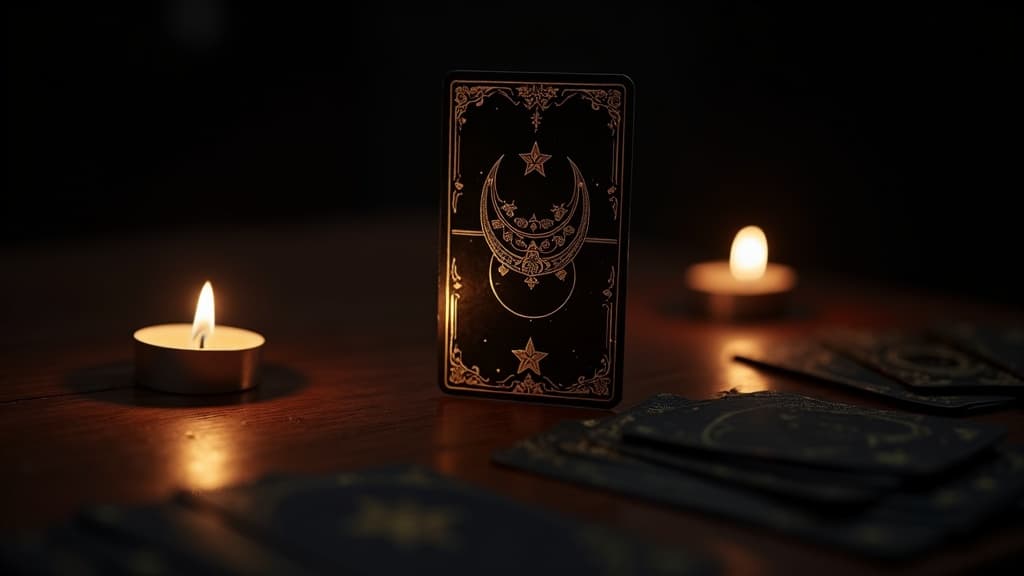
A yes/no tarot reading does not hand you a verdict. In the Rider-Waite-Smith tradition, a single card drawn to a yes/no question reads as a directional signal: upright leans toward yes — forward, open, aligned — and reversed leans toward not yet, conditional, or blocked. The card describes the current of a situation, not a fixed outcome. What it offers is a frame for reflection, not a ruling to obey.
How does a single card become a yes or a no?
In a yes/no draw you pull one card and read its orientation as a lean. An upright card generally reflects momentum in the direction you're asking about — the situation is open, the energy moves toward the thing. A reversed card reflects that same energy meeting resistance: delayed, internalized, unresolved, or pointed inward instead of out. The answer comes from reading the card's upright-or-reversed axis against your question, not from a fixed label stamped on each of the seventy-eight cards.
Some systems do assign every card a hard "yes" or "no," and if that structure helps you, it is a legitimate way to work. But an interpretive, RWS-derived reading treats the answer as a description of the card's energy in relation to what you asked — which is why the same card can lean yes for one question and only "yes, eventually" for another. The lean is a reading, not a lookup.
What do upright and reversed actually mean here?
Upright suggests the situation carries momentum toward what you're asking about. Take The Fool, drawn to "should I take this leap?" The RWS image shows a young figure at the edge of a cliff, a white rose in one hand, a small dog at their heel, a bundle on a stick — poised to step off into open air. Upright, that reads as a yes weighted toward beginning: openness, willingness, the readiness to move before every detail is settled.
Reversed, the same Fool doesn't flip to a flat no. It tends to reflect hesitation, a leap taken carelessly, or a not-quite-ready that the situation is asking you to notice. This is the key to reading reversals in a yes/no context: a reversed "yes" card is not a hard no. It reads closer to "yes, but with resistance," "not on these terms," or "not yet." The distinction matters, because treating every reversal as a refusal collapses the very nuance the reading exists to surface. (If reversals are new to you, the reversed-tarot-cards post covers reading them as a distinct interpretive layer.)
A reversed card rarely slams a door. More often it names what stands between you and the yes — the condition the situation is quietly asking you to meet first.
Which questions actually suit a yes/no draw?
The format works best when the question is genuinely binary and framed in the present — "is now a good moment to start this?", "am I ready for this?", "does this direction have life in it right now?" A single card can offer a clean lean on questions like these because they ask about your current standing, which is something the cards can reflect. It reads poorly, though, on questions that hinge on other people's decisions, or on the timing of specific future events, which no honest reading contains.
When a decision is genuinely complex — several moving parts, real stakes, a fork you can't reduce to on-or-off — a one-card yes/no will feel thin, and a fuller situation / action / outcome layout serves you better; the three-card-vs-one-card post walks through when to reach for each. And if a "will it happen?" question keeps returning, that is often a sign the question wants reframing: how-to-ask-tarot-a-question covers widening a closed question into one the cards can actually work with.
What should you do with the answer?
Hold it as a frame, not a verdict. Even the clearest lean is a description of present conditions, not a promise about how things resolve. The Sun drawn upright — the RWS card of a child on a white horse beneath a radiant sun and a wall of sunflowers — is about as bright a yes as the deck offers, and still it describes vitality available to you now rather than a guaranteed outcome later. Read the lean, then ask what it reflects about where you already stand: a strong yes to a question you were hoping to hear no to is worth sitting with.
The most useful thing a yes/no reading does is externalize a lean you may already carry and give you something to press against. Whether the card comes up open or blocked, the reflection worth having is the same one: what would it mean if this were true, and what does your reaction to the answer tell you? The card points; the deciding is still yours.