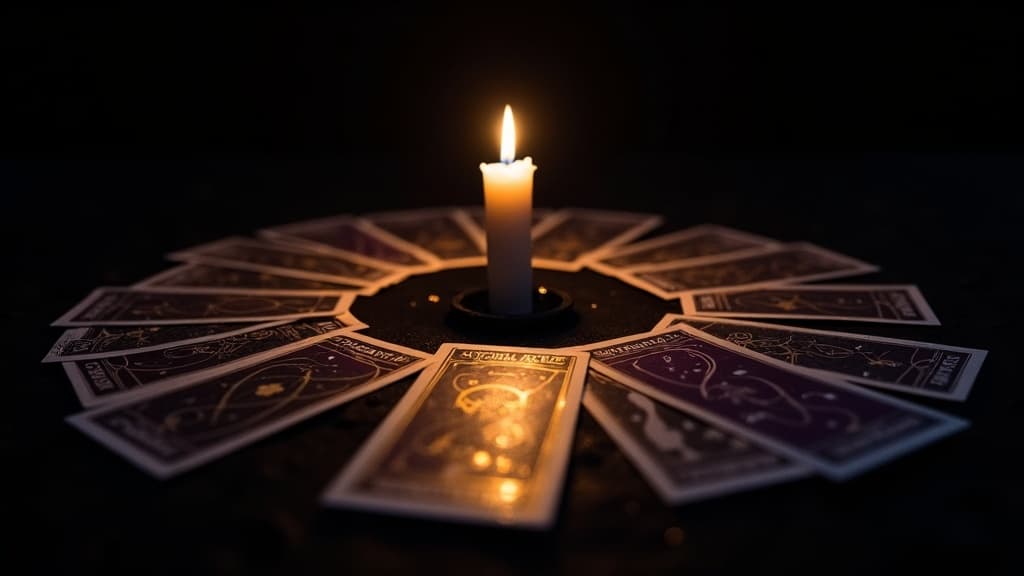
The Major Arcana is the 22-card core of a tarot deck, numbered from The Fool (0) through The World (21). These are the trump cards — The Magician, The High Priestess, Death, The Tower, The Star, and the rest — and in the Rider-Waite-Smith tradition they represent the larger forces and turning points in a situation rather than its everyday detail. When a Major Arcana card appears in a reading, it tends to carry extra weight.
A full deck has 78 cards. The other 56 are the Minor Arcana, split across four suits, and they describe the texture of ordinary life — the tasks, feelings, and conversations a question moves through. The Majors work at a different altitude. If you want the distinction in detail, it is worth reading how the Major and Minor Arcana divide; here the focus is on the 22 cards that most people picture when they think of tarot at all.
Where did the Major Arcana come from?
The Major Arcana did not begin as a mystical instrument. The cards originated in fifteenth-century northern Italy as the trumps of a card game — tarocchi — where they simply outranked the four ordinary suits, much as a trump suit does in games still played today. The allegorical figures painted on them (Death, The Tower, The Wheel of Fortune) drew on imagery already familiar in Renaissance art and pageantry, but their first job was to win tricks, not to reveal anything.
The esoteric reading came centuries later. From the late 1700s onward, French occultists began treating the trumps as a coded book of wisdom, and that interpretive layer accumulated over the next hundred and fifty years. It reached its most influential form in 1909 with the Rider-Waite-Smith deck, whose imagery is the basis for nearly every deck published since. So the Major Arcana carries two histories at once: a card game and a symbolic tradition laid over it.
What is the Fool's Journey?
The most common way to make sense of the 22 cards as a set is the Fool's Journey — the idea that, read in order, they trace a movement from innocence to integration. The Fool, numbered 0, is the open and unformed figure who steps off the cliff edge at the start. From there the sequence introduces the first powers: The Magician (1) as focused will, The High Priestess (2) as inward knowing, then The Empress and The Emperor as the nurturing and structuring forces that shape early life.
The middle of the sequence is where the tradition places its trials and turning points — Strength, The Hermit, The Wheel of Fortune, Justice, The Hanged Man, Death, and Temperance. These are the cards of reversal, surrender, and change, the passage where the easy version of a self is tested. Then the final stretch moves through The Devil, The Tower, The Star, The Moon, The Sun, and Judgement toward The World (21), which the tradition reads as completion and wholeness — the point where what was scattered comes together.
The Fool's Journey is a way of reading the deck, not a schedule for a life. In an actual spread the cards rarely arrive in order, and the sequence matters less than which stage of it your card seems to speak from.
Why are Major Arcana cards considered more significant?
In practice, a reader notices a Major Arcana card the way you notice a change in weather rather than a change in the hour. The Minor Arcana speak to the practical and the daily; the Majors point to the structural theme underneath — the season a situation belongs to, the larger pattern it is part of. When The Tower or Death turns up, the Rider-Waite-Smith tradition does not treat it as a small event but as a card about transformation and the breaking-down that precedes it. Neither is a literal forecast; both are a signal about scale.
This is why the proportion of Majors to Minors in a spread is itself information. A reading full of Major Arcana suggests that larger forces are at work and that the reflection wants a wide frame. A reading with few or none tends to point back toward the concrete and the immediate. The card invites you to consider how big a question you are actually asking, and the deck often answers that before it answers anything else.
How does the Rider-Waite-Smith tradition read them?
Each Major Arcana card is read as an archetype — a recognizable pattern of experience rather than a fixed prediction. The Star is renewal and restored faith after difficulty; Death is ending and transformation, almost never anything literal; The Lovers is alignment and choice, not simply romance. Reversed, a Major is not read as the plain opposite of its upright meaning but as that same energy blocked, internalized, or still working its way to the surface. The Rider-Waite-Smith illustrations anchor all of this — the imagery is the reference the interpretation returns to.
Read this way, the Major Arcana is less a set of answers than a vocabulary for the turning points a person actually moves through. That is how Vidastral treats them: as archetypes that help you name what you already sense about a situation, held in the Rider-Waite-Smith tradition rather than presented as fortune. The 22 cards are the deck's way of talking about the large moments — and knowing which card is speaking, and from what stage, is most of what it means to read them.