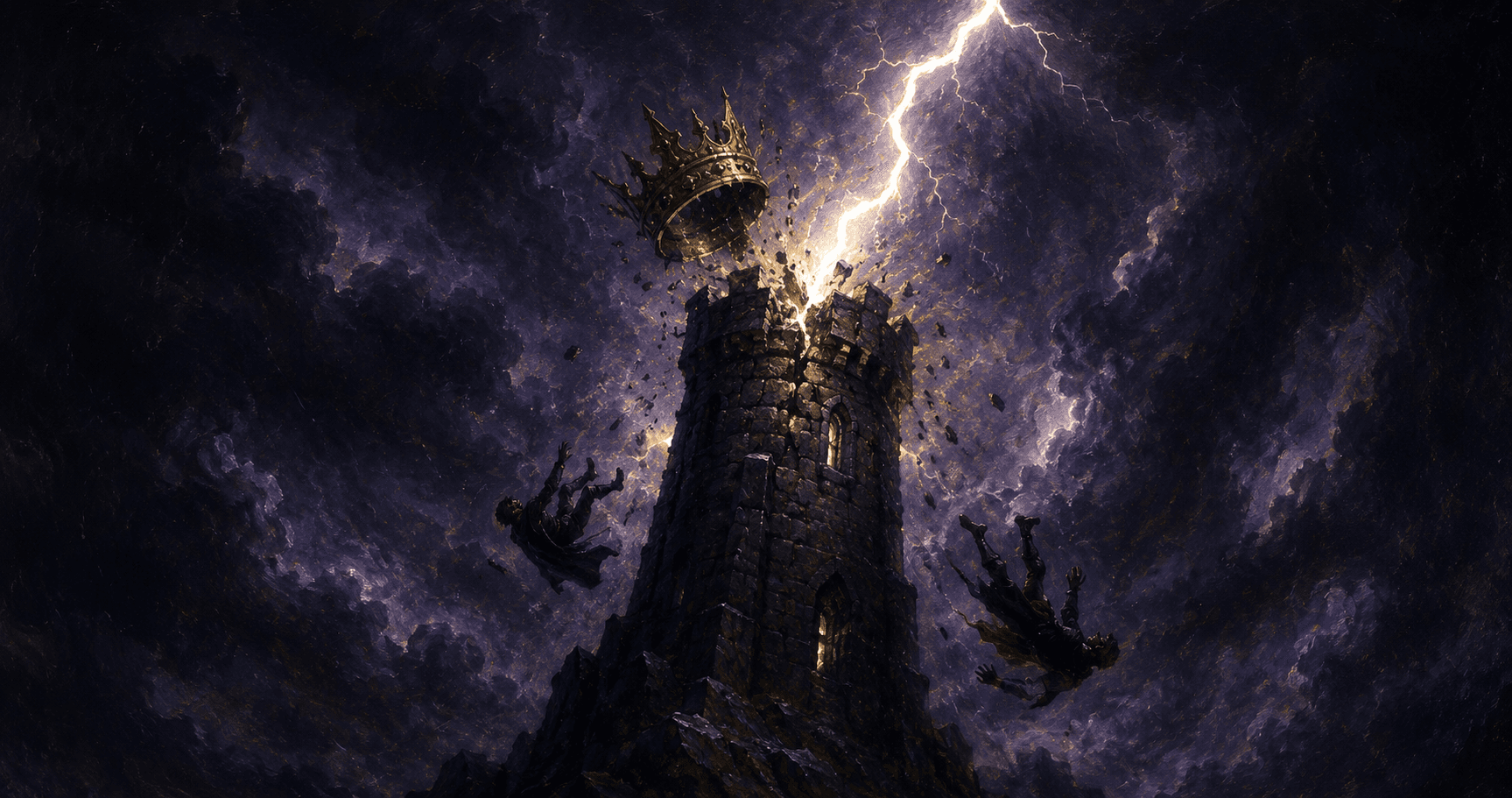
When The Tower appears in a love reading, the first instinct is to brace. The image in the Rider-Waite-Smith deck doesn't invite comfort: lightning tears through a tall stone tower, a golden crown is hurled from the top, and two figures fall through a dark sky, arms outreached. Whatever was built there is coming down. In a relational context, this card rarely sits quietly — it tends to mark the moment a relationship's hidden architecture is finally, forcibly exposed.
But before the card becomes a verdict, it helps to understand what it is actually pointing toward. The Tower doesn't describe a relationship as good or bad. It describes a structure — and a structure's sudden inability to hold the weight it has been carrying.
The Tower upright: when truth arrives without warning
Upright in a love reading, The Tower in the Rider-Waite-Smith tradition often corresponds to a sudden revelation — the kind that reshapes how you understand everything that came before it. This might look like a confession that surfaces after months of avoidance, a discovery that reframes the relationship's entire history, or an external event that forces two people to reckon with how little their connection can withstand pressure. The disruption comes fast, and it comes from outside the careful agreements you've made with each other.
What tends to make The Tower upright feel so disorienting in a relational context is the speed of it. The structure didn't erode gradually — or if it did, the awareness of that erosion arrives all at once. In a reading, this card often invites reflection on what has been suppressed, avoided, or quietly known but never spoken. The lightning in the image doesn't create the problem; it illuminates what was already there in the dark.
The Tower doesn't make something true that wasn't true before. It makes it visible.
This is why the upright Tower in love is not simply a card of destruction. The crown being struck from the tower's top can be read, in the RWS tradition, as the fall of false authority — a dynamic, a role, or a story the relationship has been organized around. What feels like an ending is sometimes the removal of a false foundation. That distinction doesn't make the disruption less painful, but it does change what the disruption might mean.
The Tower reversed: the slow collapse that refuses to fall
Reversed, The Tower shifts in character. Where the upright card describes rupture that happens to you, the reversed card in the RWS tradition often points toward rupture that is happening within you — or a collapse that is underway but has not yet fully expressed itself. In love readings, this can surface as a relationship that both people sense is not working, but where neither is yet willing or able to name what's wrong. The tower is cracking, but the crown hasn't fallen.
The reversed Tower can also reflect a pattern of resistance: the recognition that something is structurally wrong in the relationship paired with an active unwillingness to let it collapse. Sometimes that resistance is self-protective. Sometimes it delays necessary change. In a reading, this card doesn't prescribe which is happening — it asks the question. It surfaces the tension between knowing and acting on what you know.
In some readings, the reversed Tower can also indicate the aftermath of an upheaval — a period of internalized shock, where the external event has already occurred but the full reckoning with it has not. The tower fell; the person is still standing in the rubble, not yet ready to assess what might be built in its place.
The Tower in spread positions: Situation, Action, Outcome
The position a card occupies in a spread shapes its meaning considerably. When The Tower appears in the Situation position of a love spread, it suggests the current relational context is already marked by instability or shock. Something has already shifted — or is actively shifting — in how the relationship's foundation is understood. The reading is happening in the middle of the disruption, not before it.
In the Action position, The Tower is more challenging to interpret, and more interesting for it. This position points toward what might be engaged with, considered, or brought to bear on the situation. The Tower here doesn't suggest engineering a crisis — but it may be pointing toward a kind of radical honesty, a willingness to stop maintaining a structure that no longer serves the relationship. It might be asking: what would it mean to stop holding the tower up?
In the Outcome position, The Tower asks for careful interpretive attention. This position reflects a potential direction, not a fixed destination — readings in the RWS tradition are reflective tools, not forecasts. That said, The Tower here often invites consideration of whether the path the relationship is currently on leads toward an inevitable reckoning. It doesn't say that reckoning is final. It marks the direction, and it places the question back with the person reading.
What The Tower is not saying
Perhaps the most useful thing to hold when The Tower comes up in a love reading is what the card does not mean. It does not mean the relationship is over. It does not mean the disruption will be irreparable. Some of the most significant shifts in a long relationship look, in the moment, like the tower falling — and they are, in the sense that something had to fall for something truer to take its place. The card's imagery is violent precisely because false structures don't come down gently.
What The Tower tends to name, in the context of love, is the cost of a structure built on something that couldn't hold. Whether that structure is a set of assumptions, a way of communicating, a role each person has settled into, or something more foundational — the card marks the moment the weight finally shows. The question the reading opens up is not whether the tower is falling, but what you want to build once the ground is clear.