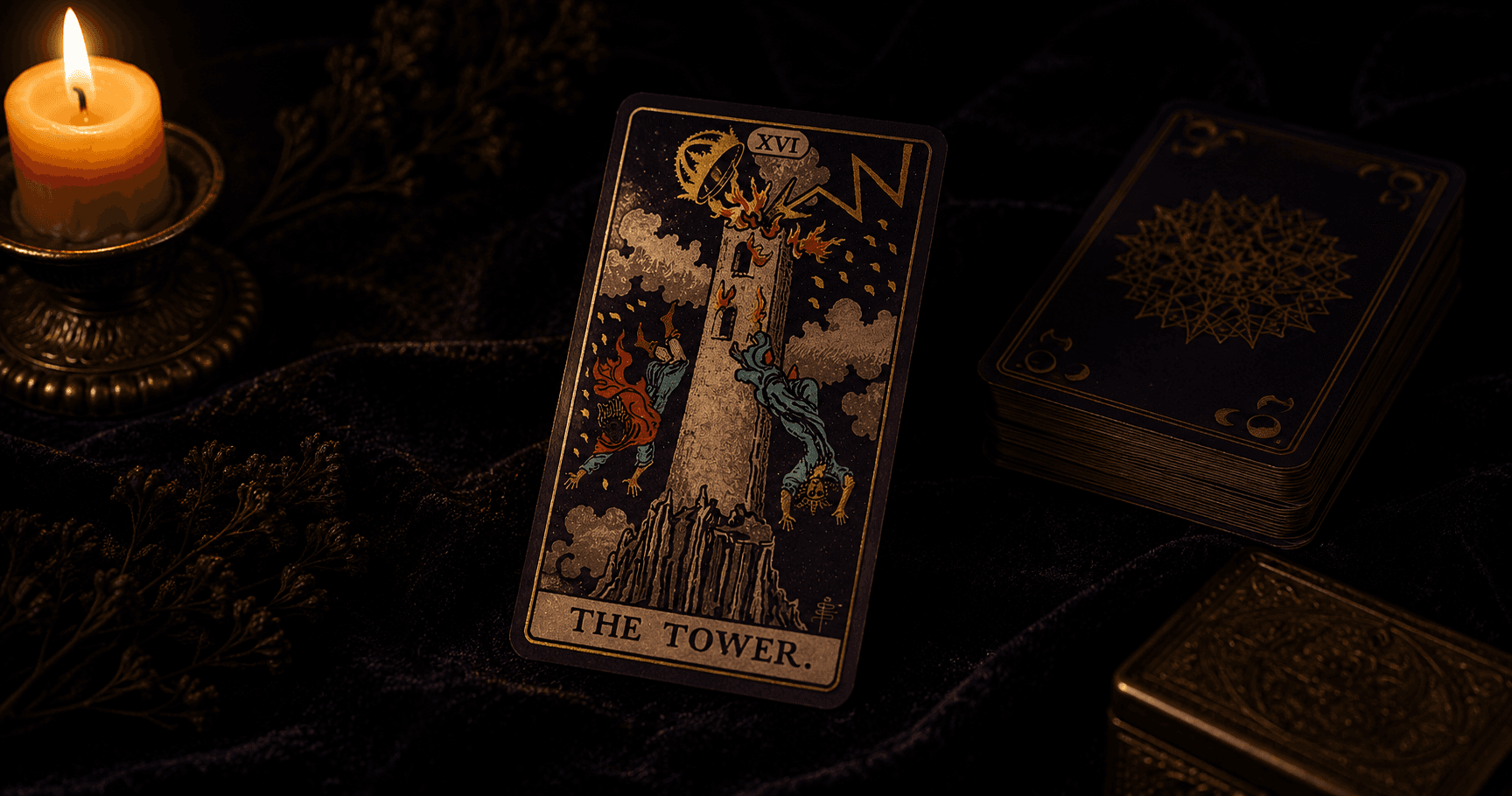
The Tower is the card most people are afraid to draw. The Rider-Waite-Smith image is stark: a tall tower struck by a bolt of lightning, its crown knocked off, two figures falling headfirst against a black sky. There is no gentle way to dress it up, and tarot tradition does not try to. The Tower is the card of sudden change — the moment a structure that could no longer hold comes down.
What the upright Tower means
Upright, The Tower is usually read as sudden upheaval: a shock that arrives from outside, a revelation that cannot be un-seen, the collapse of something that was built on unstable ground. The lightning is not random — in the traditional reading it strikes what was false or overdue to fall. The tower comes down because it could not have stood much longer. What is unsettling about the card is the speed and the lack of warning, not the underlying necessity.
It is worth saying plainly: a card depicting collapse is not the same as a prediction of disaster. Tarot is interpretive, not predictive, and The Tower does not announce a specific catastrophe on a specific date. Read at the level the cards actually work — archetype, not forecast — it more often names a structure in your own life that is already under strain, and asks what would actually fall if it gave way.
The Tower reversed
Reversed, The Tower carries its own interpretive layer rather than the simple opposite. It is often read as upheaval that is internal rather than external, a collapse that is being resisted or delayed, or a crisis narrowly avoided — the lightning that did not quite strike. Sometimes it reads as the long, slow version of the upright card: a structure coming down gradually rather than all at once, which can be harder to name precisely because it lacks the single dramatic moment.
Consider what in your own situation is being held up by more effort than it should take. The Tower rarely points at something solid; it tends to name what was already asking to change.
In a situation / action / outcome spread, The Tower changes everything around it. In the situation position it reframes what 'action' could even mean — you do not strategize calmly inside a falling building. In the outcome position it points less toward a result and more toward a clearing: the ground after something comes down, and what becomes possible only once it has. Difficult cards are not bad omens. They are the ones that tend to have the most to say.