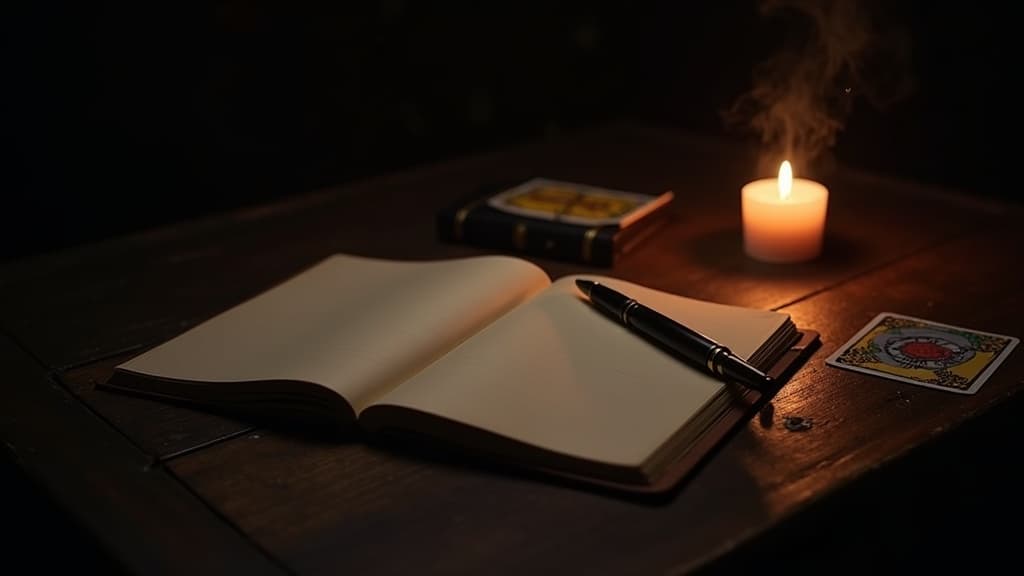
After a tarot reading, write down five things: the cards you drew and where each one fell, your first reaction before you start interpreting, what resonated and what felt off, the question the reading raised that you did not want to answer, and — over the next day or two — what you notice yourself doing differently. A reading rarely lands all at once. Journaling is how the rest of it arrives.
Why journal after a tarot reading at all?
A reading is a prompt for your own thinking, not a verdict handed down to you. The cards, in the Rider-Waite-Smith tradition, do not close a question — they open it, laying out a situation and a set of tensions and leaving the interpretation to you. That means the reading is only half finished when you set the cards down. The other half happens later, in your own words, once the images have had time to settle against your actual life. Journaling is simply where that second half takes place. If you read the cards for yourself, this is the natural next step after the spread — the same honest, slightly uncomfortable work of reading your own cards, carried past the moment of the draw.
What should you write down first?
Before you interpret anything, record the raw material. Note the cards and the position each one fell in — situation, action, outcome, or whatever frame the spread used — because a week from now you will not remember the layout, and the layout is half the meaning. Then, quickly, write your first reaction before your analytical mind smooths it over: the flicker of relief or dread or confusion you felt when the cards turned. That first reaction is data, not noise. It often tells you what you were secretly hoping the cards would say.
Next, separate what resonated from what felt off. Some of the reading will click — a card that names exactly what you have been circling. Some of it will sit wrong, as though it belongs to someone else's question. Write both down without resolving the tension between them. If you brought a written question to the reading — the kind of open, present-tense question worth asking the tarot in the first place — note whether the cards answered the question you actually asked, or a different one you had not thought to ask.
The first reaction is the most honest line in the entry and the easiest to lose. Write it before you talk yourself into a calmer version of it.
Why write about the card you wanted to skip?
In almost every reading there is one card you glance at and quietly set aside — "that one doesn't really apply." That card is usually the one worth the most journaling. Resistance tends to mark the place where a card has landed on something true that you are not ready to look at directly. In the Rider-Waite-Smith tradition, The Moon is the image of exactly this: a path between two towers under a clouded moon, a crayfish edging out of the dark water toward the bank. What it points to has not fully surfaced yet — and it does not surface on command. It comes up slowly, over days, if you leave room for it.
So the single most important entry is often the question the reading raised that you did not want to answer. Not the question you brought — the one the cards handed back. Write it down plainly, even if you have no answer, and especially if you have no answer. A question you have committed to paper is much harder to avoid than one you left hovering in your head.
What is worth noticing in the days after the reading?
The reading keeps working after you close it, and the next forty-eight hours are where most of the useful insight actually shows up. Leave a few lines in the journal for what you notice: a conversation you approached differently, a decision that suddenly felt clearer or heavier, a fear the reading gave a name to that you had been carrying without one. You are not looking for the cards to come true — that is not what they do. You are noticing how the reading changed what you are paying attention to. That change is the reading's real effect, and it is invisible unless you write it down while it is happening.
When should you return to a reading you journaled?
Come back to the entry a week later, and again a month after that. This is where journaling earns its place. The Star, which in the Rider-Waite-Smith sequence follows the upheaval of The Tower, shows a figure kneeling at the edge of a pool, pouring water back onto the land — a picture of quiet restoration after difficulty. Returning to an old reading has that same still quality: you are pouring the reading back over the ground it described, now that you can see what actually grew there. Re-reading your notes, you can tell which lines held true and which were only fear or hope talking at the time.
A single reading shows you a moment. A journal you return to shows you the pattern — which cards keep circling back, and which questions you keep declining to answer.
Kept this way, a journal is not a record you file and forget. It is the reading continuing to speak after the cards have gone quiet — in your own handwriting, at your own pace, answered across the days and weeks it genuinely takes to answer. The cards asked; the page is where you get to reply.